AI Customer service has quietly become one of the biggest battlegrounds in business. Products can be copied, prices can be matched, but a truly great service experience? That’s much harder for competitors to replicate. And that’s exactly why so many companies are turning to AI.
If you’ve been hearing about AI customer service and wondering what it really means, what it can do for your business, and how to actually get started, you’re in the right place. This guide covers it all in a friendly, no-fluff way: what AI customer service is, the real benefits, the most valuable use cases across industries, and a clear implementation roadmap you can follow.
A quick note on overlap: we’ve already published pieces on automating support with AI. This guide takes a broader, decision-maker’s view, covering the business case, industry use cases, and rollout planning, so it complements those rather than repeating them.
What Is AI Customer Service?
AI customer service is the use of artificial intelligence technologies, such as chatbots, virtual assistants, machine learning, natural language processing, and generative AI, to answer customer questions, solve problems, and support customers across channels with little or no human involvement.
In practice, it can look like:
- A chatbot on your website that answers questions instantly
- A WhatsApp assistant that tracks orders and shares updates
- An AI voice agent that handles phone calls
- Software that reads incoming emails, sorts them, and drafts replies
- Tools that summarize long conversations and suggest next steps to human agents
The best AI customer service doesn’t replace people. It handles the predictable, repetitive work so your human team can focus on complex, sensitive, and high-value conversations.
How Is AI Customer Service Different From Traditional Customer Service?
Here’s a simple comparison:
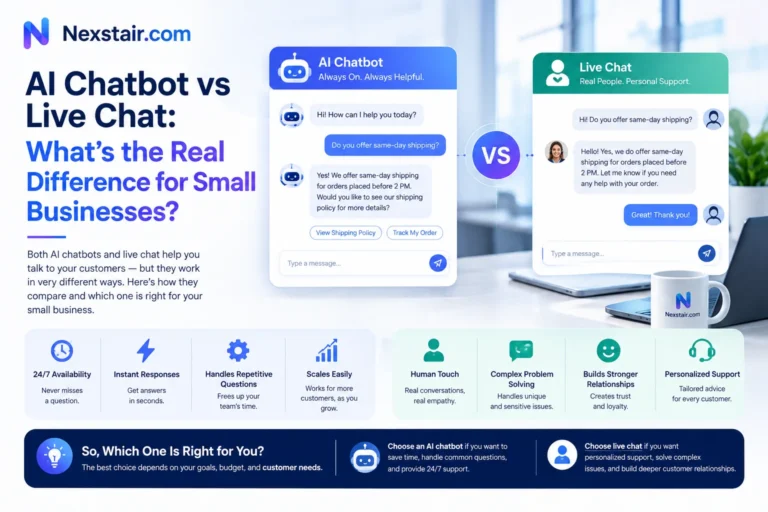
| Factor | Traditional Customer Service | AI Customer Service |
|---|---|---|
| Availability | Business hours (or shifts) | 24/7/365 |
| Response time | Minutes to hours | Seconds |
| Capacity | Limited by team size | Handles many conversations at once |
| Consistency | Varies by agent | Consistent, based on approved information |
| Cost scaling | Grows with headcount | Scales more efficiently |
| Personalization | Depends on agent knowledge | Uses customer data instantly |
| Insights | Manual analysis | Automatic conversation analytics |
| Best for | Complex, emotional, high-stakes issues | Repetitive, high-volume, rules-based issues |
Most successful companies combine both: AI for speed and scale, humans for empathy and judgment.
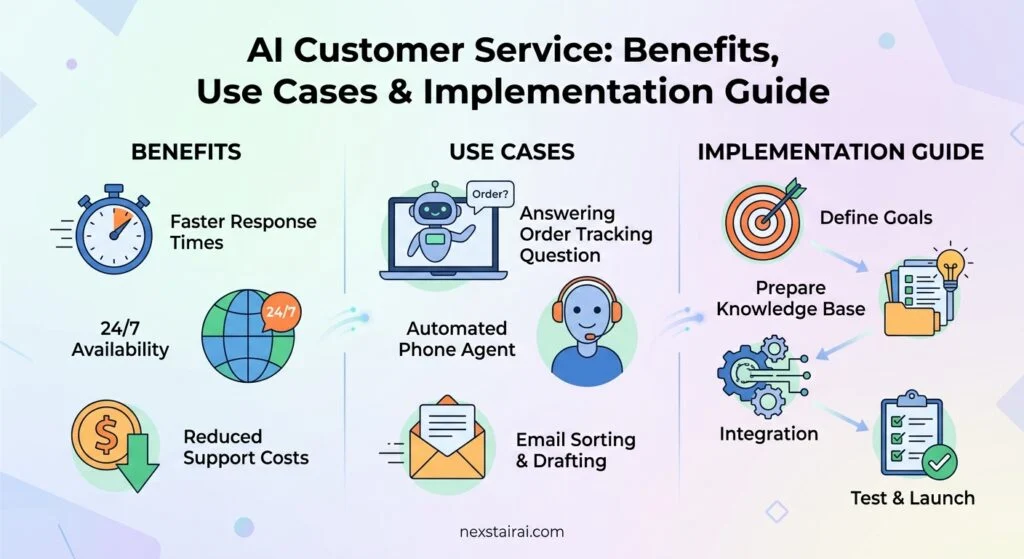
What Are the Main Benefits of AI Customer Service?
Let’s look at the benefits that matter most to real businesses.
Does AI Customer Service Provide Faster Response Times?
Yes, and this is often the first improvement customers notice. AI replies in seconds, not hours. For common questions, that means customers get answers immediately instead of waiting in a queue. Fast responses reduce frustration and keep shoppers from drifting away to a competitor.
Can AI Customer Service Be Available 24/7?
Absolutely. Customers don’t only have questions between 9 and 5. They shop in the evening, travel across time zones, and run into problems on weekends. An AI assistant never sleeps, so every customer gets help whenever they need it, without you paying for overnight shifts.
Does AI Customer Service Reduce Support Costs?
In most cases, yes. When AI resolves routine requests automatically, your team handles fewer tickets per customer, and you can support business growth without hiring at the same pace. Lower cost per interaction is one of the most commonly reported advantages, though exact savings depend on your volume, setup, and goals.
How Does AI Improve Consistency and Accuracy?
Human agents are wonderful, but they have off days, different levels of experience, and different ways of explaining things. AI gives the same approved answer every time. When your knowledge base is accurate and current, that consistency builds trust and reduces errors.
Can AI Customer Service Increase Sales?
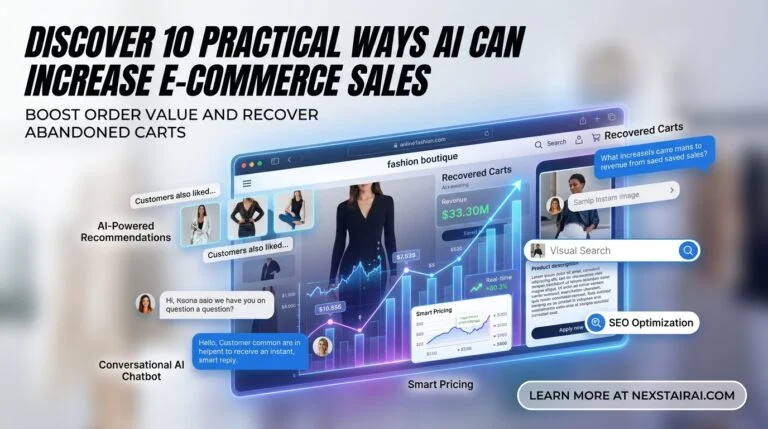
It can. AI doesn’t just solve problems; it removes friction from buying. It can answer pre-purchase questions, recommend products, address hesitation about shipping or returns, and recover shoppers who are about to abandon their cart. Support starts to function as a sales channel, not just a cost center.
If you’d like to see how a smart service assistant could lift both customer satisfaction and sales for your business, nexstairai.com is a great place to start the conversation.
How Does AI Improve the Employee Experience?
Nobody dreams of answering “Where’s my order?” 200 times a day. By taking over repetitive tickets, AI lets agents spend their time on interesting, meaningful problems. That tends to improve job satisfaction, reduce burnout, and help you keep experienced people.
Can AI Customer Service Scale With Your Business?
Yes. Whether you get ten inquiries a day or ten thousand, AI handles spikes (think Black Friday, a product launch, or an unexpected outage) without long wait times. This flexibility is especially valuable for growing businesses and seasonal industries.
What Insights Does AI Customer Service Provide?
Every conversation is data. AI can reveal your most common questions, recurring problems, confusing policies, product complaints, and even emerging trends. Those insights help you improve your website, products, and processes, which in turn reduces future support volume.
Does AI Support Multiple Languages?
Many AI systems can understand and respond in multiple languages, making it much easier to serve customers around the world without hiring a multilingual team for every market.
What Are the Best Use Cases for AI Customer Service?
AI customer service works across nearly every industry. Here are the most valuable use cases, grouped by type.
What Are the Common Use Cases Across All Industries?
- Answering FAQs: shipping, returns, pricing, hours, policies
- Order and delivery tracking: real-time status updates
- Account support: password resets, profile updates, subscription changes
- Ticket triage and routing: categorizing and assigning tickets automatically
- Lead qualification: capturing details and booking meetings or demos
- Feedback collection: surveys and satisfaction ratings after interactions
- Agent assistance: suggested replies, summaries, and knowledge lookup
- Proactive notifications: delays, reminders, and follow-ups
How Is AI Customer Service Used in E-Commerce?
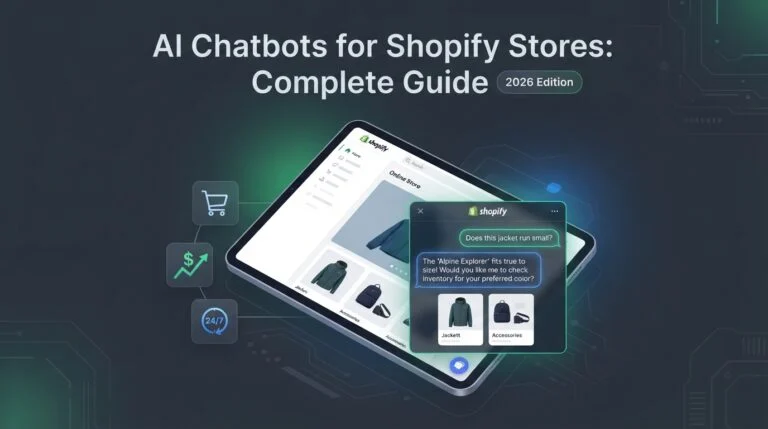
Online stores see some of the biggest gains because their questions are so repetitive. AI can handle sizing and fit questions, shipping times, stock availability, discount codes, returns and exchanges, and personalized product recommendations. It can also reach out to shoppers who hesitate at checkout and answer the exact question holding them back.
How Is AI Customer Service Used in SaaS and Technology Companies?
Software companies use AI for onboarding help, troubleshooting common errors, explaining features, guiding users through setup, and deflecting repetitive technical questions. AI can also detect when a user seems stuck and offer help before they churn.
How Is AI Customer Service Used in Banking and Finance?
Financial institutions use AI to answer questions about fees, explain products, guide customers through routine account tasks, and flag suspicious activity for review. Because of the sensitive nature of the data involved, strong security, verification steps, and clear escalation paths to human agents are essential.
How Is AI Customer Service Used in Healthcare?
Healthcare providers use AI for appointment scheduling, reminders, directions, insurance and billing questions, and general administrative information. Medical advice and decisions should always stay with qualified professionals, so AI works best as a front-desk helper here.
How Is AI Customer Service Used in Travel and Hospitality?
Hotels, airlines, and travel companies use AI for bookings, itinerary changes, check-in information, local recommendations, and handling disruptions like delays and cancellations. Instant, multilingual support is especially valuable for international travelers.
How Is AI Customer Service Used in Real Estate?
Real estate teams use AI to answer listing questions, qualify potential buyers or renters, schedule property viewings, and follow up with leads at any hour, so no inquiry sits unanswered overnight.
How Is AI Customer Service Used in Education?
Schools and online learning platforms use AI to answer admissions questions, explain course details, help with enrollment and scheduling, and support students with common administrative issues.
How Is AI Customer Service Used in Telecom and Utilities?
These industries deal with high volumes of billing, outage, and plan questions. AI can explain bills, report outages, help customers change plans, and send proactive service alerts.
What Types of AI Customer Service Tools Are Available?
The market offers several categories of tools, and many businesses use more than one:
- Chatbots and virtual assistants: conversational tools for websites, apps, and messaging platforms
- AI voice agents: automated phone support that understands natural speech
- Helpdesk platforms with AI features: ticketing systems with built-in triage, suggestions, and automation
- Agent assist tools: copilots that help human agents respond faster
- Sentiment and analytics tools: software that analyzes conversations for mood, trends, and quality
- Knowledge management tools: systems that organize and surface the right information
- Agentic AI systems: more advanced assistants that can complete multi-step tasks within your rules
How Do You Implement AI Customer Service? A Step-by-Step Guide
Now for the practical part. Here’s a roadmap you can follow whether you’re a small shop or a larger organization.
Step 1: How Do You Define Your Goals and Success Metrics?
Before choosing any tool, decide what you want to achieve. Common goals include:
- Reducing average first response time
- Resolving a target percentage of inquiries automatically
- Lowering cost per ticket
- Improving customer satisfaction (CSAT)
- Increasing conversions or lead capture
- Freeing up agent time for complex work
Write down your current numbers so you can measure real improvement later.
Step 2: How Do You Analyze Your Current Support Data?
Review three to six months of tickets and conversations. Look for:
- The most frequent questions and issue types
- Peak hours, days, and seasons
- Channels customers use most
- Which issues take longest to resolve
- Where customers get frustrated
The repetitive, high-volume, low-complexity topics become your first automation targets.
Step 3: How Do You Prepare Your Knowledge Base?
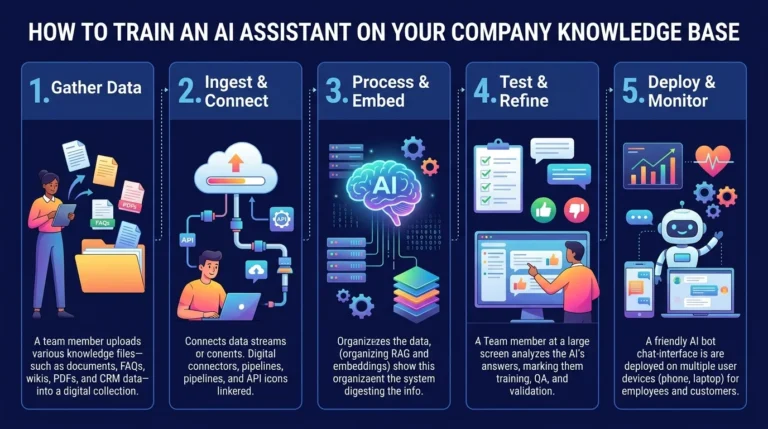
Gather and clean up your information: FAQs, help articles, policies, product details, and examples of great past answers. Fix contradictions, remove outdated content, and write in clear, simple language. This step has an outsized impact on quality, because AI can only be as accurate as the information it’s given.
Step 4: How Do You Choose the Right AI Customer Service Solution?
Evaluate options against your real needs. Consider:
- Language understanding quality: Does it handle typos, slang, and vague questions?
- Integrations: Can it connect to your CRM, helpdesk, store, and calendar?
- Channel coverage: Does it support the places your customers already are?
- Customization: Can you shape its tone, workflows, and escalation rules?
- Human handoff: Is the transition smooth, with context passed along?
- Analytics: Can you see what’s working and what isn’t?
- Security and compliance: Does it protect customer data and meet relevant regulations?
- Support and onboarding: Will you get help setting it up and improving it?
- Pricing model: Is it predictable and aligned with the value you receive?
Comparing options can feel overwhelming. The team at nexstairai.com can help you identify what your business actually needs and build an AI service experience around it, so you’re not stuck guessing.
Step 5: How Do You Design Conversations and Escalation Rules?
Map out how your AI should handle your top scenarios. For each one, define:
- What the customer is likely to say
- What information the AI needs to collect
- What the AI should answer or do
- When it should hand off to a human
Set your brand voice, too. Warm and playful, or calm and professional? Whatever you choose, keep replies clear and concise.
Step 6: How Do You Integrate AI With Your Existing Systems?
Connect the AI to your tools so it can do more than recite FAQs. AI Integration lets it check live order status, look up customer history, create tickets, book appointments, and trigger workflows. Start with the integrations that support your top use cases rather than connecting everything at once.
Step 7: How Do You Test Before Launching?
Run a thorough testing phase:
- Try your top 50 to 100 real customer questions, phrased in different ways
- Test misspellings, slang, and unclear requests
- Check escalation triggers and handoffs
- Verify accuracy against your policies
- Test on every channel and device
- Ask your support team to try to “break” it
Consider a soft launch to a small percentage of traffic or a single channel first.
Step 8: How Do You Launch and Train Your Team?
Introduce the AI to your agents as a helper, not a threat. Explain what it handles, how handoffs work, and how they can give feedback. Then announce it to customers, make it easy to find, and be upfront that they’re chatting with an AI assistant with a clear path to a human.
Step 9: How Do You Monitor, Measure, and Improve?
Launch day is the beginning, not the end. Review conversations regularly, track your metrics, and make steady improvements. Pay particular attention to:
- Questions the AI couldn’t answer
- Conversations that escalated, and why
- Low satisfaction ratings
- New questions that appear after product or policy changes
The best AI customer service systems improve every month because someone is paying attention.
Which Metrics Should You Track for AI Customer Service?
- Automated resolution rate: percentage of conversations resolved without a human
- First response time: speed of the initial reply
- Average resolution time: how long issues take to fully solve
- CSAT (customer satisfaction): ratings after interactions
- Escalation rate: how often AI hands off to people
- Containment or deflection rate: inquiries solved before becoming tickets
- Cost per resolution: total support cost divided by resolved issues
- Conversion or lead metrics: sales or leads influenced by AI conversations
- Agent productivity and satisfaction: how AI affects your human team
What Are the Challenges and Risks of AI Customer Service?
It’s important to go in with eyes open. Common challenges include:
- Accuracy issues. AI can occasionally give incorrect or outdated answers if its information is poor. Good source material and regular reviews help.
- Customer frustration. If customers can’t reach a human when they need one, trust drops quickly.
- Data privacy and security. Handling personal data requires proper safeguards and compliance with relevant laws.
- Integration complexity. Connecting legacy systems can take time and planning.
- Over-automation. Trying to automate everything, including sensitive issues, can backfire.
- Change management. Teams need clear communication and training to embrace new tools.
- Ongoing maintenance. Knowledge bases and workflows need continuous care.
The good news is that each of these is manageable with planning, transparency, and a human-in-the-loop approach.
What Are the Best Practices for AI Customer Service?
- Start small, then expand. Prove success on a few use cases first.
- Be transparent. Let customers know they’re talking to AI.
- Always offer a human option. Make it easy to reach a person.
- Keep your knowledge base current. Update it whenever things change.
- Personalize thoughtfully. Use customer history to make conversations relevant, not creepy.
- Protect privacy. Collect only what’s necessary and secure it well.
- Keep answers short and clear. Respect your customers’ time.
- Review conversations often. Real chats are your best training material.
- Involve your support team. Agents know the customer’s pain points better than anyone.
What Is the Future of AI Customer Service?
Several trends are shaping what comes next:
- Agentic AI: assistants that don’t just answer but take multi-step actions, like processing refunds or rebooking, within set limits
- Proactive service: systems that predict problems and reach out before customers do
- Voice AI: more natural, conversational phone support
- Multimodal support: assistants that understand images, documents, and screenshots, not just text
- Hyper-personalization: experiences tailored to each customer’s history and preferences
- Emotion-aware AI: better detection of customer sentiment to guide tone and escalation
Businesses that build a solid foundation today will find it much easier to adopt these capabilities as they mature.
Final Thoughts: Is AI Customer Service Right for Your Business?
If your business answers repetitive questions, serves customers outside standard hours, or wants to grow without letting support costs balloon, then AI customer service is very likely worth exploring. The benefits (speed, availability, consistency, scalability, and valuable insights) are real, and the technology has matured enough to be accessible to businesses of all sizes.
The winning formula is simple: set clear goals, start with high-volume use cases, give your AI accurate information, keep humans available for the moments that matter, and keep improving based on real conversations. Treat AI as a member of your team that you train and nurture, and it will reward you with happier customers and a more focused, energized support team.
Ready to take the next step? Visit nexstairai.com to explore how a customized AI customer service solution can help you delight customers, save time, and grow with confidence.
 can help you build one that actually fits the way you work.** ## What Technologies Power an AI Virtual Assistant? Here's a quick, scannable summary of the main building blocks: | Technology | What It Does | |---|---| | **Natural Language Processing (NLP)** | Helps the assistant read and interpret human language | | **Natural Language Understanding (NLU)** | Identifies intent and extracts key details from a request | | **Large Language Models (LLMs)** | Generate flexible, human-like responses and handle complex questions | | **Speech Recognition (ASR)** | Converts spoken words into text | | **Text-to-Speech (TTS)** | Converts text responses into natural-sounding speech | | **Machine Learning (ML)** | Helps the system learn patterns and improve over time | | **APIs and Integrations** | Connect the assistant to business tools and data | | **Knowledge Base / Retrieval** | Gives the assistant accurate, up-to-date information to draw from | ## What Are the Different Types of AI Virtual Assistants? Not every virtual assistant works the same way. Here are the main categories. **Rule-based assistants.** These follow pre-written scripts and decision trees. They're predictable and good for simple tasks, but they struggle when customers phrase things unexpectedly. **AI-powered conversational assistants.** These use NLP and machine learning to understand free-form language. They're far more flexible and can handle a wide range of questions. **LLM-powered assistants.** The newest generation uses large language models to hold fluid, natural conversations, summarize information, and reason through multi-part requests. **Voice assistants.** These specialize in spoken interactions, whether on smart speakers, phones, or automated call systems. **Agentic assistants.** An emerging category, these assistants don't just respond; they can plan and carry out multi-step tasks on your behalf, such as researching options, filling out forms, or coordinating across several apps, all within boundaries you define. ## What Is the Difference Between an AI Virtual Assistant and a Chatbot? People often use these terms interchangeably, but there's a useful distinction. A **chatbot** is typically designed for a narrow purpose, usually answering questions or following a set script within a chat window. A **virtual assistant** is generally broader: it understands context, works across multiple channels, connects to several systems, and can complete a wider range of tasks. In practice, the line is blurring. Many modern chatbots are really AI virtual assistants under the hood. The key difference to look for is capability: can it merely respond, or can it understand, remember, and act? ## What Are the Real-World Uses of AI Virtual Assistants? Virtual assistants are showing up in nearly every industry. Here are some of the most common uses. **Customer support.** Answering FAQs, tracking orders, handling returns, and escalating tricky issues to human agents, all around the clock. **E-commerce.** Recommending products, answering sizing and shipping questions, and nudging shoppers who hesitate at checkout. **Healthcare.** Scheduling appointments, sending reminders, and answering basic administrative questions (while leaving medical decisions to professionals). **Banking and finance.** Checking balances, explaining fees, and guiding customers through routine account tasks securely. **Real estate.** Answering listing questions, qualifying leads, and booking property viewings. **Hospitality and travel.** Handling reservations, itinerary questions, and local recommendations. **Human resources.** Answering employee questions about policies, benefits, and time off, and helping with onboarding. **Sales and marketing.** Qualifying leads, capturing contact details, and booking demos for the sales team. ## What Are the Benefits of Using an AI Virtual Assistant? Businesses and individuals adopt virtual assistants for good reasons. - **24/7 availability.** Help is there whenever customers need it, across every time zone. - **Instant responses.** No more waiting in queues or for email replies. - **Cost efficiency.** Handling more conversations without proportionally growing your team. - **Consistency.** The same accurate answer every time, based on your approved information. - **Scalability.** Whether you have ten conversations a day or ten thousand, the assistant keeps up. - **Happier teams.** Employees spend less time on repetitive tasks and more on meaningful work. - **Useful insights.** Conversations reveal what customers really want to know, helping you improve your products, website, and policies. - **More sales.** Quick answers and helpful recommendations remove friction and help customers complete purchases. **Curious how much time and money a virtual assistant could save your business? [nexstairai.com](https://nexstairai.com/) can help you map out the opportunity and get started without the guesswork.** ## What Are the Limitations of AI Virtual Assistants? It's worth being realistic. Even great assistants have limits. - **They can misunderstand.** Unusual phrasing, heavy ambiguity, or very niche topics may trip them up. - **They depend on their information.** If the knowledge base is outdated or incomplete, the answers will be too. - **They can sometimes be wrong.** Language-model-based systems may occasionally produce confident but inaccurate responses, which is why guardrails and good source material matter. - **They lack true human empathy.** They can detect sentiment, but emotionally sensitive situations still benefit from a real person. - **Privacy and security need attention.** Handling personal data responsibly requires proper safeguards and compliance. The good news is that all of these can be managed with thoughtful design: clear boundaries, quality information, regular reviews, and an easy path to a human when needed. ## How Do You Choose the Right AI Virtual Assistant for Your Business? If you're thinking about adopting one, ask yourself these questions. 1. **What problem am I solving?** Support volume, lead capture, scheduling, internal help, or something else? 2. **Which channels do my customers use?** Website, WhatsApp, Instagram, email, phone? 3. **What systems does it need to connect to?** Your CRM, calendar, store, or helpdesk? 4. **How customizable is it?** Can you control tone, workflows, and escalation rules? 5. **How does it handle human handoff?** The transition should be smooth, with full context passed along. 6. **What does security look like?** Look for data protection and compliance with regulations relevant to your customers. 7. **Can I see performance data?** Good analytics help you measure and improve. 8. **What support will I get?** Setup and ongoing optimization make a big difference to results. ## How Do You Get Started With an AI Virtual Assistant? You don't need a massive project to begin. A simple path looks like this: 1. **Identify your top 5 to 10 most common customer questions or tasks.** 2. **Gather accurate, up-to-date information** such as FAQs, policies, and product details. 3. **Choose a platform or partner** that fits your needs and integrates with your tools. 4. **Set up and test** with real-world questions before launching. 5. **Launch on one channel first**, then expand as you gain confidence. 6. **Review conversations regularly**, improving responses and adding new capabilities over time. Starting small and growing steadily is almost always better than trying to automate everything at once. ## What Does the Future Hold for AI Virtual Assistants? The technology is moving quickly. A few trends worth watching: - **More proactive help.** Assistants that reach out with useful information before you ask, such as shipping delays or appointment reminders. - **Greater autonomy.** Agentic assistants that complete multi-step tasks within rules you set. - **Richer personalization.** Better memory of preferences and history, creating more natural, tailored experiences. - **Multimodal interaction.** Assistants that understand text, voice, images, and documents all in one conversation. - **Smoother voice experiences.** Phone and voice interactions that feel increasingly human and natural. - **Stronger safeguards.** Better accuracy controls, privacy protections, and transparency about when you're talking to AI. The businesses that start learning and experimenting now will be best positioned to benefit as these capabilities mature. ## Final Thoughts: Is an AI Virtual Assistant Worth It? An AI virtual assistant is, at its heart, a digital teammate. It listens to what people ask, understands what they mean, finds or does what's needed, and responds in a way that feels natural, all in a matter of seconds and at any hour of the day. Under the hood, it's a clever combination of speech recognition, language understanding, decision-making, integrations, and language generation. But from the customer's point of view, it's simple: they ask, and they get helped. For businesses, the payoff is faster service, lower costs, happier teams, and more room to grow. The key is to start with a clear goal, give your assistant good information, keep humans available for the moments that matter, and keep improving based on real conversations. **Ready to bring an AI virtual assistant into your business? Visit [nexstairai.com](https://nexstairai.com/) to explore how a custom-built assistant can help you serve customers better, save time, and grow with confidence.** --- Want me to write a follow-up next? Good options might be "AI Virtual Assistant vs. Chatbot: What's the Difference?" or "How to Train an AI Virtual Assistant on Your Business Data.](https://nexstairai.com/wp-content/uploads/2026/10/🚀-Supercharge-Your-Business-Growth-with-Nexstair-–-AI-Digital-Marketing-Agency-300x164.jpg.webp)



 can help you build one that actually fits the way you work.** ## What Technologies Power an AI Virtual Assistant? Here's a quick, scannable summary of the main building blocks: | Technology | What It Does | |---|---| | **Natural Language Processing (NLP)** | Helps the assistant read and interpret human language | | **Natural Language Understanding (NLU)** | Identifies intent and extracts key details from a request | | **Large Language Models (LLMs)** | Generate flexible, human-like responses and handle complex questions | | **Speech Recognition (ASR)** | Converts spoken words into text | | **Text-to-Speech (TTS)** | Converts text responses into natural-sounding speech | | **Machine Learning (ML)** | Helps the system learn patterns and improve over time | | **APIs and Integrations** | Connect the assistant to business tools and data | | **Knowledge Base / Retrieval** | Gives the assistant accurate, up-to-date information to draw from | ## What Are the Different Types of AI Virtual Assistants? Not every virtual assistant works the same way. Here are the main categories. **Rule-based assistants.** These follow pre-written scripts and decision trees. They're predictable and good for simple tasks, but they struggle when customers phrase things unexpectedly. **AI-powered conversational assistants.** These use NLP and machine learning to understand free-form language. They're far more flexible and can handle a wide range of questions. **LLM-powered assistants.** The newest generation uses large language models to hold fluid, natural conversations, summarize information, and reason through multi-part requests. **Voice assistants.** These specialize in spoken interactions, whether on smart speakers, phones, or automated call systems. **Agentic assistants.** An emerging category, these assistants don't just respond; they can plan and carry out multi-step tasks on your behalf, such as researching options, filling out forms, or coordinating across several apps, all within boundaries you define. ## What Is the Difference Between an AI Virtual Assistant and a Chatbot? People often use these terms interchangeably, but there's a useful distinction. A **chatbot** is typically designed for a narrow purpose, usually answering questions or following a set script within a chat window. A **virtual assistant** is generally broader: it understands context, works across multiple channels, connects to several systems, and can complete a wider range of tasks. In practice, the line is blurring. Many modern chatbots are really AI virtual assistants under the hood. The key difference to look for is capability: can it merely respond, or can it understand, remember, and act? ## What Are the Real-World Uses of AI Virtual Assistants? Virtual assistants are showing up in nearly every industry. Here are some of the most common uses. **Customer support.** Answering FAQs, tracking orders, handling returns, and escalating tricky issues to human agents, all around the clock. **E-commerce.** Recommending products, answering sizing and shipping questions, and nudging shoppers who hesitate at checkout. **Healthcare.** Scheduling appointments, sending reminders, and answering basic administrative questions (while leaving medical decisions to professionals). **Banking and finance.** Checking balances, explaining fees, and guiding customers through routine account tasks securely. **Real estate.** Answering listing questions, qualifying leads, and booking property viewings. **Hospitality and travel.** Handling reservations, itinerary questions, and local recommendations. **Human resources.** Answering employee questions about policies, benefits, and time off, and helping with onboarding. **Sales and marketing.** Qualifying leads, capturing contact details, and booking demos for the sales team. ## What Are the Benefits of Using an AI Virtual Assistant? Businesses and individuals adopt virtual assistants for good reasons. - **24/7 availability.** Help is there whenever customers need it, across every time zone. - **Instant responses.** No more waiting in queues or for email replies. - **Cost efficiency.** Handling more conversations without proportionally growing your team. - **Consistency.** The same accurate answer every time, based on your approved information. - **Scalability.** Whether you have ten conversations a day or ten thousand, the assistant keeps up. - **Happier teams.** Employees spend less time on repetitive tasks and more on meaningful work. - **Useful insights.** Conversations reveal what customers really want to know, helping you improve your products, website, and policies. - **More sales.** Quick answers and helpful recommendations remove friction and help customers complete purchases. **Curious how much time and money a virtual assistant could save your business? [nexstairai.com](https://nexstairai.com/) can help you map out the opportunity and get started without the guesswork.** ## What Are the Limitations of AI Virtual Assistants? It's worth being realistic. Even great assistants have limits. - **They can misunderstand.** Unusual phrasing, heavy ambiguity, or very niche topics may trip them up. - **They depend on their information.** If the knowledge base is outdated or incomplete, the answers will be too. - **They can sometimes be wrong.** Language-model-based systems may occasionally produce confident but inaccurate responses, which is why guardrails and good source material matter. - **They lack true human empathy.** They can detect sentiment, but emotionally sensitive situations still benefit from a real person. - **Privacy and security need attention.** Handling personal data responsibly requires proper safeguards and compliance. The good news is that all of these can be managed with thoughtful design: clear boundaries, quality information, regular reviews, and an easy path to a human when needed. ## How Do You Choose the Right AI Virtual Assistant for Your Business? If you're thinking about adopting one, ask yourself these questions. 1. **What problem am I solving?** Support volume, lead capture, scheduling, internal help, or something else? 2. **Which channels do my customers use?** Website, WhatsApp, Instagram, email, phone? 3. **What systems does it need to connect to?** Your CRM, calendar, store, or helpdesk? 4. **How customizable is it?** Can you control tone, workflows, and escalation rules? 5. **How does it handle human handoff?** The transition should be smooth, with full context passed along. 6. **What does security look like?** Look for data protection and compliance with regulations relevant to your customers. 7. **Can I see performance data?** Good analytics help you measure and improve. 8. **What support will I get?** Setup and ongoing optimization make a big difference to results. ## How Do You Get Started With an AI Virtual Assistant? You don't need a massive project to begin. A simple path looks like this: 1. **Identify your top 5 to 10 most common customer questions or tasks.** 2. **Gather accurate, up-to-date information** such as FAQs, policies, and product details. 3. **Choose a platform or partner** that fits your needs and integrates with your tools. 4. **Set up and test** with real-world questions before launching. 5. **Launch on one channel first**, then expand as you gain confidence. 6. **Review conversations regularly**, improving responses and adding new capabilities over time. Starting small and growing steadily is almost always better than trying to automate everything at once. ## What Does the Future Hold for AI Virtual Assistants? The technology is moving quickly. A few trends worth watching: - **More proactive help.** Assistants that reach out with useful information before you ask, such as shipping delays or appointment reminders. - **Greater autonomy.** Agentic assistants that complete multi-step tasks within rules you set. - **Richer personalization.** Better memory of preferences and history, creating more natural, tailored experiences. - **Multimodal interaction.** Assistants that understand text, voice, images, and documents all in one conversation. - **Smoother voice experiences.** Phone and voice interactions that feel increasingly human and natural. - **Stronger safeguards.** Better accuracy controls, privacy protections, and transparency about when you're talking to AI. The businesses that start learning and experimenting now will be best positioned to benefit as these capabilities mature. ## Final Thoughts: Is an AI Virtual Assistant Worth It? An AI virtual assistant is, at its heart, a digital teammate. It listens to what people ask, understands what they mean, finds or does what's needed, and responds in a way that feels natural, all in a matter of seconds and at any hour of the day. Under the hood, it's a clever combination of speech recognition, language understanding, decision-making, integrations, and language generation. But from the customer's point of view, it's simple: they ask, and they get helped. For businesses, the payoff is faster service, lower costs, happier teams, and more room to grow. The key is to start with a clear goal, give your assistant good information, keep humans available for the moments that matter, and keep improving based on real conversations. **Ready to bring an AI virtual assistant into your business? Visit [nexstairai.com](https://nexstairai.com/) to explore how a custom-built assistant can help you serve customers better, save time, and grow with confidence.** --- Want me to write a follow-up next? Good options might be "AI Virtual Assistant vs. Chatbot: What's the Difference?" or "How to Train an AI Virtual Assistant on Your Business Data.](https://nexstairai.com/wp-content/uploads/2026/10/🚀-Supercharge-Your-Business-Growth-with-Nexstair-–-AI-Digital-Marketing-Agency-768x419.jpg.webp)