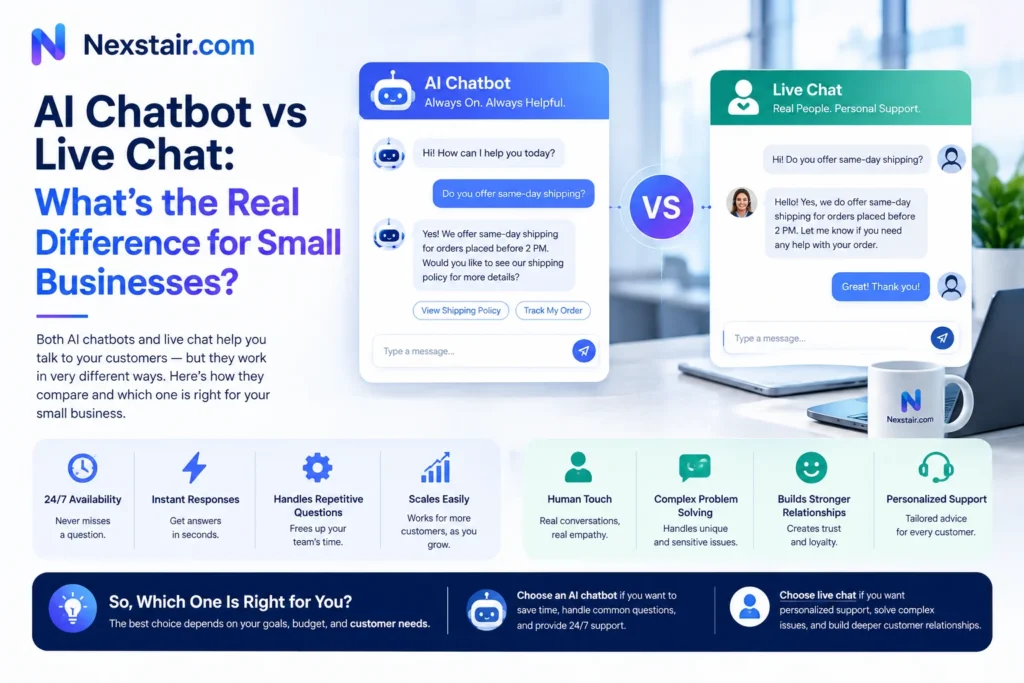
The AI chatbot vs live chat decision comes down to one core trade-off: automation that scales versus a human touch that builds trust. An AI chatbot answers instantly, works around the clock, and costs a fraction of what staffing a support team does. Live chat delivers judgment, empathy, and the kind of nuanced problem-solving a script or a language model still can’t fully replicate. Most small businesses don’t need to pick one permanently. They need to understand what each one is actually good at, so the choice fits the volume and complexity of what customers are asking.
This guide breaks down how AI chatbots and live chat differ in practice, what each one costs, when each makes sense for a small business, and why the ai chatbot vs live chat question increasingly has a “both” answer rather than an either/or one.
What an AI Chatbot Actually Is
A modern AI chatbot uses natural language processing and machine learning to understand what a customer types, not just match it against a fixed script. That’s a meaningful shift from the rule-based chatbots small businesses dealt with a few years ago, which only responded to exact keyword matches and frustrated customers the moment a question strayed from the expected phrasing.
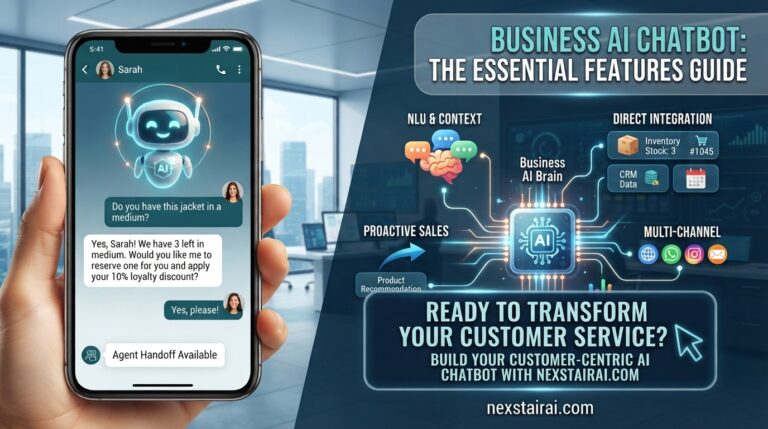
Today’s AI chatbots hold context across a conversation, handle unexpected wording, and in many cases resolve a customer’s issue without ever looping in a human. They’re available at 2am on a Sunday exactly as reliably as they are at 2pm on a Tuesday, which matters more than it sounds for a small business without the staff to cover after-hours support.
What Live Chat Actually Is
Live chat is a real-time messaging channel where an actual person, usually a member of your team, responds directly to a customer through a widget on your website or app. There’s no automation layer involved unless you add one; it’s a person typing back in real time.
The value of live chat isn’t speed, since a human typing will always be slower than an AI generating a response. The value is judgment. A live agent can read frustration in a customer’s tone, make a judgment call on a refund that falls outside policy, or simply reassure someone in a way that still reads as generic even from a well-trained AI chatbot.
AI Chatbot vs Live Chat: Where They Actually Differ
The clearest way to see the ai chatbot vs live chat gap is to compare how each one handles the same categories of interaction.
Response time favors the chatbot without contest. An AI chatbot answers in seconds regardless of volume, while live chat depends entirely on agent availability, which means wait times climb the moment more than a couple of customers reach out at once. Availability follows the same pattern. A chatbot runs 24/7 without needing shifts, holidays, or overtime, while staffing live chat around the clock requires either a large team or accepting that support simply goes offline outside business hours.
Resolution quality tells a more complicated story. Research on customer support outcomes shows live chat achieving first-contact resolution rates in the 70-79% range across most issue types, generally outperforming chatbots on complex problems, billing disputes, and situations that call for empathy rather than information. AI chatbots, meanwhile, are highly effective at deflecting the routine stuff, with some studies showing chatbots resolving 60% or more of incoming queries before a human ever needs to step in.
Cost is where the ai chatbot vs live chat comparison becomes most concrete for a small business owner. Live chat requires paying agent salaries, typically in the $35,000 to $45,000 range annually per representative in the US, plus training and benefits. An AI chatbot, by contrast, usually runs on a monthly subscription in the range of $200 to $1,000 for maintenance and updates, with no per-agent scaling cost as conversation volume grows.
Small Business AI Chatbot vs Live Chat: What the Numbers Say
For businesses with under 50 employees, AI chatbots tend to reach break-even within roughly 6 to 9 months, while live chat setups with dedicated staff often take 12 to 18 months to pay for themselves at similar volume. That gap widens further at scale. A business fielding around 10,000 customer conversations a month might spend somewhere near $15,000 on live chat staffing to cover that volume, compared to a few hundred to a couple thousand dollars a month for a comprehensive AI chatbot handling the same load.
None of this means live chat isn’t worth the investment. It means the AI chatbot vs live chat decision for a small business usually isn’t about which one is “better” in the abstract. It’s about matching the tool to your actual inquiry volume, the complexity of what customers typically ask, and how much budget you have for staffing versus software.
When a Small Business Should Choose AI Chatbot
An AI chatbot makes the most sense when your support volume is high, repetitive, and mostly made up of questions with a clear, factual answer: order status, business hours, return policy, product specs. If your team spends hours a week answering the same five or six questions, a chatbot absorbs that load immediately and frees your staff for the interactions that actually need a person.
It’s also the stronger choice if your customers reach out outside standard business hours, or if you’re a lean team without the headcount to staff live chat consistently. A well-configured AI chatbot effectively becomes your after-hours coverage, without needing anyone on call.
When a Small Business Should Choose Live Chat
Live chat earns its cost when the stakes of getting an answer wrong are high, or when the conversation itself is part of what a customer is paying for. A complex B2B sale where trust and relationship-building drive the outcome, a luxury service where personal attention is the actual product, or a billing dispute where a customer needs to feel heard rather than processed are all situations where a human still outperforms automation, regardless of how capable the underlying AI has become.
If your inquiry volume is low enough that a small team can realistically stay on top of it, live chat alone might be sufficient without needing a chatbot layered on top at all.
Why Most Small Businesses End Up Using Both
The ai chatbot vs live chat framing suggests a single choice, but most businesses that get this right don’t pick one exclusively. They use an AI chatbot to absorb routine, high-volume questions and free up their team, then route anything complex, emotional, or high-value straight to a live agent.
This hybrid model tends to outperform either channel running alone. AI chatbots can handle a large share of incoming volume automatically, while a smaller live chat team focuses only on the escalations, high-value prospects, and edge cases that genuinely need human judgment. The result is faster response times overall, lower support costs, and a live team that spends its time on conversations where a human actually makes a measurable difference.
What Customers Actually Expect Today
Customer expectations have shifted enough that the ai chatbot vs live chat decision isn’t purely a cost calculation anymore. Most customers have interacted with AI chatbots often enough to know what they’re talking to, and expectations have adjusted accordingly. A fast, accurate answer from a chatbot on a simple question rarely disappoints anyone. What does damage trust is a chatbot pretending to be human, or a live chat queue with no visibility into wait time.
Transparency matters more than which technology you choose. Customers generally don’t mind talking to a chatbot first, as long as it’s clear that’s what’s happening and there’s a visible, easy path to a human the moment the conversation needs one. Businesses that hide the chatbot’s identity, or make escalation to a person difficult, tend to see more frustration than businesses that are upfront about both.
Getting Started
If you’re evaluating AI chatbot vs live chat for the first time, start by looking at your last month of customer conversations. Sort them into routine and complex. If the routine bucket dominates, an AI chatbot alone might cover most of your needs. If complex, high-stakes conversations make up a large share, live chat deserves the bigger share of your budget, even if a chatbot still handles the overflow.
Nexstair AI’s Chatbot is built to handle the routine volume automatically while escalating anything it can’t confidently resolve, so your team only steps in where a human is actually needed. If you’re also exploring broader automation for your business, our AI Assistant page covers how that extends beyond customer support.
Frequently Asked Questions
What is the main difference between an AI chatbot and live chat?
An AI chatbot uses automation to respond to customer questions instantly and around the clock, while live chat connects a customer directly with a human agent in real time. The core trade-off is speed and scale versus judgment and empathy.
Is an AI chatbot cheaper than live chat for a small business?
Generally yes. AI chatbots typically cost a few hundred to a couple thousand dollars a month regardless of volume, while live chat requires paying agent salaries that scale with the number of staff needed to cover your support volume.
Can AI chatbots handle complex customer issues?
Modern AI chatbots handle a growing range of complex questions, but they still generally underperform live agents on issues involving billing disputes, emotional situations, or decisions that fall outside a documented policy.
Do small businesses need both an AI chatbot and live chat?
Many do. A common setup uses an AI chatbot to handle routine, high-volume questions automatically, then escalates complex or high-value conversations to a smaller live chat team, which tends to outperform relying on either channel alone.
How fast does an AI chatbot pay for itself compared to live chat?
Small businesses often see an AI chatbot break even within 6 to 9 months, compared to 12 to 18 months for a live chat setup staffed with dedicated agents, though this varies by inquiry volume and industry.
Does live chat work outside business hours?
Only if you staff it around the clock, which is expensive for most small businesses. This is one of the clearest advantages an AI chatbot has over live chat, since it can answer customer questions at any hour without added staffing cost.
Which one improves customer satisfaction more?
It depends on the type of interaction. AI chatbots tend to improve satisfaction for quick, factual questions because of instant response times, while live chat tends to improve satisfaction for complex or emotionally sensitive issues where a customer wants to feel heard by an actual person.