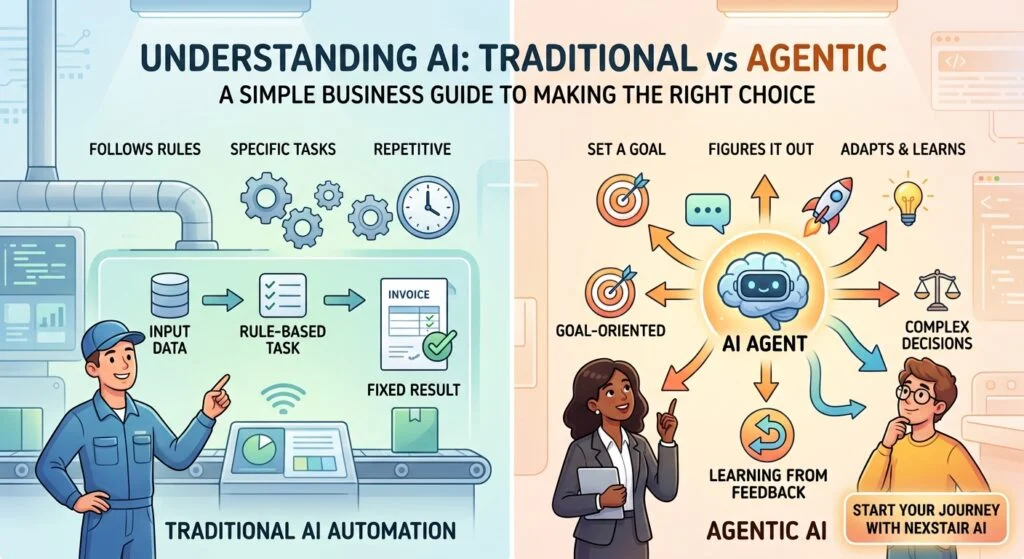
Confused about agentic AI vs traditional AI automation? Here’s a friendly, no-jargon breakdown of how they differ, real examples, and how to choose the right one for your business.
If you’ve been anywhere near a LinkedIn feed, a tech newsletter, or a boardroom in the last year, you’ve probably heard the phrase “agentic AI” thrown around like it’s the new must-have gadget. And right behind it, someone usually asks the same honest question:
“Wait… isn’t that just automation with a fancier name?”
Fair question. And the short answer is: not quite.
Traditional AI automation and agentic AI both help your business get more done with less manual effort, but they work in fundamentally different ways, they’re good at different things, and picking the wrong one for the wrong job can cost you time, money, and a whole lot of frustration.
So let’s break it down properly, in plain English, with real examples, so you can figure out exactly where each one fits into your business.
What Is Traditional AI Automation?
Traditional AI automation (think RPA, workflow bots, rule-based chatbots, scripted integrations) is software that follows a fixed set of instructions. It’s the “if this happens, do that” school of thought.
You tell it exactly what to do, step by step, and it does that same thing every single time, without deviation. No creativity, no independent judgment, no “let me think about this differently.”
A few hallmarks of traditional automation:
- It’s rule-based. Every action follows a predetermined path: if X happens, do Y.
- It needs structured, predictable inputs. Feed it something outside its expected format, and it either breaks or does the wrong thing.
- It’s incredibly consistent. Give it the same input a thousand times, and you’ll get the same correct output a thousand times.
- It needs a human to update it. If your process changes, someone has to go in and rewrite the rules.
Think of things like: an invoice-processing bot that only works when invoices arrive in one exact format, a scripted chatbot that offers three canned responses and then says “let me connect you to an agent,” or an abandoned-cart email that fires 24 hours after checkout, no matter who the customer is or what they were shopping for.
It’s reliable. It’s cheap to run once it’s built. And it has absolutely no idea what to do the moment something unexpected happens.
What Is Agentic AI?
Agentic AI flips the script. Instead of giving it a rigid set of steps, you give it a goal, and it figures out the best way to get there, on its own, adjusting as it goes.
Powered by large language models (LLMs) and reasoning capabilities, an agentic AI system can perceive a situation, plan a sequence of actions, use tools or software to carry them out, check whether it’s actually working, and course-correct if it isn’t, often without a human touching a single step.
Here’s the difference in one sentence: traditional automation executes instructions, agentic AI makes decisions.
Some things that make agentic AI distinct:
- It’s goal-oriented, not script-oriented. You tell it “resolve this customer’s billing issue,” not “click here, then here, then here.”
- It reasons through messy, unstructured information. A confusing customer email, a half-finished form, a vague request — agentic AI can work with that.
- It adapts on the fly. New information shows up mid-task? It adjusts its plan instead of grinding to a halt.
- It can use tools and take real action. It’s not just answering a question, it can actually go update the CRM, issue the refund, or reroute the shipment.
A simple way to picture it: traditional automation is a vending machine. Press the button, get the exact same snack, every time. Agentic AI is more like handing your grocery list to a genuinely capable personal shopper who knows to grab the ripe avocados and swap brands if your usual one is out of stock.
If you want a closer look at how this compares to standard chatbots specifically, this ties in nicely with our breakdown of AI agents vs. chatbots too.
See It in Action Before You Decide
Reading about the difference is one thing, seeing it work on your own website is another. Nexstair’s AI Assistant and AI Chatbot are built with real agentic capabilities, not just scripted menus, so they can actually understand what your customers need and act on it. Start your free trial and see the difference for yourself.
Agentic AI vs. Traditional AI Automation: What’s the Real Difference?
Here’s the side-by-side most people are actually searching for:
| Traditional AI Automation | Agentic AI | |
|---|---|---|
| How it works | Follows fixed, predefined rules | Reasons, plans, and adapts toward a goal |
| Handles unexpected input | Breaks or stalls | Adjusts and keeps going |
| Data it can work with | Structured, predictable data | Structured and unstructured (emails, chats, documents) |
| Human involvement | Needed to update rules when things change | Needed mainly for oversight, approvals, and edge cases |
| Best for | Repetitive, high-volume, stable processes | Complex, judgment-heavy, changing situations |
| Setup cost vs. running cost | Higher setup, very low running cost | More setup and governance, but handles more without rework |
| Reliability | Extremely predictable | Probabilistic — consistent, but needs monitoring |
Neither one is “better” in a vacuum. They’re built for different jobs, the same way a calculator and a financial advisor are both useful, just not interchangeable.
Agentic AI, AI Agents, and RPA: Aren’t They All the Same Thing?
This is genuinely one of the most-searched questions on this topic, and honestly, the industry hasn’t made it easy. Here’s the quick untangling:
- RPA (Robotic Process Automation) is the classic form of traditional automation. It mimics clicks and keystrokes a human would make on a screen, following an exact script.
- An AI agent is a single AI-powered “worker” that can reason and act toward a specific goal, like handling one customer support conversation from start to finish.
- Agentic AI usually refers to a system of multiple AI agents working together, coordinating, handing off tasks, and managing a broader, more complex workflow.
So an AI agent is one very capable employee. Agentic AI is closer to an entire, self-organizing team.
Real-World Examples: Same Task, Two Very Different Approaches
Nothing makes this clearer than seeing the same job handled both ways.
Customer support
- Traditional automation: A chatbot with a decision tree. “Press 1 for billing, 2 for returns.” If your question doesn’t fit a branch, you’re stuck.
- Agentic AI: An assistant that reads the customer’s actual message, pulls up their order history, resolves a billing dispute, and issues the refund, all in one conversation.
E-commerce
- Traditional automation: An abandoned-cart email that fires on a timer, identical for every shopper.
- Agentic AI: A system that notices the cart was abandoned, checks stock and shipping windows, and personalizes the follow-up offer based on that specific customer’s behavior.
Finance and operations
- Traditional automation: An invoice bot that processes only invoices in one exact template.
- Agentic AI: A system that reads invoices in varying formats, flags anomalies, and routes exceptions to the right person automatically.
Supply chain
- Traditional automation: A reorder trigger that fires when stock hits a fixed number.
- Agentic AI: A system that reroutes shipments on its own when it detects a weather delay or a supplier issue, before it becomes your customer’s problem.
Curious Where This Fits Into Your Own Business?
If you’re picturing your own support inbox or your own checkout flow while reading this (we don’t blame you), it’s worth seeing what an agentic setup could realistically handle for you. Explore Nexstair’s AI Assistant and get a feel for what “handled automatically” could actually mean for your team.
Pros and Cons: Where Each One Actually Wins
Traditional AI automation is the right call when:
- The process is repetitive and doesn’t change often
- Inputs arrive in a consistent, predictable format
- Compliance and auditability matter more than flexibility
- You need something fast and cheap to run at scale
Agentic AI is the right call when:
- The task involves judgment calls, not just steps
- You’re dealing with messy or unstructured information
- Conditions change often enough that “rewrite the script” isn’t sustainable
- You want the system to handle exceptions instead of escalating every one to a human
The honest downside of agentic AI? It needs more thoughtful setup, clearer guardrails, and ongoing oversight, because it’s making real decisions, not just following a script. That’s not a reason to avoid it, just a reason to implement it deliberately instead of rushing in.
Which One Does Your Business Actually Need?
Ask yourself three quick questions:
- Is this task exactly the same every single time? If yes, traditional automation is still the cheaper, more reliable choice.
- Does completing it require reading context or making a judgment call? If yes, you need at least an AI agent.
- Does it involve coordinating multiple steps, tools, or decisions that shift depending on the situation? That’s squarely agentic AI territory.
Most growing businesses don’t need to pick a side forever. A phased approach works well: keep traditional automation running your stable, high-volume, predictable processes, and layer agentic AI on top for the parts of your business that actually involve judgment, like customer conversations, lead qualification, and exception handling.
Can Agentic AI Replace Traditional AI Automation Completely?
Not really, and honestly, it shouldn’t try to. This is one of the biggest misconceptions floating around right now.
Traditional automation still delivers near-perfect reliability for stable, rule-based work like payroll processing or compliance reporting, and there’s no reason to make that more “intelligent” than it needs to be. Agentic AI, on the other hand, picks up exactly where rigid scripts fall apart: the messy, unpredictable, judgment-heavy work that used to get stuck waiting for a human.
The businesses seeing the strongest results in 2026 aren’t the ones ripping out their existing automation to chase the newest trend. They’re the ones building hybrid systems: dependable automation handling the repeatable backbone of the business, with agentic AI layered on top to manage the exceptions, the conversations, and the decisions that actually need a brain behind them.
Frequently Asked Questions | Agentic AI vs. Traditional AI Automation
Is agentic AI just a fancier chatbot? No. A scripted chatbot answers from a fixed set of responses. Agentic AI can understand intent, pull real data, take action across systems, and complete an entire task, not just talk about it.
Is agentic AI more expensive than traditional automation? Typically, yes, upfront. It requires more thoughtful setup and governance. But it also handles far more without constant reprogramming, which often pays off in reduced maintenance over time.
Do I need to replace my existing automation to use agentic AI? No. Most successful setups combine both, using agentic AI to manage what your current automation can’t.
Is agentic AI safe for customer-facing use? Yes, when it’s set up with clear boundaries, permissions, and human oversight for high-stakes actions, which is exactly how it should be implemented from day one.
Which one should a small business start with? Start with whichever removes the most manual work right now. For most small and growing businesses, that’s usually customer conversations and lead capture, which is precisely where an agentic AI assistant tends to earn its keep fastest.
The Bottom Line
Traditional automation isn’t going anywhere, and it shouldn’t. It’s still the most reliable way to handle repetitive, predictable work. But if your business is dealing with real conversations, real judgment calls, and real exceptions every single day (and let’s be honest, what business isn’t), agentic AI is where the actual time savings live.
You don’t have to figure this out alone or rebuild your entire tech stack to get started. Nexstair AI is built to give you agentic capabilities from day one, no technical background required. Get started with Nexstair AI today and see what your business looks like when the busywork runs itself.
 can help you build one that actually fits the way you work.** ## What Technologies Power an AI Virtual Assistant? Here's a quick, scannable summary of the main building blocks: | Technology | What It Does | |---|---| | **Natural Language Processing (NLP)** | Helps the assistant read and interpret human language | | **Natural Language Understanding (NLU)** | Identifies intent and extracts key details from a request | | **Large Language Models (LLMs)** | Generate flexible, human-like responses and handle complex questions | | **Speech Recognition (ASR)** | Converts spoken words into text | | **Text-to-Speech (TTS)** | Converts text responses into natural-sounding speech | | **Machine Learning (ML)** | Helps the system learn patterns and improve over time | | **APIs and Integrations** | Connect the assistant to business tools and data | | **Knowledge Base / Retrieval** | Gives the assistant accurate, up-to-date information to draw from | ## What Are the Different Types of AI Virtual Assistants? Not every virtual assistant works the same way. Here are the main categories. **Rule-based assistants.** These follow pre-written scripts and decision trees. They're predictable and good for simple tasks, but they struggle when customers phrase things unexpectedly. **AI-powered conversational assistants.** These use NLP and machine learning to understand free-form language. They're far more flexible and can handle a wide range of questions. **LLM-powered assistants.** The newest generation uses large language models to hold fluid, natural conversations, summarize information, and reason through multi-part requests. **Voice assistants.** These specialize in spoken interactions, whether on smart speakers, phones, or automated call systems. **Agentic assistants.** An emerging category, these assistants don't just respond; they can plan and carry out multi-step tasks on your behalf, such as researching options, filling out forms, or coordinating across several apps, all within boundaries you define. ## What Is the Difference Between an AI Virtual Assistant and a Chatbot? People often use these terms interchangeably, but there's a useful distinction. A **chatbot** is typically designed for a narrow purpose, usually answering questions or following a set script within a chat window. A **virtual assistant** is generally broader: it understands context, works across multiple channels, connects to several systems, and can complete a wider range of tasks. In practice, the line is blurring. Many modern chatbots are really AI virtual assistants under the hood. The key difference to look for is capability: can it merely respond, or can it understand, remember, and act? ## What Are the Real-World Uses of AI Virtual Assistants? Virtual assistants are showing up in nearly every industry. Here are some of the most common uses. **Customer support.** Answering FAQs, tracking orders, handling returns, and escalating tricky issues to human agents, all around the clock. **E-commerce.** Recommending products, answering sizing and shipping questions, and nudging shoppers who hesitate at checkout. **Healthcare.** Scheduling appointments, sending reminders, and answering basic administrative questions (while leaving medical decisions to professionals). **Banking and finance.** Checking balances, explaining fees, and guiding customers through routine account tasks securely. **Real estate.** Answering listing questions, qualifying leads, and booking property viewings. **Hospitality and travel.** Handling reservations, itinerary questions, and local recommendations. **Human resources.** Answering employee questions about policies, benefits, and time off, and helping with onboarding. **Sales and marketing.** Qualifying leads, capturing contact details, and booking demos for the sales team. ## What Are the Benefits of Using an AI Virtual Assistant? Businesses and individuals adopt virtual assistants for good reasons. - **24/7 availability.** Help is there whenever customers need it, across every time zone. - **Instant responses.** No more waiting in queues or for email replies. - **Cost efficiency.** Handling more conversations without proportionally growing your team. - **Consistency.** The same accurate answer every time, based on your approved information. - **Scalability.** Whether you have ten conversations a day or ten thousand, the assistant keeps up. - **Happier teams.** Employees spend less time on repetitive tasks and more on meaningful work. - **Useful insights.** Conversations reveal what customers really want to know, helping you improve your products, website, and policies. - **More sales.** Quick answers and helpful recommendations remove friction and help customers complete purchases. **Curious how much time and money a virtual assistant could save your business? [nexstairai.com](https://nexstairai.com/) can help you map out the opportunity and get started without the guesswork.** ## What Are the Limitations of AI Virtual Assistants? It's worth being realistic. Even great assistants have limits. - **They can misunderstand.** Unusual phrasing, heavy ambiguity, or very niche topics may trip them up. - **They depend on their information.** If the knowledge base is outdated or incomplete, the answers will be too. - **They can sometimes be wrong.** Language-model-based systems may occasionally produce confident but inaccurate responses, which is why guardrails and good source material matter. - **They lack true human empathy.** They can detect sentiment, but emotionally sensitive situations still benefit from a real person. - **Privacy and security need attention.** Handling personal data responsibly requires proper safeguards and compliance. The good news is that all of these can be managed with thoughtful design: clear boundaries, quality information, regular reviews, and an easy path to a human when needed. ## How Do You Choose the Right AI Virtual Assistant for Your Business? If you're thinking about adopting one, ask yourself these questions. 1. **What problem am I solving?** Support volume, lead capture, scheduling, internal help, or something else? 2. **Which channels do my customers use?** Website, WhatsApp, Instagram, email, phone? 3. **What systems does it need to connect to?** Your CRM, calendar, store, or helpdesk? 4. **How customizable is it?** Can you control tone, workflows, and escalation rules? 5. **How does it handle human handoff?** The transition should be smooth, with full context passed along. 6. **What does security look like?** Look for data protection and compliance with regulations relevant to your customers. 7. **Can I see performance data?** Good analytics help you measure and improve. 8. **What support will I get?** Setup and ongoing optimization make a big difference to results. ## How Do You Get Started With an AI Virtual Assistant? You don't need a massive project to begin. A simple path looks like this: 1. **Identify your top 5 to 10 most common customer questions or tasks.** 2. **Gather accurate, up-to-date information** such as FAQs, policies, and product details. 3. **Choose a platform or partner** that fits your needs and integrates with your tools. 4. **Set up and test** with real-world questions before launching. 5. **Launch on one channel first**, then expand as you gain confidence. 6. **Review conversations regularly**, improving responses and adding new capabilities over time. Starting small and growing steadily is almost always better than trying to automate everything at once. ## What Does the Future Hold for AI Virtual Assistants? The technology is moving quickly. A few trends worth watching: - **More proactive help.** Assistants that reach out with useful information before you ask, such as shipping delays or appointment reminders. - **Greater autonomy.** Agentic assistants that complete multi-step tasks within rules you set. - **Richer personalization.** Better memory of preferences and history, creating more natural, tailored experiences. - **Multimodal interaction.** Assistants that understand text, voice, images, and documents all in one conversation. - **Smoother voice experiences.** Phone and voice interactions that feel increasingly human and natural. - **Stronger safeguards.** Better accuracy controls, privacy protections, and transparency about when you're talking to AI. The businesses that start learning and experimenting now will be best positioned to benefit as these capabilities mature. ## Final Thoughts: Is an AI Virtual Assistant Worth It? An AI virtual assistant is, at its heart, a digital teammate. It listens to what people ask, understands what they mean, finds or does what's needed, and responds in a way that feels natural, all in a matter of seconds and at any hour of the day. Under the hood, it's a clever combination of speech recognition, language understanding, decision-making, integrations, and language generation. But from the customer's point of view, it's simple: they ask, and they get helped. For businesses, the payoff is faster service, lower costs, happier teams, and more room to grow. The key is to start with a clear goal, give your assistant good information, keep humans available for the moments that matter, and keep improving based on real conversations. **Ready to bring an AI virtual assistant into your business? Visit [nexstairai.com](https://nexstairai.com/) to explore how a custom-built assistant can help you serve customers better, save time, and grow with confidence.** --- Want me to write a follow-up next? Good options might be "AI Virtual Assistant vs. Chatbot: What's the Difference?" or "How to Train an AI Virtual Assistant on Your Business Data.](https://nexstairai.com/wp-content/uploads/2026/10/🚀-Supercharge-Your-Business-Growth-with-Nexstair-–-AI-Digital-Marketing-Agency-300x164.jpg.webp)

 can help you build one that actually fits the way you work.** ## What Technologies Power an AI Virtual Assistant? Here's a quick, scannable summary of the main building blocks: | Technology | What It Does | |---|---| | **Natural Language Processing (NLP)** | Helps the assistant read and interpret human language | | **Natural Language Understanding (NLU)** | Identifies intent and extracts key details from a request | | **Large Language Models (LLMs)** | Generate flexible, human-like responses and handle complex questions | | **Speech Recognition (ASR)** | Converts spoken words into text | | **Text-to-Speech (TTS)** | Converts text responses into natural-sounding speech | | **Machine Learning (ML)** | Helps the system learn patterns and improve over time | | **APIs and Integrations** | Connect the assistant to business tools and data | | **Knowledge Base / Retrieval** | Gives the assistant accurate, up-to-date information to draw from | ## What Are the Different Types of AI Virtual Assistants? Not every virtual assistant works the same way. Here are the main categories. **Rule-based assistants.** These follow pre-written scripts and decision trees. They're predictable and good for simple tasks, but they struggle when customers phrase things unexpectedly. **AI-powered conversational assistants.** These use NLP and machine learning to understand free-form language. They're far more flexible and can handle a wide range of questions. **LLM-powered assistants.** The newest generation uses large language models to hold fluid, natural conversations, summarize information, and reason through multi-part requests. **Voice assistants.** These specialize in spoken interactions, whether on smart speakers, phones, or automated call systems. **Agentic assistants.** An emerging category, these assistants don't just respond; they can plan and carry out multi-step tasks on your behalf, such as researching options, filling out forms, or coordinating across several apps, all within boundaries you define. ## What Is the Difference Between an AI Virtual Assistant and a Chatbot? People often use these terms interchangeably, but there's a useful distinction. A **chatbot** is typically designed for a narrow purpose, usually answering questions or following a set script within a chat window. A **virtual assistant** is generally broader: it understands context, works across multiple channels, connects to several systems, and can complete a wider range of tasks. In practice, the line is blurring. Many modern chatbots are really AI virtual assistants under the hood. The key difference to look for is capability: can it merely respond, or can it understand, remember, and act? ## What Are the Real-World Uses of AI Virtual Assistants? Virtual assistants are showing up in nearly every industry. Here are some of the most common uses. **Customer support.** Answering FAQs, tracking orders, handling returns, and escalating tricky issues to human agents, all around the clock. **E-commerce.** Recommending products, answering sizing and shipping questions, and nudging shoppers who hesitate at checkout. **Healthcare.** Scheduling appointments, sending reminders, and answering basic administrative questions (while leaving medical decisions to professionals). **Banking and finance.** Checking balances, explaining fees, and guiding customers through routine account tasks securely. **Real estate.** Answering listing questions, qualifying leads, and booking property viewings. **Hospitality and travel.** Handling reservations, itinerary questions, and local recommendations. **Human resources.** Answering employee questions about policies, benefits, and time off, and helping with onboarding. **Sales and marketing.** Qualifying leads, capturing contact details, and booking demos for the sales team. ## What Are the Benefits of Using an AI Virtual Assistant? Businesses and individuals adopt virtual assistants for good reasons. - **24/7 availability.** Help is there whenever customers need it, across every time zone. - **Instant responses.** No more waiting in queues or for email replies. - **Cost efficiency.** Handling more conversations without proportionally growing your team. - **Consistency.** The same accurate answer every time, based on your approved information. - **Scalability.** Whether you have ten conversations a day or ten thousand, the assistant keeps up. - **Happier teams.** Employees spend less time on repetitive tasks and more on meaningful work. - **Useful insights.** Conversations reveal what customers really want to know, helping you improve your products, website, and policies. - **More sales.** Quick answers and helpful recommendations remove friction and help customers complete purchases. **Curious how much time and money a virtual assistant could save your business? [nexstairai.com](https://nexstairai.com/) can help you map out the opportunity and get started without the guesswork.** ## What Are the Limitations of AI Virtual Assistants? It's worth being realistic. Even great assistants have limits. - **They can misunderstand.** Unusual phrasing, heavy ambiguity, or very niche topics may trip them up. - **They depend on their information.** If the knowledge base is outdated or incomplete, the answers will be too. - **They can sometimes be wrong.** Language-model-based systems may occasionally produce confident but inaccurate responses, which is why guardrails and good source material matter. - **They lack true human empathy.** They can detect sentiment, but emotionally sensitive situations still benefit from a real person. - **Privacy and security need attention.** Handling personal data responsibly requires proper safeguards and compliance. The good news is that all of these can be managed with thoughtful design: clear boundaries, quality information, regular reviews, and an easy path to a human when needed. ## How Do You Choose the Right AI Virtual Assistant for Your Business? If you're thinking about adopting one, ask yourself these questions. 1. **What problem am I solving?** Support volume, lead capture, scheduling, internal help, or something else? 2. **Which channels do my customers use?** Website, WhatsApp, Instagram, email, phone? 3. **What systems does it need to connect to?** Your CRM, calendar, store, or helpdesk? 4. **How customizable is it?** Can you control tone, workflows, and escalation rules? 5. **How does it handle human handoff?** The transition should be smooth, with full context passed along. 6. **What does security look like?** Look for data protection and compliance with regulations relevant to your customers. 7. **Can I see performance data?** Good analytics help you measure and improve. 8. **What support will I get?** Setup and ongoing optimization make a big difference to results. ## How Do You Get Started With an AI Virtual Assistant? You don't need a massive project to begin. A simple path looks like this: 1. **Identify your top 5 to 10 most common customer questions or tasks.** 2. **Gather accurate, up-to-date information** such as FAQs, policies, and product details. 3. **Choose a platform or partner** that fits your needs and integrates with your tools. 4. **Set up and test** with real-world questions before launching. 5. **Launch on one channel first**, then expand as you gain confidence. 6. **Review conversations regularly**, improving responses and adding new capabilities over time. Starting small and growing steadily is almost always better than trying to automate everything at once. ## What Does the Future Hold for AI Virtual Assistants? The technology is moving quickly. A few trends worth watching: - **More proactive help.** Assistants that reach out with useful information before you ask, such as shipping delays or appointment reminders. - **Greater autonomy.** Agentic assistants that complete multi-step tasks within rules you set. - **Richer personalization.** Better memory of preferences and history, creating more natural, tailored experiences. - **Multimodal interaction.** Assistants that understand text, voice, images, and documents all in one conversation. - **Smoother voice experiences.** Phone and voice interactions that feel increasingly human and natural. - **Stronger safeguards.** Better accuracy controls, privacy protections, and transparency about when you're talking to AI. The businesses that start learning and experimenting now will be best positioned to benefit as these capabilities mature. ## Final Thoughts: Is an AI Virtual Assistant Worth It? An AI virtual assistant is, at its heart, a digital teammate. It listens to what people ask, understands what they mean, finds or does what's needed, and responds in a way that feels natural, all in a matter of seconds and at any hour of the day. Under the hood, it's a clever combination of speech recognition, language understanding, decision-making, integrations, and language generation. But from the customer's point of view, it's simple: they ask, and they get helped. For businesses, the payoff is faster service, lower costs, happier teams, and more room to grow. The key is to start with a clear goal, give your assistant good information, keep humans available for the moments that matter, and keep improving based on real conversations. **Ready to bring an AI virtual assistant into your business? Visit [nexstairai.com](https://nexstairai.com/) to explore how a custom-built assistant can help you serve customers better, save time, and grow with confidence.** --- Want me to write a follow-up next? Good options might be "AI Virtual Assistant vs. Chatbot: What's the Difference?" or "How to Train an AI Virtual Assistant on Your Business Data.](https://nexstairai.com/wp-content/uploads/2026/10/🚀-Supercharge-Your-Business-Growth-with-Nexstair-–-AI-Digital-Marketing-Agency-768x419.jpg.webp)