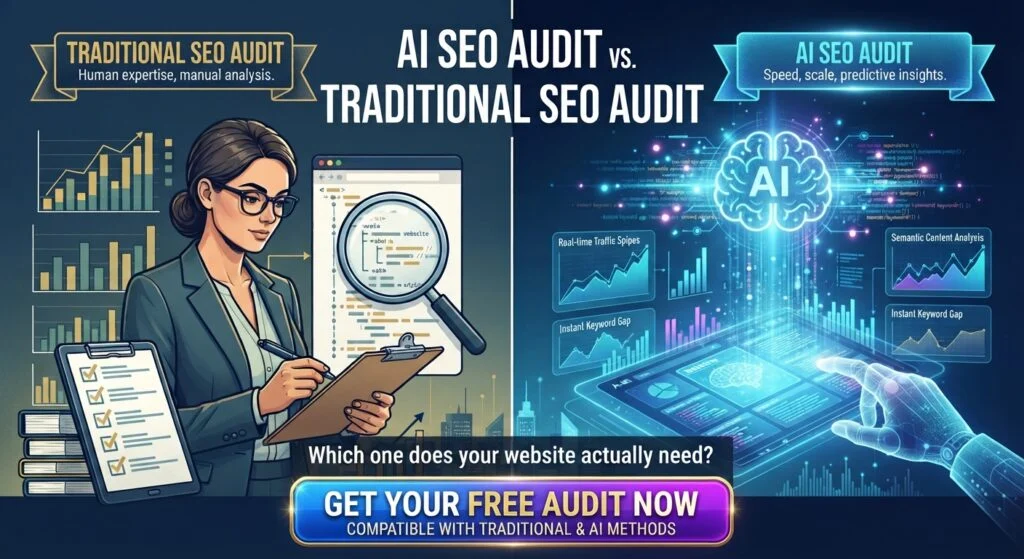
Discover the differences between AI SEO Audit vs. Traditional SEO Audit. Learn how combining human strategy with AI speed delivers a superior SEO roadmap for your website. Compare costs, accuracy, and depth of analysis.
If you’ve ever ordered an SEO audit, you know the feeling. A few weeks later, a hefty PDF lands in your inbox, filled with screenshots, color-coded warnings, and a to-do list so long it makes you want to close your laptop and take a walk. Then comes the hard part: figuring out which of those 200 “issues” actually matter for your traffic and revenue.
Now there’s a new player in the game. AI-powered SEO audits promise faster results, deeper analysis, and recommendations that go beyond a checklist. But do they really replace the traditional approach, or do the two work better together?
In this guide, we’ll break down exactly how each type of audit works, where each one shines, where each falls short, and how to decide which is right for your website. Grab a coffee, and let’s get into it.
What Is a Traditional SEO Audit?
A traditional SEO audit is a manual (or semi-manual) review of your website’s health and search performance, typically carried out by an SEO specialist or agency using a mix of tools such as crawlers, analytics platforms, and Google Search Console.
The goal is to find what’s holding your site back in search results and to build a prioritized plan to fix it. A traditional audit usually covers four core areas:
- Technical SEO: crawlability, indexation, site speed, mobile-friendliness, structured data, XML sitemaps, redirects, and broken links.
- On-page SEO: title tags, meta descriptions, headings, keyword usage, internal linking, image optimization, and content quality.
- Off-page SEO: backlink profile, referring domains, anchor text distribution, and toxic or spammy links.
- Content and competitive analysis: keyword gaps, content performance, and how your site stacks up against competitors.
The process is largely human-led. An experienced auditor crawls the site, exports data from several tools, cross-references the findings, applies professional judgment, and assembles a report with recommendations.
What Is an AI SEO Audit?
An AI SEO audit uses machine learning, natural language processing, and large language models to analyze your website, competitors, and search results at a scale and speed that manual work can’t match.
Instead of simply flagging that a page has a missing meta description, an AI-driven audit can go further. It can evaluate whether your content actually satisfies search intent, identify semantic gaps compared with top-ranking pages, predict which fixes are likely to have the biggest impact, and even draft the fixes for you.
Just as importantly, a modern AI audit looks beyond traditional Google rankings. It examines how visible your brand is in AI-generated answers, such as Google’s AI Overviews, ChatGPT, Perplexity, and other answer engines. That’s a dimension traditional audits were never designed to cover.
How Do the Two Audit Types Differ at a Glance?
Here’s a quick side-by-side comparison you can skim (and feel free to save it for later):
| Factor | Traditional SEO Audit | AI SEO Audit |
|---|---|---|
| Speed | Days to weeks | Minutes to hours |
| Scale | Limited by human time; large sites are sampled | Can analyze entire sites, even at massive page counts |
| Depth of content analysis | Keyword-focused, manually reviewed | Semantic, intent-based, entity-aware |
| Prioritization | Based on auditor experience | Data-driven scoring, often with predicted impact |
| Answer engine (AEO/GEO) coverage | Rarely included | Increasingly built in |
| Human judgment and strategy | Strong | Needs human oversight |
| Cost | Higher per audit | Lower per audit, easier to repeat |
| Frequency | Typically one-off or quarterly | Can run continuously |
Now let’s dig into what’s behind each row.
How Does the Speed and Scale of Each Audit Compare?
This is where AI has the clearest advantage. A traditional audit of a mid-sized website can take a specialist anywhere from several days to a few weeks, depending on complexity. For enterprise sites with hundreds of thousands of URLs, auditors often have to sample sections of the site rather than review every page.
An AI-powered audit can crawl and analyze an entire site in a fraction of that time. It can process thousands of pages, cluster them by topic, flag duplicate or thin content, detect internal linking gaps, and surface patterns that would take a human team weeks to notice.
Speed matters because SEO issues compound. A broken template that creates hundreds of duplicate pages costs you every day it remains unfixed. Faster detection means faster recovery.
Which Audit Does a Better Job With Technical SEO?
Here’s where it gets interesting: both approaches are strong, but in different ways.
Traditional audits excel at diagnosing complex or unusual technical problems. If your JavaScript-heavy site is confusing Googlebot, or your migration left behind a tangle of redirect chains, an experienced technical SEO can reason through the root cause, something automated tools sometimes only flag as symptoms.
AI audits excel at breadth, consistency, and monitoring. They catch issues across every page without fatigue, group problems by root cause, and alert you when something breaks after a site update. Many can also estimate which technical fixes are most likely to improve crawl efficiency or rankings.
The takeaway: AI is fantastic at finding and organizing technical issues, while human experts are still best at diagnosing the trickiest ones.
How Do They Handle Content Analysis and Search Intent?
Traditional content audits typically look at keyword usage, word count, heading structure, and whether a page targets a relevant term. An experienced strategist then adds judgment: is this article actually helpful? Does it match what searchers want?
AI audits take content analysis several steps deeper. Using natural language processing, they can:
- Compare your page against the top-ranking results and identify missing subtopics, entities, and questions.
- Score how well your content matches the dominant search intent (informational, commercial, transactional).
- Detect content decay, meaning pages that once performed well but are slipping.
- Suggest specific improvements, such as adding a FAQ section, restructuring headings into questions, or expanding thin sections.
This is particularly valuable now that search engines reward comprehensive, well-structured, genuinely helpful content, and AI answer engines pull from pages that answer questions clearly and directly.
If you’d like to see how your content measures up against what both Google and AI answer engines are looking for, nexstairai.com can help you get a clear, actionable picture of where your site stands.
Can a Traditional SEO Audit Measure Visibility in AI Search?
Mostly, no. And this is one of the biggest differences between the two approaches in 2026.
Traditional audits were built around a simple model: rank on Google, get clicks. But today, a growing share of searches end in an AI-generated answer, with the user never clicking through to a traditional result. Whether your brand gets mentioned or cited in those answers depends on factors that a classic audit doesn’t typically evaluate:
- Clear, extractable answers: Do your pages state answers concisely near the top of a section?
- Structured data and schema markup: Can machines easily understand what your content is about?
- Entity clarity and authority: Is your brand consistently described across the web?
- Content formats AI systems favor: question-based headings, lists, tables, and direct definitions.
- Citations and brand mentions: Are trusted sources referencing you?
AI-driven audits are increasingly built to test for these signals, and some can even check whether your brand appears when people ask AI assistants relevant questions in your industry. This is often called AEO (Answer Engine Optimization) or GEO (Generative Engine Optimization), and it’s quickly becoming a must-have layer on top of traditional SEO.
Where Does a Traditional SEO Audit Still Win?
It would be a mistake to write off traditional audits. They still offer real advantages, especially in these situations:
- Strategic context. A seasoned consultant understands your business model, seasonality, brand constraints, and goals, and can tailor priorities accordingly.
- Complex problem-solving. Site migrations, international SEO setups, penalties, and messy legacy architectures often benefit from human reasoning.
- Nuanced judgment calls. Should you consolidate two similar pages, or keep both? Is that backlink risky or fine? These decisions involve trade-offs that require experience.
- Stakeholder communication. A human auditor can walk your team through findings, answer questions, and help get buy-in from developers and executives.
In short, traditional audits bring wisdom and context. AI brings speed and scale. Each covers the other’s blind spots.
Where Do AI SEO Audits Fall Short?
Honesty matters here, because AI audits aren’t magic. Some limitations to keep in mind:
- Generic recommendations. Without business context, AI can suggest changes that are technically sound but strategically irrelevant.
- Possible inaccuracies. AI tools can occasionally misinterpret data or produce confident-sounding but wrong recommendations, so outputs should be verified.
- Over-optimization risk. Blindly following AI suggestions, such as stuffing in every “missing” keyword, can hurt readability and quality.
- Limited grasp of brand voice and nuance. AI may not fully understand what makes your brand distinctive.
- Data dependency. The quality of the audit depends on the quality and completeness of the data it’s fed.
The best practice is to treat AI output as a highly capable assistant’s draft, not the final word.
How Do the Costs Compare?
Traditional audits from reputable agencies or freelancers can range from a few hundred dollars for a small site to several thousand for a large or complex one. Because of the manual effort involved, they’re usually one-time or periodic projects.
AI audits generally cost less per run and can be repeated frequently, which changes the economics. Instead of paying for a big audit once or twice a year, you can monitor continuously and catch problems early. For small and mid-sized businesses, that affordability makes ongoing SEO health checks realistic rather than a luxury.
That said, the cheapest option isn’t always the best value. The real question is what you get for the money: a list of issues, or a prioritized plan that actually moves the needle.
Which Audit Is Right for Your Business?
Here’s a simple way to decide:
Choose a traditional SEO audit if:
- You’re facing a complex problem like a traffic drop after a migration, a manual penalty, or a major redesign.
- You need a strategic roadmap tied closely to business goals.
- Your site has unusual technical challenges that need expert diagnosis.
Choose an AI SEO audit if:
- You have a large site and need fast, comprehensive coverage.
- You want ongoing monitoring instead of a one-time snapshot.
- You care about visibility in AI Overviews, ChatGPT, and other answer engines.
- You’re a small team with a limited budget that still wants professional-grade insights.
Choose a hybrid approach if:
- You want the best of both worlds. (Spoiler: for most businesses, this is the winner.)
What Does a Hybrid SEO Audit Look Like in Practice?
The smartest teams aren’t choosing sides. They’re combining the strengths of both. A hybrid workflow typically looks like this:
- Run an AI-powered audit first to quickly crawl the site, detect technical issues, analyze content gaps, and check AI search visibility.
- Have a human expert review the findings, filtering out noise, validating important issues, and adding business context.
- Prioritize fixes by impact and effort, starting with quick wins like broken links, missing metadata, and unclear page structure.
- Implement changes, with AI helping draft content improvements, schema markup, and internal linking suggestions.
- Monitor continuously, using AI to track rankings, technical health, and AI-answer visibility, and bring in human expertise for quarterly strategy reviews.
This approach saves time and money while keeping strategic judgment in the loop.
If you’d like a partner who can help you combine smart AI analysis with real, practical guidance for your business, nexstairai.com is a great place to start the conversation.
What Should You Look for in an AI SEO Audit Tool or Service?
Not all AI audits are created equal. When evaluating options, look for:
- Comprehensive coverage: technical, on-page, content, and off-page signals in one place.
- Answer engine visibility checks: the ability to assess your presence in AI-generated results.
- Actionable prioritization: a ranked list of fixes, not a data dump.
- Transparent recommendations: explanations of why something matters, not just what to change.
- Integration with your existing tools: such as Google Search Console and Analytics.
- Human support or expertise: someone to help interpret results when you need it.
How Often Should You Run an SEO Audit?
The old rule of thumb was once or twice a year. But search is changing faster than ever, with algorithm updates, evolving AI search features, and shifting competitor strategies. A better cadence today looks like this:
- Continuous monitoring for technical health and key rankings (AI makes this easy).
- Monthly quick checks on content performance and new issues.
- Quarterly deep dives combining AI analysis with human strategic review.
- Immediately after major changes such as redesigns, migrations, or CMS updates.
Final Thoughts: Is AI Replacing the Traditional SEO Audit?
Not replacing, but reshaping it. Traditional SEO audits gave us a solid foundation: a disciplined process for finding and fixing what holds a website back. AI audits build on that foundation by adding speed, scale, semantic depth, and a window into the new world of AI-driven search.
The businesses that will win in the coming years aren’t the ones that pick “old” or “new.” They’re the ones that use AI to see more, move faster, and stay consistent, while relying on human judgment to make smart decisions about what to do with all that information.
If your last SEO audit is gathering digital dust, or you’ve never had one at all, now is a great time to take a fresh look at your site through both lenses.
Ready to find out what’s really going on with your website’s search performance, in both classic Google results and AI-powered answers? Visit nexstairai.com and take the first step toward a smarter SEO strategy.
 can help you build one that actually fits the way you work.** ## What Technologies Power an AI Virtual Assistant? Here's a quick, scannable summary of the main building blocks: | Technology | What It Does | |---|---| | **Natural Language Processing (NLP)** | Helps the assistant read and interpret human language | | **Natural Language Understanding (NLU)** | Identifies intent and extracts key details from a request | | **Large Language Models (LLMs)** | Generate flexible, human-like responses and handle complex questions | | **Speech Recognition (ASR)** | Converts spoken words into text | | **Text-to-Speech (TTS)** | Converts text responses into natural-sounding speech | | **Machine Learning (ML)** | Helps the system learn patterns and improve over time | | **APIs and Integrations** | Connect the assistant to business tools and data | | **Knowledge Base / Retrieval** | Gives the assistant accurate, up-to-date information to draw from | ## What Are the Different Types of AI Virtual Assistants? Not every virtual assistant works the same way. Here are the main categories. **Rule-based assistants.** These follow pre-written scripts and decision trees. They're predictable and good for simple tasks, but they struggle when customers phrase things unexpectedly. **AI-powered conversational assistants.** These use NLP and machine learning to understand free-form language. They're far more flexible and can handle a wide range of questions. **LLM-powered assistants.** The newest generation uses large language models to hold fluid, natural conversations, summarize information, and reason through multi-part requests. **Voice assistants.** These specialize in spoken interactions, whether on smart speakers, phones, or automated call systems. **Agentic assistants.** An emerging category, these assistants don't just respond; they can plan and carry out multi-step tasks on your behalf, such as researching options, filling out forms, or coordinating across several apps, all within boundaries you define. ## What Is the Difference Between an AI Virtual Assistant and a Chatbot? People often use these terms interchangeably, but there's a useful distinction. A **chatbot** is typically designed for a narrow purpose, usually answering questions or following a set script within a chat window. A **virtual assistant** is generally broader: it understands context, works across multiple channels, connects to several systems, and can complete a wider range of tasks. In practice, the line is blurring. Many modern chatbots are really AI virtual assistants under the hood. The key difference to look for is capability: can it merely respond, or can it understand, remember, and act? ## What Are the Real-World Uses of AI Virtual Assistants? Virtual assistants are showing up in nearly every industry. Here are some of the most common uses. **Customer support.** Answering FAQs, tracking orders, handling returns, and escalating tricky issues to human agents, all around the clock. **E-commerce.** Recommending products, answering sizing and shipping questions, and nudging shoppers who hesitate at checkout. **Healthcare.** Scheduling appointments, sending reminders, and answering basic administrative questions (while leaving medical decisions to professionals). **Banking and finance.** Checking balances, explaining fees, and guiding customers through routine account tasks securely. **Real estate.** Answering listing questions, qualifying leads, and booking property viewings. **Hospitality and travel.** Handling reservations, itinerary questions, and local recommendations. **Human resources.** Answering employee questions about policies, benefits, and time off, and helping with onboarding. **Sales and marketing.** Qualifying leads, capturing contact details, and booking demos for the sales team. ## What Are the Benefits of Using an AI Virtual Assistant? Businesses and individuals adopt virtual assistants for good reasons. - **24/7 availability.** Help is there whenever customers need it, across every time zone. - **Instant responses.** No more waiting in queues or for email replies. - **Cost efficiency.** Handling more conversations without proportionally growing your team. - **Consistency.** The same accurate answer every time, based on your approved information. - **Scalability.** Whether you have ten conversations a day or ten thousand, the assistant keeps up. - **Happier teams.** Employees spend less time on repetitive tasks and more on meaningful work. - **Useful insights.** Conversations reveal what customers really want to know, helping you improve your products, website, and policies. - **More sales.** Quick answers and helpful recommendations remove friction and help customers complete purchases. **Curious how much time and money a virtual assistant could save your business? [nexstairai.com](https://nexstairai.com/) can help you map out the opportunity and get started without the guesswork.** ## What Are the Limitations of AI Virtual Assistants? It's worth being realistic. Even great assistants have limits. - **They can misunderstand.** Unusual phrasing, heavy ambiguity, or very niche topics may trip them up. - **They depend on their information.** If the knowledge base is outdated or incomplete, the answers will be too. - **They can sometimes be wrong.** Language-model-based systems may occasionally produce confident but inaccurate responses, which is why guardrails and good source material matter. - **They lack true human empathy.** They can detect sentiment, but emotionally sensitive situations still benefit from a real person. - **Privacy and security need attention.** Handling personal data responsibly requires proper safeguards and compliance. The good news is that all of these can be managed with thoughtful design: clear boundaries, quality information, regular reviews, and an easy path to a human when needed. ## How Do You Choose the Right AI Virtual Assistant for Your Business? If you're thinking about adopting one, ask yourself these questions. 1. **What problem am I solving?** Support volume, lead capture, scheduling, internal help, or something else? 2. **Which channels do my customers use?** Website, WhatsApp, Instagram, email, phone? 3. **What systems does it need to connect to?** Your CRM, calendar, store, or helpdesk? 4. **How customizable is it?** Can you control tone, workflows, and escalation rules? 5. **How does it handle human handoff?** The transition should be smooth, with full context passed along. 6. **What does security look like?** Look for data protection and compliance with regulations relevant to your customers. 7. **Can I see performance data?** Good analytics help you measure and improve. 8. **What support will I get?** Setup and ongoing optimization make a big difference to results. ## How Do You Get Started With an AI Virtual Assistant? You don't need a massive project to begin. A simple path looks like this: 1. **Identify your top 5 to 10 most common customer questions or tasks.** 2. **Gather accurate, up-to-date information** such as FAQs, policies, and product details. 3. **Choose a platform or partner** that fits your needs and integrates with your tools. 4. **Set up and test** with real-world questions before launching. 5. **Launch on one channel first**, then expand as you gain confidence. 6. **Review conversations regularly**, improving responses and adding new capabilities over time. Starting small and growing steadily is almost always better than trying to automate everything at once. ## What Does the Future Hold for AI Virtual Assistants? The technology is moving quickly. A few trends worth watching: - **More proactive help.** Assistants that reach out with useful information before you ask, such as shipping delays or appointment reminders. - **Greater autonomy.** Agentic assistants that complete multi-step tasks within rules you set. - **Richer personalization.** Better memory of preferences and history, creating more natural, tailored experiences. - **Multimodal interaction.** Assistants that understand text, voice, images, and documents all in one conversation. - **Smoother voice experiences.** Phone and voice interactions that feel increasingly human and natural. - **Stronger safeguards.** Better accuracy controls, privacy protections, and transparency about when you're talking to AI. The businesses that start learning and experimenting now will be best positioned to benefit as these capabilities mature. ## Final Thoughts: Is an AI Virtual Assistant Worth It? An AI virtual assistant is, at its heart, a digital teammate. It listens to what people ask, understands what they mean, finds or does what's needed, and responds in a way that feels natural, all in a matter of seconds and at any hour of the day. Under the hood, it's a clever combination of speech recognition, language understanding, decision-making, integrations, and language generation. But from the customer's point of view, it's simple: they ask, and they get helped. For businesses, the payoff is faster service, lower costs, happier teams, and more room to grow. The key is to start with a clear goal, give your assistant good information, keep humans available for the moments that matter, and keep improving based on real conversations. **Ready to bring an AI virtual assistant into your business? Visit [nexstairai.com](https://nexstairai.com/) to explore how a custom-built assistant can help you serve customers better, save time, and grow with confidence.** --- Want me to write a follow-up next? Good options might be "AI Virtual Assistant vs. Chatbot: What's the Difference?" or "How to Train an AI Virtual Assistant on Your Business Data.](https://nexstairai.com/wp-content/uploads/2026/10/🚀-Supercharge-Your-Business-Growth-with-Nexstair-–-AI-Digital-Marketing-Agency-300x164.jpg.webp)


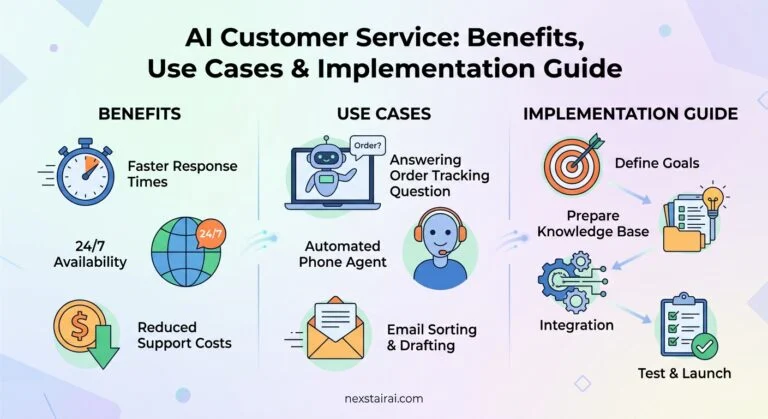
 can help you build one that actually fits the way you work.** ## What Technologies Power an AI Virtual Assistant? Here's a quick, scannable summary of the main building blocks: | Technology | What It Does | |---|---| | **Natural Language Processing (NLP)** | Helps the assistant read and interpret human language | | **Natural Language Understanding (NLU)** | Identifies intent and extracts key details from a request | | **Large Language Models (LLMs)** | Generate flexible, human-like responses and handle complex questions | | **Speech Recognition (ASR)** | Converts spoken words into text | | **Text-to-Speech (TTS)** | Converts text responses into natural-sounding speech | | **Machine Learning (ML)** | Helps the system learn patterns and improve over time | | **APIs and Integrations** | Connect the assistant to business tools and data | | **Knowledge Base / Retrieval** | Gives the assistant accurate, up-to-date information to draw from | ## What Are the Different Types of AI Virtual Assistants? Not every virtual assistant works the same way. Here are the main categories. **Rule-based assistants.** These follow pre-written scripts and decision trees. They're predictable and good for simple tasks, but they struggle when customers phrase things unexpectedly. **AI-powered conversational assistants.** These use NLP and machine learning to understand free-form language. They're far more flexible and can handle a wide range of questions. **LLM-powered assistants.** The newest generation uses large language models to hold fluid, natural conversations, summarize information, and reason through multi-part requests. **Voice assistants.** These specialize in spoken interactions, whether on smart speakers, phones, or automated call systems. **Agentic assistants.** An emerging category, these assistants don't just respond; they can plan and carry out multi-step tasks on your behalf, such as researching options, filling out forms, or coordinating across several apps, all within boundaries you define. ## What Is the Difference Between an AI Virtual Assistant and a Chatbot? People often use these terms interchangeably, but there's a useful distinction. A **chatbot** is typically designed for a narrow purpose, usually answering questions or following a set script within a chat window. A **virtual assistant** is generally broader: it understands context, works across multiple channels, connects to several systems, and can complete a wider range of tasks. In practice, the line is blurring. Many modern chatbots are really AI virtual assistants under the hood. The key difference to look for is capability: can it merely respond, or can it understand, remember, and act? ## What Are the Real-World Uses of AI Virtual Assistants? Virtual assistants are showing up in nearly every industry. Here are some of the most common uses. **Customer support.** Answering FAQs, tracking orders, handling returns, and escalating tricky issues to human agents, all around the clock. **E-commerce.** Recommending products, answering sizing and shipping questions, and nudging shoppers who hesitate at checkout. **Healthcare.** Scheduling appointments, sending reminders, and answering basic administrative questions (while leaving medical decisions to professionals). **Banking and finance.** Checking balances, explaining fees, and guiding customers through routine account tasks securely. **Real estate.** Answering listing questions, qualifying leads, and booking property viewings. **Hospitality and travel.** Handling reservations, itinerary questions, and local recommendations. **Human resources.** Answering employee questions about policies, benefits, and time off, and helping with onboarding. **Sales and marketing.** Qualifying leads, capturing contact details, and booking demos for the sales team. ## What Are the Benefits of Using an AI Virtual Assistant? Businesses and individuals adopt virtual assistants for good reasons. - **24/7 availability.** Help is there whenever customers need it, across every time zone. - **Instant responses.** No more waiting in queues or for email replies. - **Cost efficiency.** Handling more conversations without proportionally growing your team. - **Consistency.** The same accurate answer every time, based on your approved information. - **Scalability.** Whether you have ten conversations a day or ten thousand, the assistant keeps up. - **Happier teams.** Employees spend less time on repetitive tasks and more on meaningful work. - **Useful insights.** Conversations reveal what customers really want to know, helping you improve your products, website, and policies. - **More sales.** Quick answers and helpful recommendations remove friction and help customers complete purchases. **Curious how much time and money a virtual assistant could save your business? [nexstairai.com](https://nexstairai.com/) can help you map out the opportunity and get started without the guesswork.** ## What Are the Limitations of AI Virtual Assistants? It's worth being realistic. Even great assistants have limits. - **They can misunderstand.** Unusual phrasing, heavy ambiguity, or very niche topics may trip them up. - **They depend on their information.** If the knowledge base is outdated or incomplete, the answers will be too. - **They can sometimes be wrong.** Language-model-based systems may occasionally produce confident but inaccurate responses, which is why guardrails and good source material matter. - **They lack true human empathy.** They can detect sentiment, but emotionally sensitive situations still benefit from a real person. - **Privacy and security need attention.** Handling personal data responsibly requires proper safeguards and compliance. The good news is that all of these can be managed with thoughtful design: clear boundaries, quality information, regular reviews, and an easy path to a human when needed. ## How Do You Choose the Right AI Virtual Assistant for Your Business? If you're thinking about adopting one, ask yourself these questions. 1. **What problem am I solving?** Support volume, lead capture, scheduling, internal help, or something else? 2. **Which channels do my customers use?** Website, WhatsApp, Instagram, email, phone? 3. **What systems does it need to connect to?** Your CRM, calendar, store, or helpdesk? 4. **How customizable is it?** Can you control tone, workflows, and escalation rules? 5. **How does it handle human handoff?** The transition should be smooth, with full context passed along. 6. **What does security look like?** Look for data protection and compliance with regulations relevant to your customers. 7. **Can I see performance data?** Good analytics help you measure and improve. 8. **What support will I get?** Setup and ongoing optimization make a big difference to results. ## How Do You Get Started With an AI Virtual Assistant? You don't need a massive project to begin. A simple path looks like this: 1. **Identify your top 5 to 10 most common customer questions or tasks.** 2. **Gather accurate, up-to-date information** such as FAQs, policies, and product details. 3. **Choose a platform or partner** that fits your needs and integrates with your tools. 4. **Set up and test** with real-world questions before launching. 5. **Launch on one channel first**, then expand as you gain confidence. 6. **Review conversations regularly**, improving responses and adding new capabilities over time. Starting small and growing steadily is almost always better than trying to automate everything at once. ## What Does the Future Hold for AI Virtual Assistants? The technology is moving quickly. A few trends worth watching: - **More proactive help.** Assistants that reach out with useful information before you ask, such as shipping delays or appointment reminders. - **Greater autonomy.** Agentic assistants that complete multi-step tasks within rules you set. - **Richer personalization.** Better memory of preferences and history, creating more natural, tailored experiences. - **Multimodal interaction.** Assistants that understand text, voice, images, and documents all in one conversation. - **Smoother voice experiences.** Phone and voice interactions that feel increasingly human and natural. - **Stronger safeguards.** Better accuracy controls, privacy protections, and transparency about when you're talking to AI. The businesses that start learning and experimenting now will be best positioned to benefit as these capabilities mature. ## Final Thoughts: Is an AI Virtual Assistant Worth It? An AI virtual assistant is, at its heart, a digital teammate. It listens to what people ask, understands what they mean, finds or does what's needed, and responds in a way that feels natural, all in a matter of seconds and at any hour of the day. Under the hood, it's a clever combination of speech recognition, language understanding, decision-making, integrations, and language generation. But from the customer's point of view, it's simple: they ask, and they get helped. For businesses, the payoff is faster service, lower costs, happier teams, and more room to grow. The key is to start with a clear goal, give your assistant good information, keep humans available for the moments that matter, and keep improving based on real conversations. **Ready to bring an AI virtual assistant into your business? Visit [nexstairai.com](https://nexstairai.com/) to explore how a custom-built assistant can help you serve customers better, save time, and grow with confidence.** --- Want me to write a follow-up next? Good options might be "AI Virtual Assistant vs. Chatbot: What's the Difference?" or "How to Train an AI Virtual Assistant on Your Business Data.](https://nexstairai.com/wp-content/uploads/2026/10/🚀-Supercharge-Your-Business-Growth-with-Nexstair-–-AI-Digital-Marketing-Agency-768x419.jpg.webp)