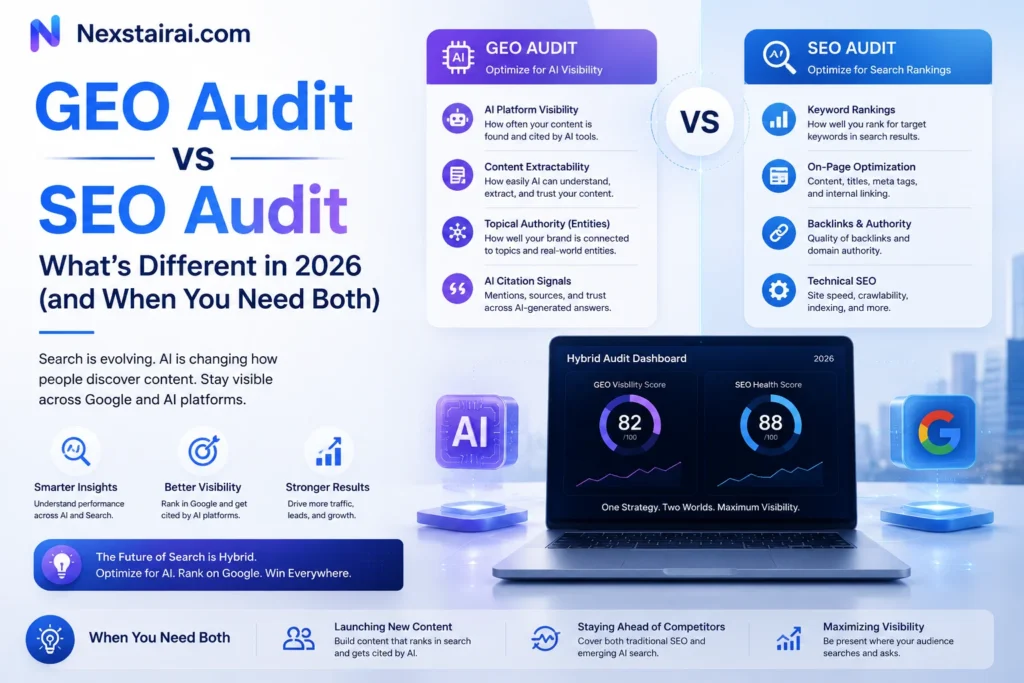
An SEO audit checks whether Google can crawl, index, and rank your site. A GEO audit checks something different: whether ChatGPT, Perplexity, Gemini, and Google AI Overviews can find your content, understand it, and cite it in the answers they generate. Both matter in 2026, but they measure different things, use different tools, and fix different problems.
If your team is still running only traditional SEO audits, you’re likely missing a growing share of how people now find businesses like yours. This guide breaks down what each audit covers, where they overlap, and when you need both running side by side.
What Is an SEO Audit?
An SEO audit is a health check for how your site performs in traditional search results, the ranked list of blue links on Google or Bing. It looks at technical crawlability, page speed, mobile usability, site structure, backlinks, and on-page elements like title tags and headers.
The goal is straightforward: find what’s stopping Google from ranking your pages, then fix it. A typical SEO audit flags broken links, slow-loading pages, duplicate content, missing meta descriptions, and thin content that isn’t competitive against what’s already ranking. Tools like Screaming Frog, Ahrefs, and Google Search Console handle most of this work, and the fixes tend to be concrete: compress an image, rewrite a title tag, consolidate two competing pages into one.
SEO audits have been the standard for over two decades because search engines rewarded a fairly stable set of signals. That’s changing.
What Is a GEO Audit?
A GEO (Generative Engine Optimization) audit checks whether AI-powered search tools can find, understand, and cite your content when they generate an answer. Instead of asking “can Google rank this page,” a GEO audit asks “does ChatGPT mention my brand when someone asks a question in my industry.”
That’s a meaningfully different problem. When someone searches Google the old way, they get a page of links and click through. When someone asks an AI assistant the same question, the AI synthesizes an answer from multiple sources and only cites the ones it trusts. If your content never gets pulled into that answer, you’re invisible to that user, even if you’d rank on page one of a traditional Google search for the same query.
A GEO audit typically covers citation frequency across major AI platforms, how clearly your content signals entities and facts an LLM can extract, whether AI crawlers can actually access your site, and how your structured data and schema markup compare to competitors who are already getting cited.
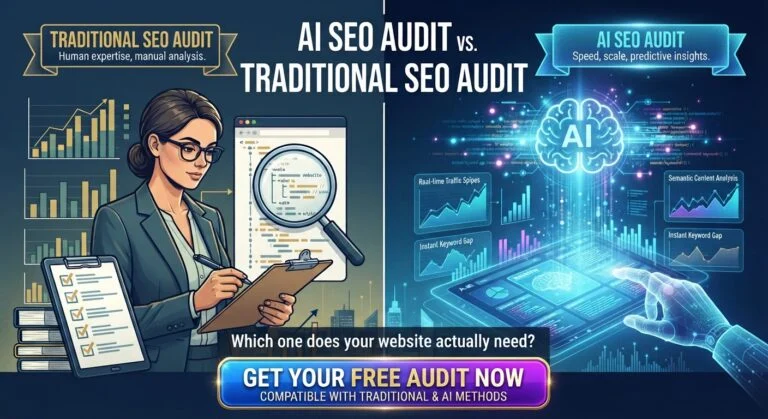
Key Differences Between SEO and GEO Audits
| SEO Audit | GEO Audit | |
| Question it answers | Can search engines crawl and rank this page? | Can AI models find and cite this page? |
| Primary metric | Keyword rankings, organic traffic | Citation share, mention frequency across AI answers |
| Platforms measured | Google, Bing | ChatGPT, Perplexity, Gemini, Claude, AI Overviews |
| Core tools | Screaming Frog, Ahrefs, Search Console | Prompt panels, citation tracking tools, AI crawler log analysis |
| Typical fixes | Speed, structure, backlinks, on-page tags | Entity clarity, extractable answers, schema, AI crawler access |
| Output | Ranked position in search results | Whether and how often you’re cited in AI-generated answers |
The two audits overlap on fundamentals. A site that’s slow, poorly structured, or blocked from crawlers struggles in both. But past that baseline, they diverge sharply, and a page that ranks well in Google can still be completely absent from AI answers if it isn’t written in a way that’s easy for an LLM to extract and cite.
What a GEO Audit Actually Checks
A proper GEO audit works through several layers rather than a single score.
It starts with AI crawler access, confirming that bots like GPTBot, PerplexityBot, and Google-Extended can actually reach your pages, since a site accidentally blocking these in robots.txt is invisible to AI search no matter how good the content is. Next comes entity clarity, checking whether your content clearly defines who you are, what you offer, and how those concepts connect, since LLMs rely on clear entity relationships to decide what to cite.
Answer extractability matters just as much. AI models tend to cite content that answers a question directly and concisely, often in the first few sentences of a section, rather than content that buries the answer under several paragraphs of preamble. Schema and structured data give models an additional, more reliable signal to pull from, separate from the surrounding prose. Finally, a solid GEO audit benchmarks citation share against competitors, running the same set of prompts across ChatGPT, Perplexity, and Gemini to see who’s actually getting mentioned for queries relevant to your business, and how often.
What an SEO Audit Actually Checks
A technical SEO audit works through a more established checklist. It confirms your site can be crawled and indexed without errors, checks Core Web Vitals and page load speed, and reviews mobile usability since most search traffic now comes from mobile devices.
Content review flags thin or duplicate pages, missing or poorly written title tags and meta descriptions, and gaps against what’s currently ranking for your target keywords. A backlink review looks at the quality and relevance of sites linking to you, since this remains one of the strongest ranking signals in traditional search. None of this work is wasted from a GEO standpoint either, since a technically sound, well-structured site is easier for AI crawlers to process too.
Do You Need Both? When to Run Each
For most businesses in 2026, the answer is yes, run both, but they don’t need to happen on the same schedule or with the same urgency.
Run an SEO audit if your organic traffic has dropped, you’ve never had a technical review done, or you’re planning a site migration or redesign. These are situations where a ranking problem has a clear, traceable cause that a standard audit will surface. Run a GEO audit if you’ve noticed AI Overviews or chatbot answers referencing competitors instead of you, if your industry involves high-consideration purchases where buyers research using AI tools, or if you simply haven’t checked your AI visibility at all yet, since most businesses fall into that last category by default.
If you’re only going to prioritize one first, base it on where your buyers actually start their research. A local service business fielding most of its traffic from Google Maps and local search still needs SEO fundamentals handled first. A B2B software company selling to buyers who increasingly ask ChatGPT for comparisons before ever touching Google should treat GEO as equally urgent, not an afterthought.
Consider two businesses side by side. A regional plumbing company gets nearly all of its leads from “near me” searches and Google Maps listings, so a technical SEO audit covering local schema, site speed, and Google Business Profile optimization delivers the fastest return. A SaaS company selling project management software to enterprise buyers, on the other hand, is increasingly competing for a mention inside ChatGPT’s answer to “best project management tools for enterprise teams,” a query where traditional rankings barely matter if the AI’s answer doesn’t include the brand at all.
How to Run a Combined Audit Without Duplicating Work
The two audits share enough groundwork that running them together, rather than as two separate projects, saves time.
Start with the technical layer both depend on: crawlability, site speed, and structured data. Fixing this once benefits both audits simultaneously. From there, split the content review. For SEO, check keyword coverage and competitive gaps against what’s ranking. For GEO, check whether the same content clearly states facts, defines entities, and answers questions directly enough for an AI model to lift and cite.
Finish with platform-specific checks. Confirm indexing status and ranking positions in Google Search Console for the SEO side. Run a set of real prompts across ChatGPT, Perplexity, and Gemini related to your business and note whether you’re mentioned, and how, for the GEO side. Doing both passes against the same page list, rather than auditing content twice from scratch, is what actually saves the time this guide’s title promises.
Signs You Need a GEO Audit Now
A few signals tend to show up before most businesses think to look for them. Your organic traffic has stayed flat or declined even though your rankings look stable, which often means clicks are being absorbed by AI Overviews instead of reaching your site. Competitors are showing up when you test your own industry questions in ChatGPT or Perplexity, and you aren’t. Your product or service involves the kind of research-heavy decision where buyers now commonly consult an AI assistant before ever visiting a company’s website directly.
Any one of these on its own is worth investigating. All three together mean a GEO audit should move up the priority list, not sit behind a full SEO overhaul.
Getting Started
You don’t need to run both audits as one massive project. Start with a technical baseline that serves both, then layer in the AI-specific citation and entity checks once that foundation is solid.
Nexstair AI’s SEO Audit Report covers the technical and content groundwork both audits share, giving you a clear starting point before deciding how deep to go on the GEO side. If you’re also exploring how AI tools fit into your broader workflow, our AI Assistant page covers how that works in practice.
Frequently Asked Questions
What’s the main difference between a GEO audit and an SEO audit?
An SEO audit checks whether traditional search engines like Google can crawl, index, and rank your pages. A GEO audit checks whether AI platforms like ChatGPT and Perplexity can find, understand, and cite your content in generated answers.
Do I need a GEO audit if my SEO is already strong?
Yes, ranking well in Google doesn’t guarantee AI models cite you. The two use different criteria, and a page that ranks on page one can still be entirely absent from AI-generated answers if it isn’t structured for extraction.
How often should I run a GEO audit?
Most businesses benefit from a GEO audit every quarter, since AI platforms update their models and crawling behavior more frequently than traditional search algorithms change. Industries with fast-moving competition may want to check monthly.
Can one audit cover both SEO and GEO?
The technical foundation, crawlability, site speed, and structured data, can be checked once and used for both. But the content and platform-specific reviews differ enough that they need separate passes even within a combined audit process.
What tools are used for a GEO audit?
Common tools include AI crawler log analysis, citation tracking platforms, and manual prompt testing across ChatGPT, Perplexity, Gemini, and Claude. Most SEO-only tools like Ahrefs or Screaming Frog don’t yet measure AI citation share directly.
Is GEO replacing SEO?
No. Traditional search still drives significant traffic for most businesses, and SEO fundamentals like crawlability and site structure directly support GEO performance too. GEO is an addition to a search strategy, not a replacement for it.
How do I know if AI Overviews are affecting my traffic?
Compare your Search Console click data against your ranking positions over the same period. If rankings hold steady but clicks decline, AI Overviews or chatbot answers absorbing the query without sending a click
 can help you build one that actually fits the way you work.** ## What Technologies Power an AI Virtual Assistant? Here's a quick, scannable summary of the main building blocks: | Technology | What It Does | |---|---| | **Natural Language Processing (NLP)** | Helps the assistant read and interpret human language | | **Natural Language Understanding (NLU)** | Identifies intent and extracts key details from a request | | **Large Language Models (LLMs)** | Generate flexible, human-like responses and handle complex questions | | **Speech Recognition (ASR)** | Converts spoken words into text | | **Text-to-Speech (TTS)** | Converts text responses into natural-sounding speech | | **Machine Learning (ML)** | Helps the system learn patterns and improve over time | | **APIs and Integrations** | Connect the assistant to business tools and data | | **Knowledge Base / Retrieval** | Gives the assistant accurate, up-to-date information to draw from | ## What Are the Different Types of AI Virtual Assistants? Not every virtual assistant works the same way. Here are the main categories. **Rule-based assistants.** These follow pre-written scripts and decision trees. They're predictable and good for simple tasks, but they struggle when customers phrase things unexpectedly. **AI-powered conversational assistants.** These use NLP and machine learning to understand free-form language. They're far more flexible and can handle a wide range of questions. **LLM-powered assistants.** The newest generation uses large language models to hold fluid, natural conversations, summarize information, and reason through multi-part requests. **Voice assistants.** These specialize in spoken interactions, whether on smart speakers, phones, or automated call systems. **Agentic assistants.** An emerging category, these assistants don't just respond; they can plan and carry out multi-step tasks on your behalf, such as researching options, filling out forms, or coordinating across several apps, all within boundaries you define. ## What Is the Difference Between an AI Virtual Assistant and a Chatbot? People often use these terms interchangeably, but there's a useful distinction. A **chatbot** is typically designed for a narrow purpose, usually answering questions or following a set script within a chat window. A **virtual assistant** is generally broader: it understands context, works across multiple channels, connects to several systems, and can complete a wider range of tasks. In practice, the line is blurring. Many modern chatbots are really AI virtual assistants under the hood. The key difference to look for is capability: can it merely respond, or can it understand, remember, and act? ## What Are the Real-World Uses of AI Virtual Assistants? Virtual assistants are showing up in nearly every industry. Here are some of the most common uses. **Customer support.** Answering FAQs, tracking orders, handling returns, and escalating tricky issues to human agents, all around the clock. **E-commerce.** Recommending products, answering sizing and shipping questions, and nudging shoppers who hesitate at checkout. **Healthcare.** Scheduling appointments, sending reminders, and answering basic administrative questions (while leaving medical decisions to professionals). **Banking and finance.** Checking balances, explaining fees, and guiding customers through routine account tasks securely. **Real estate.** Answering listing questions, qualifying leads, and booking property viewings. **Hospitality and travel.** Handling reservations, itinerary questions, and local recommendations. **Human resources.** Answering employee questions about policies, benefits, and time off, and helping with onboarding. **Sales and marketing.** Qualifying leads, capturing contact details, and booking demos for the sales team. ## What Are the Benefits of Using an AI Virtual Assistant? Businesses and individuals adopt virtual assistants for good reasons. - **24/7 availability.** Help is there whenever customers need it, across every time zone. - **Instant responses.** No more waiting in queues or for email replies. - **Cost efficiency.** Handling more conversations without proportionally growing your team. - **Consistency.** The same accurate answer every time, based on your approved information. - **Scalability.** Whether you have ten conversations a day or ten thousand, the assistant keeps up. - **Happier teams.** Employees spend less time on repetitive tasks and more on meaningful work. - **Useful insights.** Conversations reveal what customers really want to know, helping you improve your products, website, and policies. - **More sales.** Quick answers and helpful recommendations remove friction and help customers complete purchases. **Curious how much time and money a virtual assistant could save your business? [nexstairai.com](https://nexstairai.com/) can help you map out the opportunity and get started without the guesswork.** ## What Are the Limitations of AI Virtual Assistants? It's worth being realistic. Even great assistants have limits. - **They can misunderstand.** Unusual phrasing, heavy ambiguity, or very niche topics may trip them up. - **They depend on their information.** If the knowledge base is outdated or incomplete, the answers will be too. - **They can sometimes be wrong.** Language-model-based systems may occasionally produce confident but inaccurate responses, which is why guardrails and good source material matter. - **They lack true human empathy.** They can detect sentiment, but emotionally sensitive situations still benefit from a real person. - **Privacy and security need attention.** Handling personal data responsibly requires proper safeguards and compliance. The good news is that all of these can be managed with thoughtful design: clear boundaries, quality information, regular reviews, and an easy path to a human when needed. ## How Do You Choose the Right AI Virtual Assistant for Your Business? If you're thinking about adopting one, ask yourself these questions. 1. **What problem am I solving?** Support volume, lead capture, scheduling, internal help, or something else? 2. **Which channels do my customers use?** Website, WhatsApp, Instagram, email, phone? 3. **What systems does it need to connect to?** Your CRM, calendar, store, or helpdesk? 4. **How customizable is it?** Can you control tone, workflows, and escalation rules? 5. **How does it handle human handoff?** The transition should be smooth, with full context passed along. 6. **What does security look like?** Look for data protection and compliance with regulations relevant to your customers. 7. **Can I see performance data?** Good analytics help you measure and improve. 8. **What support will I get?** Setup and ongoing optimization make a big difference to results. ## How Do You Get Started With an AI Virtual Assistant? You don't need a massive project to begin. A simple path looks like this: 1. **Identify your top 5 to 10 most common customer questions or tasks.** 2. **Gather accurate, up-to-date information** such as FAQs, policies, and product details. 3. **Choose a platform or partner** that fits your needs and integrates with your tools. 4. **Set up and test** with real-world questions before launching. 5. **Launch on one channel first**, then expand as you gain confidence. 6. **Review conversations regularly**, improving responses and adding new capabilities over time. Starting small and growing steadily is almost always better than trying to automate everything at once. ## What Does the Future Hold for AI Virtual Assistants? The technology is moving quickly. A few trends worth watching: - **More proactive help.** Assistants that reach out with useful information before you ask, such as shipping delays or appointment reminders. - **Greater autonomy.** Agentic assistants that complete multi-step tasks within rules you set. - **Richer personalization.** Better memory of preferences and history, creating more natural, tailored experiences. - **Multimodal interaction.** Assistants that understand text, voice, images, and documents all in one conversation. - **Smoother voice experiences.** Phone and voice interactions that feel increasingly human and natural. - **Stronger safeguards.** Better accuracy controls, privacy protections, and transparency about when you're talking to AI. The businesses that start learning and experimenting now will be best positioned to benefit as these capabilities mature. ## Final Thoughts: Is an AI Virtual Assistant Worth It? An AI virtual assistant is, at its heart, a digital teammate. It listens to what people ask, understands what they mean, finds or does what's needed, and responds in a way that feels natural, all in a matter of seconds and at any hour of the day. Under the hood, it's a clever combination of speech recognition, language understanding, decision-making, integrations, and language generation. But from the customer's point of view, it's simple: they ask, and they get helped. For businesses, the payoff is faster service, lower costs, happier teams, and more room to grow. The key is to start with a clear goal, give your assistant good information, keep humans available for the moments that matter, and keep improving based on real conversations. **Ready to bring an AI virtual assistant into your business? Visit [nexstairai.com](https://nexstairai.com/) to explore how a custom-built assistant can help you serve customers better, save time, and grow with confidence.** --- Want me to write a follow-up next? Good options might be "AI Virtual Assistant vs. Chatbot: What's the Difference?" or "How to Train an AI Virtual Assistant on Your Business Data.](https://nexstairai.com/wp-content/uploads/2026/10/🚀-Supercharge-Your-Business-Growth-with-Nexstair-–-AI-Digital-Marketing-Agency-300x164.jpg.webp)


 can help you build one that actually fits the way you work.** ## What Technologies Power an AI Virtual Assistant? Here's a quick, scannable summary of the main building blocks: | Technology | What It Does | |---|---| | **Natural Language Processing (NLP)** | Helps the assistant read and interpret human language | | **Natural Language Understanding (NLU)** | Identifies intent and extracts key details from a request | | **Large Language Models (LLMs)** | Generate flexible, human-like responses and handle complex questions | | **Speech Recognition (ASR)** | Converts spoken words into text | | **Text-to-Speech (TTS)** | Converts text responses into natural-sounding speech | | **Machine Learning (ML)** | Helps the system learn patterns and improve over time | | **APIs and Integrations** | Connect the assistant to business tools and data | | **Knowledge Base / Retrieval** | Gives the assistant accurate, up-to-date information to draw from | ## What Are the Different Types of AI Virtual Assistants? Not every virtual assistant works the same way. Here are the main categories. **Rule-based assistants.** These follow pre-written scripts and decision trees. They're predictable and good for simple tasks, but they struggle when customers phrase things unexpectedly. **AI-powered conversational assistants.** These use NLP and machine learning to understand free-form language. They're far more flexible and can handle a wide range of questions. **LLM-powered assistants.** The newest generation uses large language models to hold fluid, natural conversations, summarize information, and reason through multi-part requests. **Voice assistants.** These specialize in spoken interactions, whether on smart speakers, phones, or automated call systems. **Agentic assistants.** An emerging category, these assistants don't just respond; they can plan and carry out multi-step tasks on your behalf, such as researching options, filling out forms, or coordinating across several apps, all within boundaries you define. ## What Is the Difference Between an AI Virtual Assistant and a Chatbot? People often use these terms interchangeably, but there's a useful distinction. A **chatbot** is typically designed for a narrow purpose, usually answering questions or following a set script within a chat window. A **virtual assistant** is generally broader: it understands context, works across multiple channels, connects to several systems, and can complete a wider range of tasks. In practice, the line is blurring. Many modern chatbots are really AI virtual assistants under the hood. The key difference to look for is capability: can it merely respond, or can it understand, remember, and act? ## What Are the Real-World Uses of AI Virtual Assistants? Virtual assistants are showing up in nearly every industry. Here are some of the most common uses. **Customer support.** Answering FAQs, tracking orders, handling returns, and escalating tricky issues to human agents, all around the clock. **E-commerce.** Recommending products, answering sizing and shipping questions, and nudging shoppers who hesitate at checkout. **Healthcare.** Scheduling appointments, sending reminders, and answering basic administrative questions (while leaving medical decisions to professionals). **Banking and finance.** Checking balances, explaining fees, and guiding customers through routine account tasks securely. **Real estate.** Answering listing questions, qualifying leads, and booking property viewings. **Hospitality and travel.** Handling reservations, itinerary questions, and local recommendations. **Human resources.** Answering employee questions about policies, benefits, and time off, and helping with onboarding. **Sales and marketing.** Qualifying leads, capturing contact details, and booking demos for the sales team. ## What Are the Benefits of Using an AI Virtual Assistant? Businesses and individuals adopt virtual assistants for good reasons. - **24/7 availability.** Help is there whenever customers need it, across every time zone. - **Instant responses.** No more waiting in queues or for email replies. - **Cost efficiency.** Handling more conversations without proportionally growing your team. - **Consistency.** The same accurate answer every time, based on your approved information. - **Scalability.** Whether you have ten conversations a day or ten thousand, the assistant keeps up. - **Happier teams.** Employees spend less time on repetitive tasks and more on meaningful work. - **Useful insights.** Conversations reveal what customers really want to know, helping you improve your products, website, and policies. - **More sales.** Quick answers and helpful recommendations remove friction and help customers complete purchases. **Curious how much time and money a virtual assistant could save your business? [nexstairai.com](https://nexstairai.com/) can help you map out the opportunity and get started without the guesswork.** ## What Are the Limitations of AI Virtual Assistants? It's worth being realistic. Even great assistants have limits. - **They can misunderstand.** Unusual phrasing, heavy ambiguity, or very niche topics may trip them up. - **They depend on their information.** If the knowledge base is outdated or incomplete, the answers will be too. - **They can sometimes be wrong.** Language-model-based systems may occasionally produce confident but inaccurate responses, which is why guardrails and good source material matter. - **They lack true human empathy.** They can detect sentiment, but emotionally sensitive situations still benefit from a real person. - **Privacy and security need attention.** Handling personal data responsibly requires proper safeguards and compliance. The good news is that all of these can be managed with thoughtful design: clear boundaries, quality information, regular reviews, and an easy path to a human when needed. ## How Do You Choose the Right AI Virtual Assistant for Your Business? If you're thinking about adopting one, ask yourself these questions. 1. **What problem am I solving?** Support volume, lead capture, scheduling, internal help, or something else? 2. **Which channels do my customers use?** Website, WhatsApp, Instagram, email, phone? 3. **What systems does it need to connect to?** Your CRM, calendar, store, or helpdesk? 4. **How customizable is it?** Can you control tone, workflows, and escalation rules? 5. **How does it handle human handoff?** The transition should be smooth, with full context passed along. 6. **What does security look like?** Look for data protection and compliance with regulations relevant to your customers. 7. **Can I see performance data?** Good analytics help you measure and improve. 8. **What support will I get?** Setup and ongoing optimization make a big difference to results. ## How Do You Get Started With an AI Virtual Assistant? You don't need a massive project to begin. A simple path looks like this: 1. **Identify your top 5 to 10 most common customer questions or tasks.** 2. **Gather accurate, up-to-date information** such as FAQs, policies, and product details. 3. **Choose a platform or partner** that fits your needs and integrates with your tools. 4. **Set up and test** with real-world questions before launching. 5. **Launch on one channel first**, then expand as you gain confidence. 6. **Review conversations regularly**, improving responses and adding new capabilities over time. Starting small and growing steadily is almost always better than trying to automate everything at once. ## What Does the Future Hold for AI Virtual Assistants? The technology is moving quickly. A few trends worth watching: - **More proactive help.** Assistants that reach out with useful information before you ask, such as shipping delays or appointment reminders. - **Greater autonomy.** Agentic assistants that complete multi-step tasks within rules you set. - **Richer personalization.** Better memory of preferences and history, creating more natural, tailored experiences. - **Multimodal interaction.** Assistants that understand text, voice, images, and documents all in one conversation. - **Smoother voice experiences.** Phone and voice interactions that feel increasingly human and natural. - **Stronger safeguards.** Better accuracy controls, privacy protections, and transparency about when you're talking to AI. The businesses that start learning and experimenting now will be best positioned to benefit as these capabilities mature. ## Final Thoughts: Is an AI Virtual Assistant Worth It? An AI virtual assistant is, at its heart, a digital teammate. It listens to what people ask, understands what they mean, finds or does what's needed, and responds in a way that feels natural, all in a matter of seconds and at any hour of the day. Under the hood, it's a clever combination of speech recognition, language understanding, decision-making, integrations, and language generation. But from the customer's point of view, it's simple: they ask, and they get helped. For businesses, the payoff is faster service, lower costs, happier teams, and more room to grow. The key is to start with a clear goal, give your assistant good information, keep humans available for the moments that matter, and keep improving based on real conversations. **Ready to bring an AI virtual assistant into your business? Visit [nexstairai.com](https://nexstairai.com/) to explore how a custom-built assistant can help you serve customers better, save time, and grow with confidence.** --- Want me to write a follow-up next? Good options might be "AI Virtual Assistant vs. Chatbot: What's the Difference?" or "How to Train an AI Virtual Assistant on Your Business Data.](https://nexstairai.com/wp-content/uploads/2026/10/🚀-Supercharge-Your-Business-Growth-with-Nexstair-–-AI-Digital-Marketing-Agency-768x419.jpg.webp)