
Wondering What Features Should a Business AI Chatbot Have? Discover the essential capabilities—from NLU to CRM integration—that separate a frustrating bot from a revenue-driving tool. Not all AI chatbots are built the same, and that difference shows up fast the moment real customers start using one. Some feel like talking to a genuinely helpful team member. Others feel like arguing with an automated phone menu that keeps misunderstanding you. If you’re evaluating chatbot options for your business, knowing exactly which features separate the two is the difference between a tool that pays for itself and one that quietly gets ignored by your customers.
This guide breaks down the essential features a business AI chatbot needs — and why each one matters more than it might seem at first glance.
Why Does Feature Selection Matter So Much for a Business Chatbot?
A chatbot is often the first interaction a customer has with your brand outside of your website copy. If it’s clunky, repetitive, or clearly scripted, it can actually damage trust rather than build it. On the other hand, a well-equipped chatbot can handle a huge share of customer interactions competently, freeing your human team for the complex, high-value conversations that actually need a person.
The right feature set depends somewhat on your business type, but there’s a core list that matters for nearly every business, plus some advanced capabilities worth considering as you scale.
Does It Need Natural Language Understanding (NLU)?
Yes — this is non-negotiable. Natural language understanding is what allows a chatbot to interpret what a customer actually means, not just match exact keywords.
Without solid NLU, a chatbot chokes on typos, slang, regional phrasing, or questions asked in a roundabout way. A customer typing “do u guys ship 2 canada” should get a real answer, not a “I didn’t understand that” dead end. Good NLU also picks up on intent even when the wording is unusual — recognizing that “is this gonna run big?” and “what’s the sizing like?” are asking the same thing.
This single feature is often the biggest gap between a genuinely useful chatbot and a frustrating one.
Can It Maintain Context Across a Conversation?
A business chatbot needs conversational memory — the ability to remember what was said two messages ago without the customer having to repeat themselves.
For example, if a customer says “I’m looking for a gift for my sister, she likes minimalist jewelry,” and then a few messages later asks “what’s the return policy on that?”, the bot should know “that” refers to the jewelry recommendation it just made — not ask “what product are you referring to?”
Without context retention, conversations feel robotic and customers give up quickly. With it, the interaction starts to feel like an actual conversation.
Should It Integrate Directly With Your Business Systems?
Absolutely — this is where a chatbot goes from “answers generic questions” to “actually useful for my specific business.” Real integration means the chatbot can pull live data from:
- Your inventory or product catalog, so it never recommends something that’s out of stock
- Order management systems, so it can answer “where’s my order?” with an actual real-time answer
- CRM or customer data, so returning customers get personalized responses rather than being treated like strangers every time
- Calendar or booking systems, if your business takes appointments
A chatbot that’s disconnected from these systems can only ever give generic, static answers — which limits its usefulness considerably.
This kind of deep, real-data integration is exactly what nexstairai.com focuses on when building chatbots for businesses — connecting the conversation to your actual systems, not just a script.
Does It Need Multi-Channel Availability?
Customers reach out from wherever they already are — your website, Instagram DMs, WhatsApp, email, or SMS. A strong business chatbot should be able to operate across these channels with a consistent experience, ideally sharing conversation history so a customer doesn’t have to re-explain themselves if they switch channels mid-conversation.
This matters more each year, as customer communication continues to fragment across platforms rather than consolidate into one.
Should It Be Able to Recommend Products or Services Proactively?
For any business with a catalog — physical products, services, or subscriptions — proactive recommendation capability turns the chatbot from a support tool into a genuine sales assistant.
This means the bot can:
- Suggest complementary products based on what’s already in a cart
- Recommend alternatives when something’s out of stock
- Ask a clarifying question or two to narrow down the right option, similar to how a good salesperson would
The key word here is proactive — a chatbot that only responds when asked is missing a major opportunity to guide the sale.
How Important Is a Smooth Human Handoff Feature?
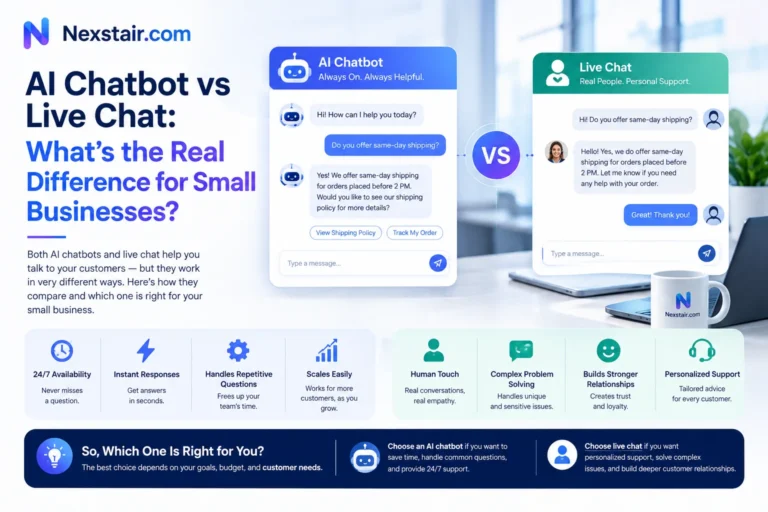
Very important, and often overlooked. No AI chatbot, no matter how advanced, should handle 100% of conversations. Complex complaints, sensitive situations, or genuinely novel questions need a real person — and the handoff needs to be seamless.
A good handoff feature:
- Recognizes when it’s out of its depth rather than guessing or looping
- Passes full conversation context to the human agent, so the customer never has to repeat themselves
- Sets a clear expectation with the customer about response time
Chatbots that trap frustrated customers in an endless loop with no escape route do real damage to trust — this feature protects against that.
Does It Need Analytics and Conversation Insights?
Yes, and this is a feature many businesses underestimate. Every conversation your chatbot has is a small piece of market research — the actual questions, objections, and confusions your customers have, in their own words.
Useful analytics should show you:
- The most frequently asked questions (which often reveal gaps in your website or product pages)
- Where conversations stall or customers disengage
- Conversion rates from chat interactions
- Common complaints or objections that come up repeatedly
Without this visibility, you’re flying blind on one of your richest sources of customer insight.
Should It Support Multiple Languages?
If you serve customers beyond a single language market, this is essential rather than optional. A chatbot that can detect and respond fluently in a customer’s preferred language removes a significant barrier to purchase — and signals that your business takes international or multilingual customers seriously.
Does It Need Personalization Based on Customer History?
A returning customer asking a question should get a different experience than a first-time visitor. Personalization features might include:
- Referencing a customer’s past orders (“since you loved the espresso blend last time…”)
- Adjusting tone or offers based on customer loyalty tier
- Recognizing VIP or high-value customers and prioritizing their requests
This level of personalization is what makes a chatbot feel less like automation and more like genuine customer care — even though it’s happening at scale.
What About Security and Data Privacy Features?
Any chatbot handling order details, payment status, or personal customer information needs to meet real security standards — encrypted data handling, compliance with relevant regulations (like GDPR for European customers), and clear boundaries around what information it will and won’t share in a conversation. This isn’t a nice-to-have; it’s a baseline requirement for any business chatbot handling customer data.
Should It Be Able to Complete Transactions, Not Just Answer Questions?
The most advanced business chatbots go a step further than information and recommendations — they can actually process a purchase, apply a discount code, or complete a booking directly within the chat window. This removes the final bit of friction between “I want this” and “I bought this,” which can meaningfully boost conversion for businesses that implement it well.
Building a chatbot with this level of capability — one that genuinely closes the loop from conversation to conversion — is a specialty of nexstairai.com, and it’s often the feature that separates a chatbot that pays for itself from one that just sits there.
How Do You Prioritize These Features for Your Business?
Not every business needs every feature from day one. A reasonable prioritization order looks like:
- Start with solid NLU and context retention — the foundation everything else builds on.
- Add system integration for inventory, orders, or bookings relevant to your business.
- Build in human handoff before launch, not after a bad experience forces the issue.
- Layer in analytics early so you’re learning from real conversations from day one.
- Expand into personalization, multi-channel support, and transaction completion as your chatbot proves its value and your team gets comfortable managing it.
Final Thoughts: What Features Should a Business AI Chatbot Have?
A good chatbot answers questions accurately. A great one understands context, integrates with your real business data, knows when to hand off to a human, and actively contributes to sales rather than just deflecting support tickets. The feature list matters less than how well those features work together to create a conversation that actually feels helpful.
As you evaluate options, resist the urge to just pick the tool with the longest feature list — instead, map features back to your actual customer pain points and business goals.
If you’re trying to figure out which features actually matter for your specific business, nexstairai.com can help you build a chatbot strategy around what your customers really need — not a generic template.
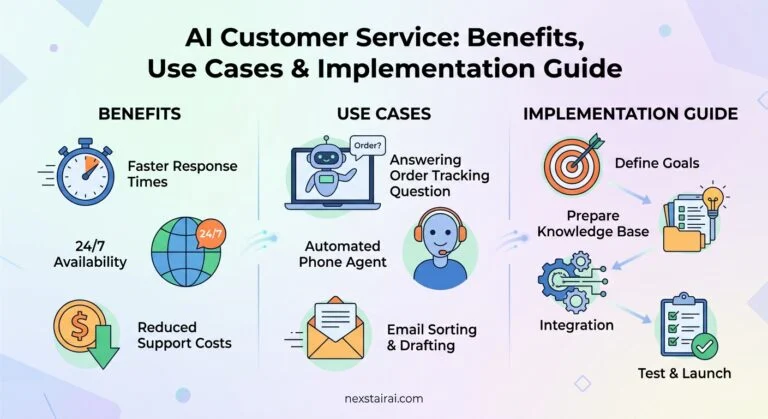
 can help you build one that actually fits the way you work.** ## What Technologies Power an AI Virtual Assistant? Here's a quick, scannable summary of the main building blocks: | Technology | What It Does | |---|---| | **Natural Language Processing (NLP)** | Helps the assistant read and interpret human language | | **Natural Language Understanding (NLU)** | Identifies intent and extracts key details from a request | | **Large Language Models (LLMs)** | Generate flexible, human-like responses and handle complex questions | | **Speech Recognition (ASR)** | Converts spoken words into text | | **Text-to-Speech (TTS)** | Converts text responses into natural-sounding speech | | **Machine Learning (ML)** | Helps the system learn patterns and improve over time | | **APIs and Integrations** | Connect the assistant to business tools and data | | **Knowledge Base / Retrieval** | Gives the assistant accurate, up-to-date information to draw from | ## What Are the Different Types of AI Virtual Assistants? Not every virtual assistant works the same way. Here are the main categories. **Rule-based assistants.** These follow pre-written scripts and decision trees. They're predictable and good for simple tasks, but they struggle when customers phrase things unexpectedly. **AI-powered conversational assistants.** These use NLP and machine learning to understand free-form language. They're far more flexible and can handle a wide range of questions. **LLM-powered assistants.** The newest generation uses large language models to hold fluid, natural conversations, summarize information, and reason through multi-part requests. **Voice assistants.** These specialize in spoken interactions, whether on smart speakers, phones, or automated call systems. **Agentic assistants.** An emerging category, these assistants don't just respond; they can plan and carry out multi-step tasks on your behalf, such as researching options, filling out forms, or coordinating across several apps, all within boundaries you define. ## What Is the Difference Between an AI Virtual Assistant and a Chatbot? People often use these terms interchangeably, but there's a useful distinction. A **chatbot** is typically designed for a narrow purpose, usually answering questions or following a set script within a chat window. A **virtual assistant** is generally broader: it understands context, works across multiple channels, connects to several systems, and can complete a wider range of tasks. In practice, the line is blurring. Many modern chatbots are really AI virtual assistants under the hood. The key difference to look for is capability: can it merely respond, or can it understand, remember, and act? ## What Are the Real-World Uses of AI Virtual Assistants? Virtual assistants are showing up in nearly every industry. Here are some of the most common uses. **Customer support.** Answering FAQs, tracking orders, handling returns, and escalating tricky issues to human agents, all around the clock. **E-commerce.** Recommending products, answering sizing and shipping questions, and nudging shoppers who hesitate at checkout. **Healthcare.** Scheduling appointments, sending reminders, and answering basic administrative questions (while leaving medical decisions to professionals). **Banking and finance.** Checking balances, explaining fees, and guiding customers through routine account tasks securely. **Real estate.** Answering listing questions, qualifying leads, and booking property viewings. **Hospitality and travel.** Handling reservations, itinerary questions, and local recommendations. **Human resources.** Answering employee questions about policies, benefits, and time off, and helping with onboarding. **Sales and marketing.** Qualifying leads, capturing contact details, and booking demos for the sales team. ## What Are the Benefits of Using an AI Virtual Assistant? Businesses and individuals adopt virtual assistants for good reasons. - **24/7 availability.** Help is there whenever customers need it, across every time zone. - **Instant responses.** No more waiting in queues or for email replies. - **Cost efficiency.** Handling more conversations without proportionally growing your team. - **Consistency.** The same accurate answer every time, based on your approved information. - **Scalability.** Whether you have ten conversations a day or ten thousand, the assistant keeps up. - **Happier teams.** Employees spend less time on repetitive tasks and more on meaningful work. - **Useful insights.** Conversations reveal what customers really want to know, helping you improve your products, website, and policies. - **More sales.** Quick answers and helpful recommendations remove friction and help customers complete purchases. **Curious how much time and money a virtual assistant could save your business? [nexstairai.com](https://nexstairai.com/) can help you map out the opportunity and get started without the guesswork.** ## What Are the Limitations of AI Virtual Assistants? It's worth being realistic. Even great assistants have limits. - **They can misunderstand.** Unusual phrasing, heavy ambiguity, or very niche topics may trip them up. - **They depend on their information.** If the knowledge base is outdated or incomplete, the answers will be too. - **They can sometimes be wrong.** Language-model-based systems may occasionally produce confident but inaccurate responses, which is why guardrails and good source material matter. - **They lack true human empathy.** They can detect sentiment, but emotionally sensitive situations still benefit from a real person. - **Privacy and security need attention.** Handling personal data responsibly requires proper safeguards and compliance. The good news is that all of these can be managed with thoughtful design: clear boundaries, quality information, regular reviews, and an easy path to a human when needed. ## How Do You Choose the Right AI Virtual Assistant for Your Business? If you're thinking about adopting one, ask yourself these questions. 1. **What problem am I solving?** Support volume, lead capture, scheduling, internal help, or something else? 2. **Which channels do my customers use?** Website, WhatsApp, Instagram, email, phone? 3. **What systems does it need to connect to?** Your CRM, calendar, store, or helpdesk? 4. **How customizable is it?** Can you control tone, workflows, and escalation rules? 5. **How does it handle human handoff?** The transition should be smooth, with full context passed along. 6. **What does security look like?** Look for data protection and compliance with regulations relevant to your customers. 7. **Can I see performance data?** Good analytics help you measure and improve. 8. **What support will I get?** Setup and ongoing optimization make a big difference to results. ## How Do You Get Started With an AI Virtual Assistant? You don't need a massive project to begin. A simple path looks like this: 1. **Identify your top 5 to 10 most common customer questions or tasks.** 2. **Gather accurate, up-to-date information** such as FAQs, policies, and product details. 3. **Choose a platform or partner** that fits your needs and integrates with your tools. 4. **Set up and test** with real-world questions before launching. 5. **Launch on one channel first**, then expand as you gain confidence. 6. **Review conversations regularly**, improving responses and adding new capabilities over time. Starting small and growing steadily is almost always better than trying to automate everything at once. ## What Does the Future Hold for AI Virtual Assistants? The technology is moving quickly. A few trends worth watching: - **More proactive help.** Assistants that reach out with useful information before you ask, such as shipping delays or appointment reminders. - **Greater autonomy.** Agentic assistants that complete multi-step tasks within rules you set. - **Richer personalization.** Better memory of preferences and history, creating more natural, tailored experiences. - **Multimodal interaction.** Assistants that understand text, voice, images, and documents all in one conversation. - **Smoother voice experiences.** Phone and voice interactions that feel increasingly human and natural. - **Stronger safeguards.** Better accuracy controls, privacy protections, and transparency about when you're talking to AI. The businesses that start learning and experimenting now will be best positioned to benefit as these capabilities mature. ## Final Thoughts: Is an AI Virtual Assistant Worth It? An AI virtual assistant is, at its heart, a digital teammate. It listens to what people ask, understands what they mean, finds or does what's needed, and responds in a way that feels natural, all in a matter of seconds and at any hour of the day. Under the hood, it's a clever combination of speech recognition, language understanding, decision-making, integrations, and language generation. But from the customer's point of view, it's simple: they ask, and they get helped. For businesses, the payoff is faster service, lower costs, happier teams, and more room to grow. The key is to start with a clear goal, give your assistant good information, keep humans available for the moments that matter, and keep improving based on real conversations. **Ready to bring an AI virtual assistant into your business? Visit [nexstairai.com](https://nexstairai.com/) to explore how a custom-built assistant can help you serve customers better, save time, and grow with confidence.** --- Want me to write a follow-up next? Good options might be "AI Virtual Assistant vs. Chatbot: What's the Difference?" or "How to Train an AI Virtual Assistant on Your Business Data.](https://nexstairai.com/wp-content/uploads/2026/10/🚀-Supercharge-Your-Business-Growth-with-Nexstair-–-AI-Digital-Marketing-Agency-300x164.jpg.webp)


 can help you build one that actually fits the way you work.** ## What Technologies Power an AI Virtual Assistant? Here's a quick, scannable summary of the main building blocks: | Technology | What It Does | |---|---| | **Natural Language Processing (NLP)** | Helps the assistant read and interpret human language | | **Natural Language Understanding (NLU)** | Identifies intent and extracts key details from a request | | **Large Language Models (LLMs)** | Generate flexible, human-like responses and handle complex questions | | **Speech Recognition (ASR)** | Converts spoken words into text | | **Text-to-Speech (TTS)** | Converts text responses into natural-sounding speech | | **Machine Learning (ML)** | Helps the system learn patterns and improve over time | | **APIs and Integrations** | Connect the assistant to business tools and data | | **Knowledge Base / Retrieval** | Gives the assistant accurate, up-to-date information to draw from | ## What Are the Different Types of AI Virtual Assistants? Not every virtual assistant works the same way. Here are the main categories. **Rule-based assistants.** These follow pre-written scripts and decision trees. They're predictable and good for simple tasks, but they struggle when customers phrase things unexpectedly. **AI-powered conversational assistants.** These use NLP and machine learning to understand free-form language. They're far more flexible and can handle a wide range of questions. **LLM-powered assistants.** The newest generation uses large language models to hold fluid, natural conversations, summarize information, and reason through multi-part requests. **Voice assistants.** These specialize in spoken interactions, whether on smart speakers, phones, or automated call systems. **Agentic assistants.** An emerging category, these assistants don't just respond; they can plan and carry out multi-step tasks on your behalf, such as researching options, filling out forms, or coordinating across several apps, all within boundaries you define. ## What Is the Difference Between an AI Virtual Assistant and a Chatbot? People often use these terms interchangeably, but there's a useful distinction. A **chatbot** is typically designed for a narrow purpose, usually answering questions or following a set script within a chat window. A **virtual assistant** is generally broader: it understands context, works across multiple channels, connects to several systems, and can complete a wider range of tasks. In practice, the line is blurring. Many modern chatbots are really AI virtual assistants under the hood. The key difference to look for is capability: can it merely respond, or can it understand, remember, and act? ## What Are the Real-World Uses of AI Virtual Assistants? Virtual assistants are showing up in nearly every industry. Here are some of the most common uses. **Customer support.** Answering FAQs, tracking orders, handling returns, and escalating tricky issues to human agents, all around the clock. **E-commerce.** Recommending products, answering sizing and shipping questions, and nudging shoppers who hesitate at checkout. **Healthcare.** Scheduling appointments, sending reminders, and answering basic administrative questions (while leaving medical decisions to professionals). **Banking and finance.** Checking balances, explaining fees, and guiding customers through routine account tasks securely. **Real estate.** Answering listing questions, qualifying leads, and booking property viewings. **Hospitality and travel.** Handling reservations, itinerary questions, and local recommendations. **Human resources.** Answering employee questions about policies, benefits, and time off, and helping with onboarding. **Sales and marketing.** Qualifying leads, capturing contact details, and booking demos for the sales team. ## What Are the Benefits of Using an AI Virtual Assistant? Businesses and individuals adopt virtual assistants for good reasons. - **24/7 availability.** Help is there whenever customers need it, across every time zone. - **Instant responses.** No more waiting in queues or for email replies. - **Cost efficiency.** Handling more conversations without proportionally growing your team. - **Consistency.** The same accurate answer every time, based on your approved information. - **Scalability.** Whether you have ten conversations a day or ten thousand, the assistant keeps up. - **Happier teams.** Employees spend less time on repetitive tasks and more on meaningful work. - **Useful insights.** Conversations reveal what customers really want to know, helping you improve your products, website, and policies. - **More sales.** Quick answers and helpful recommendations remove friction and help customers complete purchases. **Curious how much time and money a virtual assistant could save your business? [nexstairai.com](https://nexstairai.com/) can help you map out the opportunity and get started without the guesswork.** ## What Are the Limitations of AI Virtual Assistants? It's worth being realistic. Even great assistants have limits. - **They can misunderstand.** Unusual phrasing, heavy ambiguity, or very niche topics may trip them up. - **They depend on their information.** If the knowledge base is outdated or incomplete, the answers will be too. - **They can sometimes be wrong.** Language-model-based systems may occasionally produce confident but inaccurate responses, which is why guardrails and good source material matter. - **They lack true human empathy.** They can detect sentiment, but emotionally sensitive situations still benefit from a real person. - **Privacy and security need attention.** Handling personal data responsibly requires proper safeguards and compliance. The good news is that all of these can be managed with thoughtful design: clear boundaries, quality information, regular reviews, and an easy path to a human when needed. ## How Do You Choose the Right AI Virtual Assistant for Your Business? If you're thinking about adopting one, ask yourself these questions. 1. **What problem am I solving?** Support volume, lead capture, scheduling, internal help, or something else? 2. **Which channels do my customers use?** Website, WhatsApp, Instagram, email, phone? 3. **What systems does it need to connect to?** Your CRM, calendar, store, or helpdesk? 4. **How customizable is it?** Can you control tone, workflows, and escalation rules? 5. **How does it handle human handoff?** The transition should be smooth, with full context passed along. 6. **What does security look like?** Look for data protection and compliance with regulations relevant to your customers. 7. **Can I see performance data?** Good analytics help you measure and improve. 8. **What support will I get?** Setup and ongoing optimization make a big difference to results. ## How Do You Get Started With an AI Virtual Assistant? You don't need a massive project to begin. A simple path looks like this: 1. **Identify your top 5 to 10 most common customer questions or tasks.** 2. **Gather accurate, up-to-date information** such as FAQs, policies, and product details. 3. **Choose a platform or partner** that fits your needs and integrates with your tools. 4. **Set up and test** with real-world questions before launching. 5. **Launch on one channel first**, then expand as you gain confidence. 6. **Review conversations regularly**, improving responses and adding new capabilities over time. Starting small and growing steadily is almost always better than trying to automate everything at once. ## What Does the Future Hold for AI Virtual Assistants? The technology is moving quickly. A few trends worth watching: - **More proactive help.** Assistants that reach out with useful information before you ask, such as shipping delays or appointment reminders. - **Greater autonomy.** Agentic assistants that complete multi-step tasks within rules you set. - **Richer personalization.** Better memory of preferences and history, creating more natural, tailored experiences. - **Multimodal interaction.** Assistants that understand text, voice, images, and documents all in one conversation. - **Smoother voice experiences.** Phone and voice interactions that feel increasingly human and natural. - **Stronger safeguards.** Better accuracy controls, privacy protections, and transparency about when you're talking to AI. The businesses that start learning and experimenting now will be best positioned to benefit as these capabilities mature. ## Final Thoughts: Is an AI Virtual Assistant Worth It? An AI virtual assistant is, at its heart, a digital teammate. It listens to what people ask, understands what they mean, finds or does what's needed, and responds in a way that feels natural, all in a matter of seconds and at any hour of the day. Under the hood, it's a clever combination of speech recognition, language understanding, decision-making, integrations, and language generation. But from the customer's point of view, it's simple: they ask, and they get helped. For businesses, the payoff is faster service, lower costs, happier teams, and more room to grow. The key is to start with a clear goal, give your assistant good information, keep humans available for the moments that matter, and keep improving based on real conversations. **Ready to bring an AI virtual assistant into your business? Visit [nexstairai.com](https://nexstairai.com/) to explore how a custom-built assistant can help you serve customers better, save time, and grow with confidence.** --- Want me to write a follow-up next? Good options might be "AI Virtual Assistant vs. Chatbot: What's the Difference?" or "How to Train an AI Virtual Assistant on Your Business Data.](https://nexstairai.com/wp-content/uploads/2026/10/🚀-Supercharge-Your-Business-Growth-with-Nexstair-–-AI-Digital-Marketing-Agency-768x419.jpg.webp)