Discover How AI Chatbots Increase Customer Conversion Rates by 20–35%. Learn proven strategies to automate lead gen and boost 24/7 sales.
An AI chatbot increases customer conversion rates by removing friction at the exact moment a visitor is deciding whether to buy, book, or sign up. Instead of a visitor leaving your site to search for an answer, wait for an email reply, or abandon a form halfway through, an AI chatbot answers instantly, qualifies the visitor’s intent, and guides them toward a purchase or booking in real time.
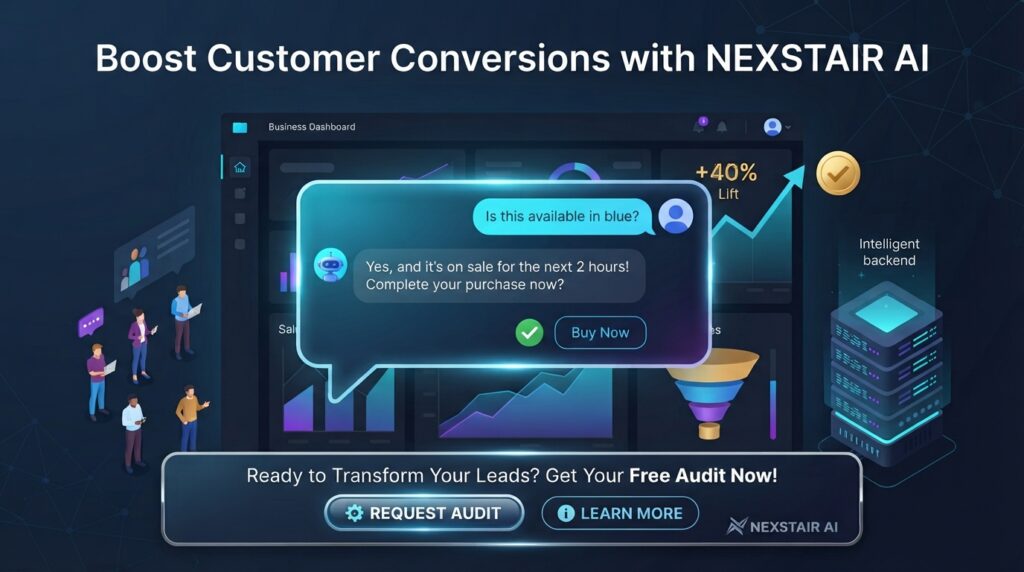
Industry data from 2026 consistently shows that businesses deploying AI chatbots see conversion improvements in the range of 20–35%, with proactive chat triggers (a chatbot that initiates a conversation rather than waiting to be clicked) producing lifts of up to 40% in some deployments. In e-commerce specifically, sites offering round-the-clock chatbot support report a 20–30% increase in sales, largely because customers who have a question outside business hours no longer wait — they buy from whoever answers first.
This isn’t a marginal optimization tactic. It’s a structural shift in how conversion happens: from “convince the visitor to come back later” to “resolve their hesitation right now.”
Why Do AI Chatbots Convert Better Than Static Websites?
A static website presents the same content to every visitor regardless of what they’re actually looking for. An AI chatbot, by contrast, adapts to each visitor’s specific question in real time — which matters because most lost sales aren’t caused by a bad product or price, they’re caused by unanswered questions.
Three structural advantages explain the conversion gap:
- Speed. A chatbot responds in seconds, before a high-intent visitor has the chance to get impatient and leave. Every additional minute of waiting increases the odds a visitor closes the tab and goes to a competitor instead.
- Availability. Chatbots operate 24/7, capturing leads and answering questions during nights, weekends, and holidays — the exact windows when human support teams are offline but customers are still browsing and buying.
- Personalized qualification. Rather than showing every visitor the same generic call-to-action, a chatbot asks clarifying questions and routes each visitor toward the specific product, service tier, or next step that matches their actual need.
Customer preference data backs this up: roughly 82% of customers now say they’d rather interact with a chatbot than wait in a queue for a human representative for routine questions — a meaningful jump from just a few years ago. That preference shift alone means a business without a chatbot is actively working against how modern customers want to be served.
How Do AI Chatbots Reduce Cart and Form Abandonment?
Cart abandonment and form abandonment happen for a small, predictable set of reasons: unclear pricing, unanswered shipping or return questions, uncertainty about product fit, or a form that feels too long. An AI chatbot intercepts each of these moments before the visitor gives up.
- On product and pricing pages, a chatbot can instantly clarify shipping costs, delivery timelines, or plan differences — the exact questions that otherwise send a visitor to open a new tab and compare with a competitor (often never returning).
- On checkout pages, a chatbot can proactively offer help the moment it detects hesitation, such as a long pause on the payment page, and resolve the doubt before the visitor closes the tab.
- On lead forms, a conversational chatbot format that asks one question at a time consistently completes at higher rates than a traditional multi-field form, because it feels like a conversation rather than paperwork.
In e-commerce specifically, sites with AI chatbot support report a meaningfully higher share of total conversions coming directly from chatbot-assisted interactions compared to sites without one — often cited as a multiple-times lift over sites relying on static pages alone.
How Do AI Chatbots Qualify and Nurture Leads Automatically?
One of the most measurable conversion benefits of AI chatbots is automated lead qualification. Instead of every inbound inquiry going to a sales rep regardless of fit, a chatbot can ask a short sequence of qualifying questions — budget, timeline, use case, location — and route only the qualified leads to a human, while nurturing the rest automatically.
This matters at scale. Automated AI lead nurturing has been shown to increase conversion rates by roughly a third in service-based industries like fitness studios and local businesses, largely because leads get followed up with immediately instead of sitting in an inbox for hours or days. AI chatbots in these settings routinely handle the majority of routine, repetitive inquiries — commonly cited in the 65–80% range — freeing human staff to focus only on the conversations that actually require a person.
The conversion impact compounds because unqualified leads no longer clog the sales pipeline, and qualified leads no longer wait for a callback. Both groups get an immediate, appropriate response.
What Makes Proactive Chatbot Engagement More Effective Than Passive Widgets?
There’s a meaningful difference between a chatbot that sits quietly in the corner of a page waiting to be clicked, and one that proactively opens a conversation based on visitor behavior — such as time on page, scroll depth, or exit intent.
Proactive chat invitations produce roughly three times higher engagement rates than passive, click-to-open chat widgets. The reasoning is simple: most visitors won’t click on a chat icon unless they’re already frustrated, but a well-timed proactive message (“Looking for something specific? I can help.”) captures visitors earlier — before frustration sets in, and before they’ve mentally started to leave.
This is also why every AI chatbot conversation is a source of conversion intelligence, not just a support channel. The questions visitors ask before converting, the objections that come up repeatedly, and the exact page where hesitation spikes are all data points a business can use to fix conversion leaks elsewhere on the site — something a standard analytics dashboard can’t show on its own.
Do AI Chatbots Actually Deliver Positive ROI?
Yes, and the return is generally fast. Businesses report an average return in the range of $8 for every $1 invested across a chatbot’s full lifecycle, with first-year ROI commonly falling between 200% and 1,000% depending on conversation volume and prior support costs. Payback periods for properly integrated deployments have compressed to as little as 1–3 months in many cases.
The ROI comes from two combined effects, not just one:
- Revenue gained from higher conversion rates, faster response times, and reduced abandonment.
- Cost avoided from lower support staffing needs, since chatbots now handle a large share of routine service cases without human involvement — Gartner-cited data points to roughly 30% of service cases already resolved by AI as of 2026, trending toward 50% by 2027.
For most businesses, the practical conclusion is that a well-implemented chatbot pays for itself well within the first year, then continues generating incremental revenue with minimal ongoing cost.
How Do AI Chatbots Improve Customer Satisfaction Alongside Conversion?
Conversion and satisfaction are often treated as separate metrics, but with AI chatbots they move together. Customer satisfaction with AI chatbot interactions has climbed significantly in recent years — commonly cited around 87% globally in 2026, up sharply from just a few years earlier — as natural language models have gotten far better at understanding intent and responding naturally rather than with rigid, scripted answers.
That said, chatbots aren’t a universal replacement for human support. Roughly half of consumers still prefer a human agent specifically for complex issues that require empathy, negotiation, or creative problem-solving. The highest-converting setups typically use AI chatbots to handle the high-volume, repetitive front end of customer interaction, while seamlessly escalating complex or emotionally sensitive conversations to a human — rather than forcing every interaction through the bot regardless of complexity.
This hybrid model is what actually drives the conversion lift: customers get instant answers for simple questions, and a smooth handoff to a person when the situation genuinely calls for one.
What Are the Best Practices for Deploying a Conversion-Focused AI Chatbot?
1. Respond Within Seconds, Not Minutes
Speed is the single biggest driver of chatbot-assisted conversions. Any delay beyond a few seconds significantly increases the odds a high-intent visitor leaves before getting an answer.
2. Use Proactive Triggers, Not Just Passive Widgets
Set up behavior-based triggers — exit intent, time on page, or scroll depth — so the chatbot reaches visitors at the moment they’re most likely to have an unanswered question, rather than waiting for them to click first.
3. Ask Qualifying Questions Early
Route leads by intent and fit within the first few exchanges. This prevents unqualified leads from clogging your sales pipeline and ensures qualified leads get the fastest possible follow-up.
4. Integrate Across Every Channel Customers Use
The most effective deployments in 2026 connect one AI chatbot across website, SMS, WhatsApp, voice, and social channels simultaneously, so customers get consistent answers wherever they reach out.
5. Build in a Clean Handoff to Humans
Design the chatbot to recognize when a conversation needs a human — complex complaints, high-value negotiations, emotionally sensitive issues — and hand off smoothly rather than forcing the customer to repeat themselves.
6. Review Chatbot Transcripts for Conversion Leaks
Treat every conversation as data. Recurring objections or confusion points reveal exactly where your website, pricing page, or checkout flow is losing customers — insights a standard analytics dashboard won’t surface on its own.
7. Personalize Based on Visitor History
Where technically feasible, adapt tone, product recommendations, and messaging based on a visitor’s prior behavior. Increasingly capable AI models are making this level of personalization affordable even for mid-market businesses, not just large enterprises.
What Industries See the Biggest Conversion Gains from AI Chatbots?
While AI chatbots improve conversion across nearly every sector, the gains are especially pronounced in industries with high query volume and time-sensitive purchase decisions:
- E-commerce and retail — instant answers on shipping, sizing, and returns directly reduce cart abandonment.
- Local services and appointment-based businesses (fitness studios, clinics, salons) — automated booking and lead qualification convert browsers into scheduled visits without staff involvement.
- SaaS and B2B — chatbots qualify inbound leads by budget and use case before routing them to sales, shortening the sales cycle.
- Healthcare and insurance — 24/7 triage and FAQ handling captures leads outside standard business hours, when many inquiries actually happen.
Across all of these, the common thread is the same: chatbots convert best wherever customers have repetitive, answerable questions standing between them and a purchase decision.
Ready to Turn Your Website Visitors Into Customers?
AI chatbots increase conversion rates by answering questions instantly, qualifying leads automatically, and being available exactly when customers are ready to act — day or night. But the conversion lift only materializes when the chatbot is set up correctly: proactive triggers, smart qualification flows, multi-channel integration, and a clean handoff to humans when needed.
Need this built for your business? Nexstair designs and implements AI-powered chatbot systems that are tuned specifically for lead qualification, conversion optimization, and 24/7 customer engagement.
👉 Visit Nexstair.com to get a free chatbot conversion audit
👉 Talk to Nexstair about building an AI chatbot for your website
Frequently Asked Questions | How AI Chatbots Increase Customer Conversion Rates
Q: How much do AI chatbots increase conversion rates?
A: Most businesses see conversion improvements in the range of 20–35%, with proactive chat triggers producing lifts of up to 40% in some deployments.
Q: Do AI chatbots really deliver positive ROI?
A: Yes. Businesses report an average return of roughly $8 for every $1 invested, with payback periods as short as 1–3 months for properly integrated deployments.
Q: Can AI chatbots replace human customer support entirely?
A: No. Chatbots handle high-volume, repetitive queries well, but roughly half of consumers still prefer a human for complex or emotionally sensitive issues. The best setups combine both.
Q: Why do proactive chatbots convert better than passive chat widgets?
A: Proactive chat invitations get roughly three times higher engagement than passive widgets because they reach visitors before frustration sets in, rather than waiting to be clicked.
Q: What’s the fastest way to reduce cart abandonment with a chatbot?
A: Deploy proactive triggers on checkout and pricing pages that detect hesitation (like a long pause) and instantly offer to answer shipping, pricing, or product-fit questions.
Q: Which industries benefit most from AI chatbot conversion optimization?
A: E-commerce, local appointment-based services, SaaS/B2B lead qualification, and healthcare/insurance triage see some of the largest measurable gains.