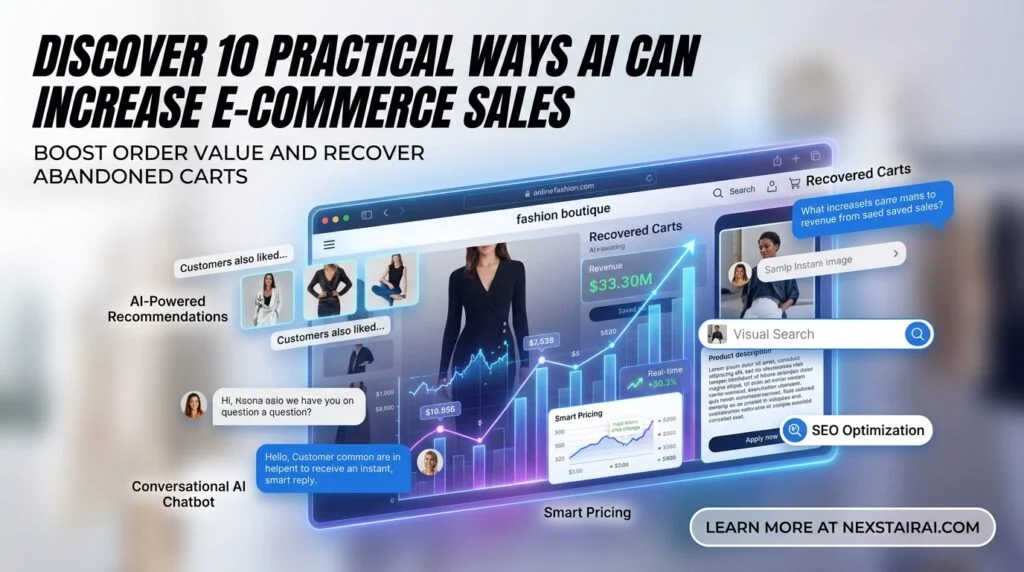
Discover 10 practical ways AI can increase e-commerce sales. Learn how smart online stores use AI to boost order value and recover abandoned carts.
If you’re running an online store in 2026, you’ve probably noticed something: the brands pulling ahead aren’t necessarily the ones with the biggest ad budgets anymore. They’re the ones using AI smartly — to understand shoppers better, respond faster, and sell more without burning out their teams.
Good news: you don’t need a data science degree or a six-figure tech budget to get in on this. AI tools have become genuinely accessible, and the ROI for e-commerce specifically is some of the clearest in any industry. Let’s walk through exactly how AI can move the needle on your sales — with real, practical ways to apply each one.
What Is AI-Driven E-Commerce, and Why Does It Matter Now?
AI-driven e-commerce simply means using machine learning, natural language processing, and predictive algorithms to make your store smarter — smarter at recommending products, smarter at pricing, smarter at talking to customers, and smarter at predicting what happens next.
Why now? Because customer expectations have shifted. Shoppers expect Amazon-level personalization even from a small boutique store. They expect instant answers, not “we’ll get back to you in 24-48 hours.” AI is what lets smaller and mid-sized brands compete on that experience without hiring a 50-person support team.
With that context, let’s get into the ten Ways AI Can Increase E-Commerce Sales;
1. How Does AI-Powered Product Recommendation Boost Average Order Value?
Personalized recommendations are probably the most well-known AI application in e-commerce, and for good reason — they work.
AI recommendation engines analyze browsing behavior, purchase history, cart contents, and even time spent on a page to suggest products a shopper is genuinely likely to want. Unlike static “customers also bought” widgets, AI-driven recommendations update in real time and get smarter with every interaction.
Practical impact:
- Higher average order value through smart upsells and cross-sells at checkout
- Reduced browsing fatigue since customers see relevant items faster
- Increased repeat purchases from tailored homepage and email recommendations
Stores using AI recommendations commonly see recommended products account for a meaningful chunk of total revenue — often 10-30% depending on the catalog size and how well the engine is tuned.
2. Can AI Chatbots Really Replace a Sales Team?
Not entirely — but they can do a lot of the heavy lifting, especially the repetitive, time-sensitive parts of the sales conversation.
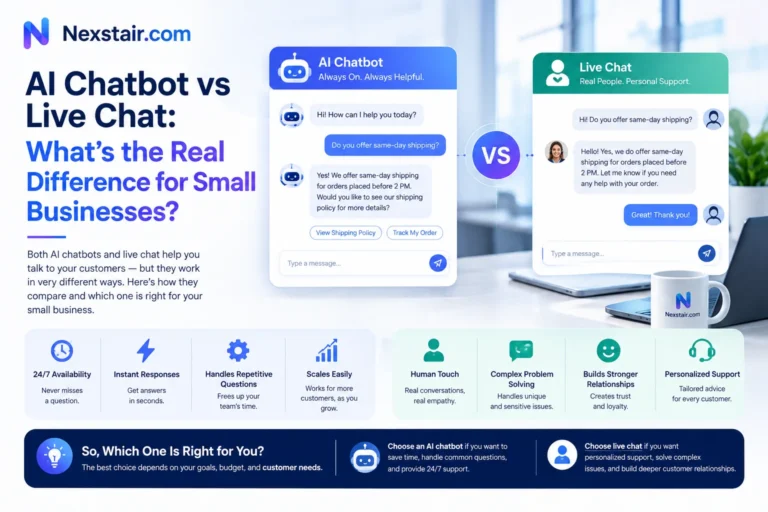
Modern AI chatbots don’t just answer FAQs. They can walk a customer through choosing between two products, apply a discount code, check order status, and even nudge someone toward completing a purchase they were hesitating on — all instantly, 24/7, without a human needing to be online.
This matters because a huge share of potential sales happen outside business hours. If a customer has a question at 11pm and gets no answer, they often just leave. An AI chatbot keeps that conversation — and that sale — alive.
This is exactly the kind of conversational AI infrastructure nexstairai.com helps businesses put in place — turning casual browsers into confident buyers around the clock.
3. How Does AI Reduce Cart Abandonment?
Cart abandonment is one of the most frustrating problems in e-commerce — studies consistently show that the majority of online carts are abandoned before checkout. AI tackles this from multiple angles:
- Predictive exit intent: AI models detect signals that a customer is about to leave (mouse movement, hesitation, time on page) and trigger a timely discount or reassurance message.
- Smart cart-abandonment emails: Instead of generic “you left something behind” emails, AI personalizes the message, timing, and even the incentive based on that specific customer’s behavior and value.
- Conversational recovery: AI chatbots can proactively re-engage a customer who paused mid-checkout, answering the exact question that made them stall — usually shipping cost, return policy, or product fit.
Fixing even a modest percentage of abandoned carts can represent a significant revenue lift, since these are shoppers who were already close to buying.
4. What Role Does AI Play in Dynamic Pricing?
Dynamic pricing used to be something only airlines and big retailers could pull off. AI has changed that.
AI pricing tools continuously analyze competitor prices, demand fluctuations, inventory levels, and even weather or seasonal trends to adjust prices in near real time. This means you’re never leaving money on the table during high-demand periods, and you’re not sitting on stagnant inventory during slow ones.
Common use cases:
- Automatically matching or beating competitor pricing without manual monitoring
- Adjusting prices based on stock levels to move slow inventory
- Offering personalized discounts to price-sensitive shoppers while protecting margin elsewhere
5. How Does AI-Powered Search Improve Conversion Rates?
Traditional on-site search is notoriously bad — one typo or an unusual phrasing and customers get zero results, then leave. AI-powered search fixes this by understanding intent, not just keywords.
AI search can interpret vague queries (“something for a rainy hike”), correct typos automatically, and rank results based on what’s most likely to convert — not just what technically matches. Visual search (upload a photo, find similar products) is another AI-driven feature that’s becoming standard for fashion and home goods stores.
The result: fewer “no results found” pages, fewer abandoned sessions, and more customers actually finding what they came to buy.
6. Can AI Predict What Customers Will Want Before They Ask?
Predictive analytics is where AI starts to feel almost like a crystal ball — but it’s really just pattern recognition at scale.
By analyzing past purchase cycles, AI can predict:
- When a customer is likely to need a reorder (great for consumables and subscriptions)
- Which products are trending upward before they hit mainstream demand
- Which customers are at risk of churning, so you can re-engage them proactively
This lets you be proactive instead of reactive — sending the “time to restock?” email exactly when it’s useful, not weeks too late.
7. How Do AI-Generated Product Descriptions and Content Improve SEO and Sales?
Writing unique, compelling product descriptions for hundreds or thousands of SKUs is a massive time sink — and it’s also where a lot of e-commerce SEO opportunity gets left on the table.
AI content tools can generate SEO-optimized, benefit-driven product descriptions at scale, while still allowing human review for brand voice. This isn’t just about saving time — well-optimized descriptions directly improve organic search visibility, which brings in free, high-intent traffic.
AI can also help with:
- Generating alt text for images (boosting accessibility and image search rankings)
- Creating varied ad copy for A/B testing
- Drafting blog content that answers exactly what your customers are searching for
8. How Does AI Improve Email and Ad Targeting Precision?
Generic “batch and blast” email marketing is dying, and AI is the reason. AI-driven segmentation groups customers not just by demographics, but by behavior patterns, purchase likelihood, and lifetime value predictions.
This means:
- Higher email open and click rates because content actually matches the recipient’s interests
- Lower ad spend waste since AI targeting identifies who’s actually likely to convert, not just who fits a broad audience
- Smarter retargeting that shows the right product at the right moment, rather than annoying repeat ads for something already purchased
9. What Is the Impact of AI-Powered Visual Merchandising?
AI can analyze which product images, layouts, and homepage arrangements drive the most engagement and automatically optimize the visual presentation of your store for different visitor segments.
For example, a first-time visitor might see a homepage optimized for browsing and discovery, while a returning customer sees one optimized for quick repurchase. AI can even test dozens of layout variations simultaneously — something that would take a human team months to A/B test manually.
10. How Does Conversational AI Turn Customer Service Into a Sales Channel?
This is one of the biggest mindset shifts in modern e-commerce: customer service isn’t just a cost center anymore — it’s a sales opportunity.
A well-designed AI assistant doesn’t just resolve complaints. It can:
- Suggest a better-fitting product when a customer asks about sizing or compatibility
- Offer a loyalty discount to a customer who’s had a frustrating experience, saving the sale
- Answer pre-purchase questions instantly, removing the last bit of friction before checkout
Businesses that treat every customer interaction — even support tickets — as a potential upsell moment consistently see stronger revenue per customer.
If you’re ready to turn your customer conversations into a genuine sales engine, this is precisely the kind of AI-powered customer experience nexstairai.com specializes in building for growing e-commerce brands.
How Do You Get Started With AI in Your E-Commerce Store?
You don’t need to implement all ten of these at once. The smartest approach is usually:
- Start with the highest-friction point in your current funnel — often cart abandonment or customer support response time.
- Pick one or two AI tools that solve that specific problem well.
- Measure results for 30-60 days before adding more.
- Scale what works into other areas like email, search, or pricing.
This incremental approach avoids overwhelm and lets you see real ROI before committing to a bigger AI investment.
Final Thoughts: Best Possible Ways AI Can Increase E-Commerce Sales
Absolutely — and increasingly, it’s less of a competitive advantage and more of a baseline expectation. Customers are getting used to fast, personalized, intelligent shopping experiences, and stores that don’t offer them start to feel outdated by comparison.
The good news is that AI adoption in e-commerce has never been more accessible. You don’t need a massive team or budget — you need the right tools applied to the right problems.
If you want help figuring out exactly where AI could make the biggest difference for your store — from conversational sales assistants to smart customer engagement — nexstairai.com is a great place to start the conversation.
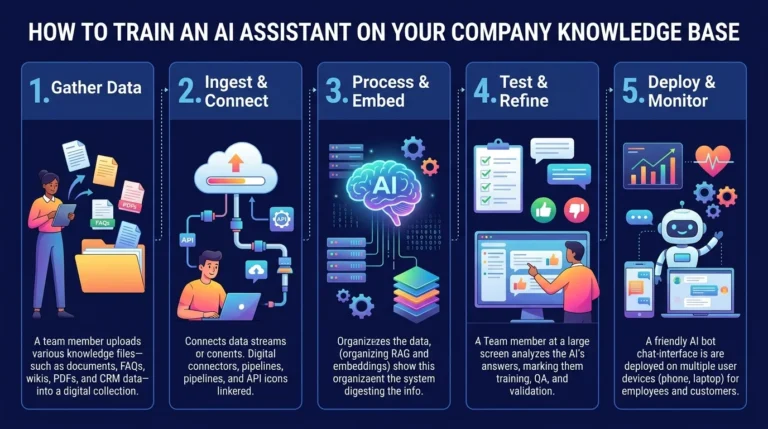
 can help you build one that actually fits the way you work.** ## What Technologies Power an AI Virtual Assistant? Here's a quick, scannable summary of the main building blocks: | Technology | What It Does | |---|---| | **Natural Language Processing (NLP)** | Helps the assistant read and interpret human language | | **Natural Language Understanding (NLU)** | Identifies intent and extracts key details from a request | | **Large Language Models (LLMs)** | Generate flexible, human-like responses and handle complex questions | | **Speech Recognition (ASR)** | Converts spoken words into text | | **Text-to-Speech (TTS)** | Converts text responses into natural-sounding speech | | **Machine Learning (ML)** | Helps the system learn patterns and improve over time | | **APIs and Integrations** | Connect the assistant to business tools and data | | **Knowledge Base / Retrieval** | Gives the assistant accurate, up-to-date information to draw from | ## What Are the Different Types of AI Virtual Assistants? Not every virtual assistant works the same way. Here are the main categories. **Rule-based assistants.** These follow pre-written scripts and decision trees. They're predictable and good for simple tasks, but they struggle when customers phrase things unexpectedly. **AI-powered conversational assistants.** These use NLP and machine learning to understand free-form language. They're far more flexible and can handle a wide range of questions. **LLM-powered assistants.** The newest generation uses large language models to hold fluid, natural conversations, summarize information, and reason through multi-part requests. **Voice assistants.** These specialize in spoken interactions, whether on smart speakers, phones, or automated call systems. **Agentic assistants.** An emerging category, these assistants don't just respond; they can plan and carry out multi-step tasks on your behalf, such as researching options, filling out forms, or coordinating across several apps, all within boundaries you define. ## What Is the Difference Between an AI Virtual Assistant and a Chatbot? People often use these terms interchangeably, but there's a useful distinction. A **chatbot** is typically designed for a narrow purpose, usually answering questions or following a set script within a chat window. A **virtual assistant** is generally broader: it understands context, works across multiple channels, connects to several systems, and can complete a wider range of tasks. In practice, the line is blurring. Many modern chatbots are really AI virtual assistants under the hood. The key difference to look for is capability: can it merely respond, or can it understand, remember, and act? ## What Are the Real-World Uses of AI Virtual Assistants? Virtual assistants are showing up in nearly every industry. Here are some of the most common uses. **Customer support.** Answering FAQs, tracking orders, handling returns, and escalating tricky issues to human agents, all around the clock. **E-commerce.** Recommending products, answering sizing and shipping questions, and nudging shoppers who hesitate at checkout. **Healthcare.** Scheduling appointments, sending reminders, and answering basic administrative questions (while leaving medical decisions to professionals). **Banking and finance.** Checking balances, explaining fees, and guiding customers through routine account tasks securely. **Real estate.** Answering listing questions, qualifying leads, and booking property viewings. **Hospitality and travel.** Handling reservations, itinerary questions, and local recommendations. **Human resources.** Answering employee questions about policies, benefits, and time off, and helping with onboarding. **Sales and marketing.** Qualifying leads, capturing contact details, and booking demos for the sales team. ## What Are the Benefits of Using an AI Virtual Assistant? Businesses and individuals adopt virtual assistants for good reasons. - **24/7 availability.** Help is there whenever customers need it, across every time zone. - **Instant responses.** No more waiting in queues or for email replies. - **Cost efficiency.** Handling more conversations without proportionally growing your team. - **Consistency.** The same accurate answer every time, based on your approved information. - **Scalability.** Whether you have ten conversations a day or ten thousand, the assistant keeps up. - **Happier teams.** Employees spend less time on repetitive tasks and more on meaningful work. - **Useful insights.** Conversations reveal what customers really want to know, helping you improve your products, website, and policies. - **More sales.** Quick answers and helpful recommendations remove friction and help customers complete purchases. **Curious how much time and money a virtual assistant could save your business? [nexstairai.com](https://nexstairai.com/) can help you map out the opportunity and get started without the guesswork.** ## What Are the Limitations of AI Virtual Assistants? It's worth being realistic. Even great assistants have limits. - **They can misunderstand.** Unusual phrasing, heavy ambiguity, or very niche topics may trip them up. - **They depend on their information.** If the knowledge base is outdated or incomplete, the answers will be too. - **They can sometimes be wrong.** Language-model-based systems may occasionally produce confident but inaccurate responses, which is why guardrails and good source material matter. - **They lack true human empathy.** They can detect sentiment, but emotionally sensitive situations still benefit from a real person. - **Privacy and security need attention.** Handling personal data responsibly requires proper safeguards and compliance. The good news is that all of these can be managed with thoughtful design: clear boundaries, quality information, regular reviews, and an easy path to a human when needed. ## How Do You Choose the Right AI Virtual Assistant for Your Business? If you're thinking about adopting one, ask yourself these questions. 1. **What problem am I solving?** Support volume, lead capture, scheduling, internal help, or something else? 2. **Which channels do my customers use?** Website, WhatsApp, Instagram, email, phone? 3. **What systems does it need to connect to?** Your CRM, calendar, store, or helpdesk? 4. **How customizable is it?** Can you control tone, workflows, and escalation rules? 5. **How does it handle human handoff?** The transition should be smooth, with full context passed along. 6. **What does security look like?** Look for data protection and compliance with regulations relevant to your customers. 7. **Can I see performance data?** Good analytics help you measure and improve. 8. **What support will I get?** Setup and ongoing optimization make a big difference to results. ## How Do You Get Started With an AI Virtual Assistant? You don't need a massive project to begin. A simple path looks like this: 1. **Identify your top 5 to 10 most common customer questions or tasks.** 2. **Gather accurate, up-to-date information** such as FAQs, policies, and product details. 3. **Choose a platform or partner** that fits your needs and integrates with your tools. 4. **Set up and test** with real-world questions before launching. 5. **Launch on one channel first**, then expand as you gain confidence. 6. **Review conversations regularly**, improving responses and adding new capabilities over time. Starting small and growing steadily is almost always better than trying to automate everything at once. ## What Does the Future Hold for AI Virtual Assistants? The technology is moving quickly. A few trends worth watching: - **More proactive help.** Assistants that reach out with useful information before you ask, such as shipping delays or appointment reminders. - **Greater autonomy.** Agentic assistants that complete multi-step tasks within rules you set. - **Richer personalization.** Better memory of preferences and history, creating more natural, tailored experiences. - **Multimodal interaction.** Assistants that understand text, voice, images, and documents all in one conversation. - **Smoother voice experiences.** Phone and voice interactions that feel increasingly human and natural. - **Stronger safeguards.** Better accuracy controls, privacy protections, and transparency about when you're talking to AI. The businesses that start learning and experimenting now will be best positioned to benefit as these capabilities mature. ## Final Thoughts: Is an AI Virtual Assistant Worth It? An AI virtual assistant is, at its heart, a digital teammate. It listens to what people ask, understands what they mean, finds or does what's needed, and responds in a way that feels natural, all in a matter of seconds and at any hour of the day. Under the hood, it's a clever combination of speech recognition, language understanding, decision-making, integrations, and language generation. But from the customer's point of view, it's simple: they ask, and they get helped. For businesses, the payoff is faster service, lower costs, happier teams, and more room to grow. The key is to start with a clear goal, give your assistant good information, keep humans available for the moments that matter, and keep improving based on real conversations. **Ready to bring an AI virtual assistant into your business? Visit [nexstairai.com](https://nexstairai.com/) to explore how a custom-built assistant can help you serve customers better, save time, and grow with confidence.** --- Want me to write a follow-up next? Good options might be "AI Virtual Assistant vs. Chatbot: What's the Difference?" or "How to Train an AI Virtual Assistant on Your Business Data.](https://nexstairai.com/wp-content/uploads/2026/10/🚀-Supercharge-Your-Business-Growth-with-Nexstair-–-AI-Digital-Marketing-Agency-300x164.jpg.webp)


 can help you build one that actually fits the way you work.** ## What Technologies Power an AI Virtual Assistant? Here's a quick, scannable summary of the main building blocks: | Technology | What It Does | |---|---| | **Natural Language Processing (NLP)** | Helps the assistant read and interpret human language | | **Natural Language Understanding (NLU)** | Identifies intent and extracts key details from a request | | **Large Language Models (LLMs)** | Generate flexible, human-like responses and handle complex questions | | **Speech Recognition (ASR)** | Converts spoken words into text | | **Text-to-Speech (TTS)** | Converts text responses into natural-sounding speech | | **Machine Learning (ML)** | Helps the system learn patterns and improve over time | | **APIs and Integrations** | Connect the assistant to business tools and data | | **Knowledge Base / Retrieval** | Gives the assistant accurate, up-to-date information to draw from | ## What Are the Different Types of AI Virtual Assistants? Not every virtual assistant works the same way. Here are the main categories. **Rule-based assistants.** These follow pre-written scripts and decision trees. They're predictable and good for simple tasks, but they struggle when customers phrase things unexpectedly. **AI-powered conversational assistants.** These use NLP and machine learning to understand free-form language. They're far more flexible and can handle a wide range of questions. **LLM-powered assistants.** The newest generation uses large language models to hold fluid, natural conversations, summarize information, and reason through multi-part requests. **Voice assistants.** These specialize in spoken interactions, whether on smart speakers, phones, or automated call systems. **Agentic assistants.** An emerging category, these assistants don't just respond; they can plan and carry out multi-step tasks on your behalf, such as researching options, filling out forms, or coordinating across several apps, all within boundaries you define. ## What Is the Difference Between an AI Virtual Assistant and a Chatbot? People often use these terms interchangeably, but there's a useful distinction. A **chatbot** is typically designed for a narrow purpose, usually answering questions or following a set script within a chat window. A **virtual assistant** is generally broader: it understands context, works across multiple channels, connects to several systems, and can complete a wider range of tasks. In practice, the line is blurring. Many modern chatbots are really AI virtual assistants under the hood. The key difference to look for is capability: can it merely respond, or can it understand, remember, and act? ## What Are the Real-World Uses of AI Virtual Assistants? Virtual assistants are showing up in nearly every industry. Here are some of the most common uses. **Customer support.** Answering FAQs, tracking orders, handling returns, and escalating tricky issues to human agents, all around the clock. **E-commerce.** Recommending products, answering sizing and shipping questions, and nudging shoppers who hesitate at checkout. **Healthcare.** Scheduling appointments, sending reminders, and answering basic administrative questions (while leaving medical decisions to professionals). **Banking and finance.** Checking balances, explaining fees, and guiding customers through routine account tasks securely. **Real estate.** Answering listing questions, qualifying leads, and booking property viewings. **Hospitality and travel.** Handling reservations, itinerary questions, and local recommendations. **Human resources.** Answering employee questions about policies, benefits, and time off, and helping with onboarding. **Sales and marketing.** Qualifying leads, capturing contact details, and booking demos for the sales team. ## What Are the Benefits of Using an AI Virtual Assistant? Businesses and individuals adopt virtual assistants for good reasons. - **24/7 availability.** Help is there whenever customers need it, across every time zone. - **Instant responses.** No more waiting in queues or for email replies. - **Cost efficiency.** Handling more conversations without proportionally growing your team. - **Consistency.** The same accurate answer every time, based on your approved information. - **Scalability.** Whether you have ten conversations a day or ten thousand, the assistant keeps up. - **Happier teams.** Employees spend less time on repetitive tasks and more on meaningful work. - **Useful insights.** Conversations reveal what customers really want to know, helping you improve your products, website, and policies. - **More sales.** Quick answers and helpful recommendations remove friction and help customers complete purchases. **Curious how much time and money a virtual assistant could save your business? [nexstairai.com](https://nexstairai.com/) can help you map out the opportunity and get started without the guesswork.** ## What Are the Limitations of AI Virtual Assistants? It's worth being realistic. Even great assistants have limits. - **They can misunderstand.** Unusual phrasing, heavy ambiguity, or very niche topics may trip them up. - **They depend on their information.** If the knowledge base is outdated or incomplete, the answers will be too. - **They can sometimes be wrong.** Language-model-based systems may occasionally produce confident but inaccurate responses, which is why guardrails and good source material matter. - **They lack true human empathy.** They can detect sentiment, but emotionally sensitive situations still benefit from a real person. - **Privacy and security need attention.** Handling personal data responsibly requires proper safeguards and compliance. The good news is that all of these can be managed with thoughtful design: clear boundaries, quality information, regular reviews, and an easy path to a human when needed. ## How Do You Choose the Right AI Virtual Assistant for Your Business? If you're thinking about adopting one, ask yourself these questions. 1. **What problem am I solving?** Support volume, lead capture, scheduling, internal help, or something else? 2. **Which channels do my customers use?** Website, WhatsApp, Instagram, email, phone? 3. **What systems does it need to connect to?** Your CRM, calendar, store, or helpdesk? 4. **How customizable is it?** Can you control tone, workflows, and escalation rules? 5. **How does it handle human handoff?** The transition should be smooth, with full context passed along. 6. **What does security look like?** Look for data protection and compliance with regulations relevant to your customers. 7. **Can I see performance data?** Good analytics help you measure and improve. 8. **What support will I get?** Setup and ongoing optimization make a big difference to results. ## How Do You Get Started With an AI Virtual Assistant? You don't need a massive project to begin. A simple path looks like this: 1. **Identify your top 5 to 10 most common customer questions or tasks.** 2. **Gather accurate, up-to-date information** such as FAQs, policies, and product details. 3. **Choose a platform or partner** that fits your needs and integrates with your tools. 4. **Set up and test** with real-world questions before launching. 5. **Launch on one channel first**, then expand as you gain confidence. 6. **Review conversations regularly**, improving responses and adding new capabilities over time. Starting small and growing steadily is almost always better than trying to automate everything at once. ## What Does the Future Hold for AI Virtual Assistants? The technology is moving quickly. A few trends worth watching: - **More proactive help.** Assistants that reach out with useful information before you ask, such as shipping delays or appointment reminders. - **Greater autonomy.** Agentic assistants that complete multi-step tasks within rules you set. - **Richer personalization.** Better memory of preferences and history, creating more natural, tailored experiences. - **Multimodal interaction.** Assistants that understand text, voice, images, and documents all in one conversation. - **Smoother voice experiences.** Phone and voice interactions that feel increasingly human and natural. - **Stronger safeguards.** Better accuracy controls, privacy protections, and transparency about when you're talking to AI. The businesses that start learning and experimenting now will be best positioned to benefit as these capabilities mature. ## Final Thoughts: Is an AI Virtual Assistant Worth It? An AI virtual assistant is, at its heart, a digital teammate. It listens to what people ask, understands what they mean, finds or does what's needed, and responds in a way that feels natural, all in a matter of seconds and at any hour of the day. Under the hood, it's a clever combination of speech recognition, language understanding, decision-making, integrations, and language generation. But from the customer's point of view, it's simple: they ask, and they get helped. For businesses, the payoff is faster service, lower costs, happier teams, and more room to grow. The key is to start with a clear goal, give your assistant good information, keep humans available for the moments that matter, and keep improving based on real conversations. **Ready to bring an AI virtual assistant into your business? Visit [nexstairai.com](https://nexstairai.com/) to explore how a custom-built assistant can help you serve customers better, save time, and grow with confidence.** --- Want me to write a follow-up next? Good options might be "AI Virtual Assistant vs. Chatbot: What's the Difference?" or "How to Train an AI Virtual Assistant on Your Business Data.](https://nexstairai.com/wp-content/uploads/2026/10/🚀-Supercharge-Your-Business-Growth-with-Nexstair-–-AI-Digital-Marketing-Agency-768x419.jpg.webp)