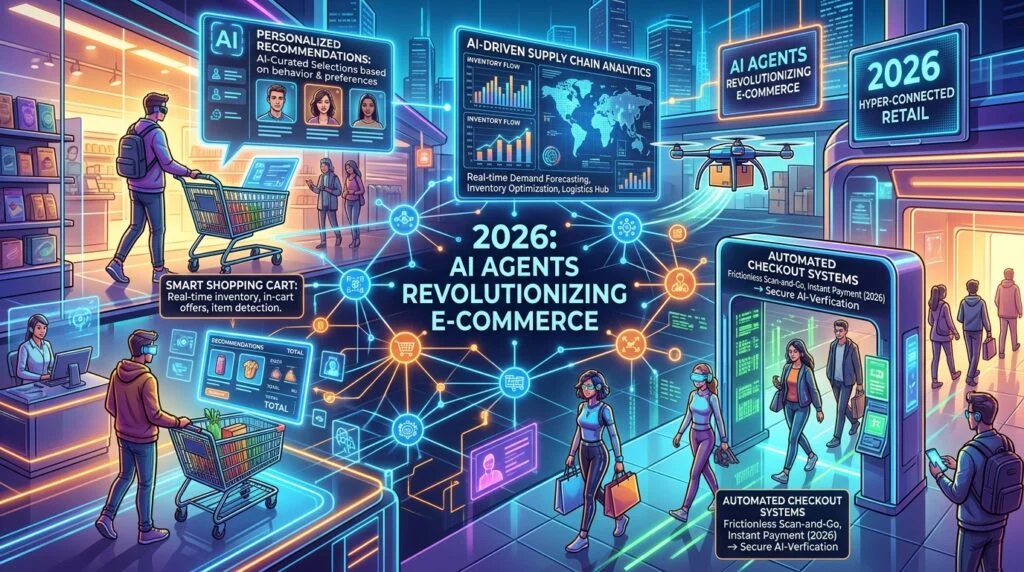
How AI Agents Are Changing E-Commerce in 2026: From agentic checkout to AI-optimized product feeds, here’s a friendly, practical look at how AI agents are reshaping online shopping in 2026, and what it means for your store.
Picture this: a customer doesn’t visit your homepage, doesn’t browse your category pages, and never sees your carefully shot product photos. Instead, they type a request into ChatGPT or Gemini, an AI agent compares a handful of options across the web, and the purchase happens right there in the chat window.
That’s not a hypothetical anymore. It’s Tuesday.
2025 was the year “agentic commerce” became a buzzword. 2026 is the year it started showing up in actual revenue reports, actual checkout flows, and actual boardroom strategy decks. If you run an online store, this shift touches everything from how customers find you to how your backend systems need to talk to the outside world.
So let’s walk through what’s actually changing, minus the hype, plus the parts that genuinely matter for your business.
What Exactly Is an “AI Agent” in E-Commerce?
Quick refresher, because the term gets used loosely: an AI agent isn’t just a smarter search bar or a chatbot with better small talk. It’s software that can understand a goal (“find me a durable carry-on under $150”), reason through the options, and take real action, comparing products, checking reviews, applying filters, and in a growing number of cases, completing the purchase itself.
In e-commerce specifically, that shows up in two big ways:
- Consumer-facing shopping agents — tools like ChatGPT, Perplexity, Google’s AI Mode, Microsoft Copilot, and Amazon’s Rufus that help shoppers research and buy on their behalf.
- Merchant-side operational agents — the AI running quietly behind your own storefront, handling customer support, personalization, inventory decisions, and pricing.
Both are reshaping e-commerce in 2026, just from opposite ends of the transaction.
How Are Shoppers Actually Using AI Agents to Buy Things Right Now?
Faster than most retailers expected, honestly. Consumer surveys through 2025 and into 2026 have consistently found that a large and growing share of U.S. shoppers now use AI somewhere in their buying journey, whether that’s asking ChatGPT to compare two products, letting Amazon’s Rufus narrow down options, or having Google’s AI Mode summarize reviews before they commit.
A few patterns worth noting:
- Younger shoppers (18–34) are notably more comfortable letting an agent make decisions on their behalf than older shoppers are.
- Traffic referred from AI platforms tends to convert at a noticeably higher rate than traditional organic traffic, and often carries a higher average order value.
- Even so, full autonomous checkout (where the AI buys without a final human “yes”) is still the minority behavior. Most shoppers currently use AI to research and shortlist, then complete the purchase themselves.
In other words: AI is already deeply embedded in how people decide what to buy. Whether it’s also pulling the trigger on the purchase is the part still catching up.
What Is Agentic Checkout, and Which Platforms Actually Support It?
This is the part that’s moved fastest, and it’s worth knowing the players, because they don’t all work the same way.
| Platform | How it works | Notable detail |
|---|---|---|
| ChatGPT (OpenAI) | Launched in-chat “Instant Checkout” in late 2025, then pulled back to focus on product discovery in early 2026, with purchases now completing through merchant sites via the Agentic Commerce Protocol (ACP) | Roughly a million Shopify merchants and platforms like Etsy and PayPal feed into it |
| Perplexity | “Instant Buy,” built on a PayPal integration, lets users complete purchases without leaving the chat | Was among the earliest movers into agentic checkout |
| Universal Commerce Protocol (UCP), developed with Shopify and donated as an open standard, powers purchases inside AI Mode and Gemini | Backed by a broad merchant coalition including major retailers | |
| Microsoft Copilot | “Copilot Checkout,” launched in early 2026 via PayPal, Shopify, Stripe, and Etsy | Microsoft reports notably shorter shopping journeys when buying intent is clear |
| Amazon Rufus | A closed, purchase-first assistant inside Amazon’s own app and site | Massive reach, but doesn’t operate on open protocols the way the others do |
The bigger-picture trend underneath all of this: checkout is slowly turning from a page into a protocol. Instead of a customer landing on your cart page, an AI agent talks to your systems directly using a shared standard, whether that’s ACP, UCP, or one of the payment-specific frameworks from Visa and Mastercard built specifically to authenticate agent-driven transactions.
Not Sure Where Your Customers Are Actually Finding You Anymore?
If half your traffic conversations are starting to happen inside a chat window instead of on your homepage, your customer support needs to show up there too. Nexstair’s AI Chatbot keeps your business answering questions, capturing leads, and staying “always on,” even as more of the buying journey moves off your own site. See how it works.
How Are AI Agents Changing Things Behind the Scenes for Retailers?
The customer-facing side gets all the headlines, but the operational side is arguably where AI agents are delivering the most consistent, measurable value right now.
Customer support and service Agentic support tools can now handle an entire customer interaction end to end: reading the actual complaint, pulling the order history, checking the return policy, and resolving it, not just deflecting to a human after two failed menu options.
Personalization Rather than showing every visitor the same “recommended for you” row, agentic systems can reason about what a specific shopper actually needs based on context, not just past clicks, which is a big part of why AI-driven recommendations are converting meaningfully better than generic ones.
Inventory and supply chain Agents are increasingly handling reordering, flagging supplier delays, and rerouting shipments before a stockout ever reaches the customer, tasks that used to need a person watching a dashboard.
Fraud and risk This one’s a double-edged sword worth knowing about. AI shopping agents behave differently than human shoppers do (rapid sequential orders, purchases across unrelated categories), which is already forcing retailers to recalibrate fraud models that would otherwise flag legitimate AI-driven purchases as suspicious.
Pricing Dynamic pricing agents are moving from “adjust prices based on demand” to reasoning about competitor moves, inventory age, and customer segment simultaneously, in real time.
Curious What an Agent Could Take Off Your Team’s Plate?
A lot of this operational shift doesn’t require a massive rebuild to get started. Nexstair’s AI Assistant is built to plug into your existing workflow and start handling the repetitive parts, customer queries, routine tasks, day-to-day questions, without needing a technical team to stand it up. Explore the AI Assistant.
Do I Need to Optimize My Product Data for AI Agents?
Yes, and this is genuinely one of the most important operational shifts happening right now, even though it’s the least glamorous.
Here’s the uncomfortable truth: AI shopping agents don’t see your homepage, your brand story, or your lifestyle photography. They read your structured product data. If your feed is missing key attributes, has inconsistent pricing across sources, or lacks basic identifiers, the agent doesn’t “figure it out anyway.” It just moves on to a competitor whose data is easier to trust.
What that means practically:
- Make sure core attributes (title, brand, category, price, availability, condition, GTIN/MPN, images) are complete and consistent everywhere they appear.
- Add the details that actually answer customer questions (“is it machine washable,” “does it work with X”), not just marketing copy.
- Implement structured data markup (like Product and Review schema) so agents can parse your pages with confidence.
- Keep pricing and stock in sync in real time. A mismatch between your feed and your live site is one of the fastest ways to get quietly dropped from recommendations.
- If you’re on Shopify, look into agentic storefront tools that let you syndicate one catalog across multiple AI platforms at once, rather than maintaining separate feeds for each one.
Think of it as SEO’s new sibling: instead of optimizing purely for how Google’s crawler reads your page, you’re now also optimizing for how an AI agent evaluates whether your product deserves to be recommended at all.
Is Agentic Commerce Actually Safe for Shoppers and Retailers?
This is one of the most searched questions on the topic right now, and it’s a fair one.
For shoppers, trust is still catching up to usage. Plenty of people are comfortable letting AI help them shop, but a much smaller share are currently comfortable letting an AI autonomously complete a purchase without a final confirmation. That gap is closing, but slowly and unevenly.
For retailers, the concerns are a little different:
- Authentication. How do you know a “purchase request” is coming from a legitimate shopping agent and not a malicious bot scraping your checkout? This is exactly why frameworks like Visa’s Trusted Agent Protocol and Mastercard’s Agent Pay exist, they’re built specifically to verify and authorize agent-initiated transactions.
- Attribution. When a sale happens entirely inside a chat interface, your usual analytics can lose visibility into how it happened. Retailers are increasingly leaning on server-side tracking and webhook data from these commerce protocols to fill that gap.
- Legal boundaries. Not every platform welcomes every agent. Amazon, for instance, has taken legal and technical steps to block outside shopping agents from operating on its marketplace, a sign that the rules of the road are still being actively written.
The short version: agentic commerce is real and growing fast, but the guardrails (payments, authentication, attribution) are still maturing right alongside it.
Will AI Agents Replace Traditional E-Commerce Websites?
Not any time soon, and probably not entirely even in the long run. Here’s why.
Even with agentic checkout expanding, most purchases today still start with research done through an AI agent and finish on a merchant’s own site or app. Your website, your checkout flow, and your customer relationship still matter enormously, they’re just gaining a new discovery layer on top.
A more realistic way to think about it: your storefront isn’t being replaced, it’s being read by a new kind of visitor. Some of your traffic will keep browsing the old-fashioned way. A growing slice will arrive already having “talked” to an AI agent about what they want. Your job is to make sure your store is legible and trustworthy to both.
How Should a Small or Mid-Sized Business Actually Prepare for This?
You don’t need an enterprise data team to get started. A realistic first-90-days approach looks like:
- Clean up your product data first. This has the highest immediate payoff and doesn’t require picking a “winning” AI platform.
- Make sure your customer-facing support can keep up. If AI-referred traffic is converting well but arriving with sharper, more specific questions, your support experience needs to match that.
- Watch where your traffic is actually coming from. Server-side and referral tracking will matter more than they used to, since a chat-based purchase doesn’t leave the usual breadcrumb trail.
- Don’t try to build a custom integration for every single AI platform at once. Prioritize the protocol-based approaches (ACP, UCP) that let you plug in once and reach multiple platforms, rather than chasing each one individually.
Frequently Asked Questions | How AI Agents Are Changing E-Commerce
What’s the difference between an AI agent and a regular chatbot in e-commerce? A scripted chatbot answers from a fixed set of responses. An AI agent can actually reason through a request, pull real data, and take action, like completing a return or finalizing a purchase, rather than just pointing you toward an FAQ page.
Are AI shopping agents actually buying things on their own yet? Increasingly, yes, though full autonomous purchasing is still a minority of transactions. Most current usage involves AI assisting with research and comparison, with a human confirming the final purchase.
Do I need to be on Shopify to support AI shopping agents? No, but it helps. Several major protocols have shipped tight integrations with Shopify first, though platforms like BigCommerce, Wix, and custom setups are increasingly supported too, typically through payment partners like PayPal and Stripe.
Will small businesses get left behind by agentic commerce? Not necessarily. Since agents evaluate products on data quality rather than marketing budget, a well-structured product feed can actually help a smaller retailer compete more evenly against bigger names with sloppier data.
Is this just a 2026 trend, or is it here to stay? Every major signal points to this being a structural shift rather than a passing trend, though exactly which platforms and protocols “win” is still being sorted out in real time.
The Bottom Line | How AI Agents Are Changing E-Commerce in 2026
AI agents are changing e-commerce on both sides of the transaction at once: reshaping how customers discover and decide what to buy, and reshaping how retailers run support, personalization, inventory, and pricing behind the scenes. Neither shift is finished. The payment rails, trust levels, and standards are all still being built as we go.
The businesses that come out ahead won’t necessarily be the ones with the biggest AI budget. They’ll be the ones who got their data, their support, and their operations agent-ready early, while everyone else was still debating whether any of this was real.
If you’re figuring out where to start, you don’t have to build all of it yourself. Get started with Nexstair AI today and put an AI assistant and chatbot to work on the parts of your e-commerce operation that are ready for it right now.
 can help you build one that actually fits the way you work.** ## What Technologies Power an AI Virtual Assistant? Here's a quick, scannable summary of the main building blocks: | Technology | What It Does | |---|---| | **Natural Language Processing (NLP)** | Helps the assistant read and interpret human language | | **Natural Language Understanding (NLU)** | Identifies intent and extracts key details from a request | | **Large Language Models (LLMs)** | Generate flexible, human-like responses and handle complex questions | | **Speech Recognition (ASR)** | Converts spoken words into text | | **Text-to-Speech (TTS)** | Converts text responses into natural-sounding speech | | **Machine Learning (ML)** | Helps the system learn patterns and improve over time | | **APIs and Integrations** | Connect the assistant to business tools and data | | **Knowledge Base / Retrieval** | Gives the assistant accurate, up-to-date information to draw from | ## What Are the Different Types of AI Virtual Assistants? Not every virtual assistant works the same way. Here are the main categories. **Rule-based assistants.** These follow pre-written scripts and decision trees. They're predictable and good for simple tasks, but they struggle when customers phrase things unexpectedly. **AI-powered conversational assistants.** These use NLP and machine learning to understand free-form language. They're far more flexible and can handle a wide range of questions. **LLM-powered assistants.** The newest generation uses large language models to hold fluid, natural conversations, summarize information, and reason through multi-part requests. **Voice assistants.** These specialize in spoken interactions, whether on smart speakers, phones, or automated call systems. **Agentic assistants.** An emerging category, these assistants don't just respond; they can plan and carry out multi-step tasks on your behalf, such as researching options, filling out forms, or coordinating across several apps, all within boundaries you define. ## What Is the Difference Between an AI Virtual Assistant and a Chatbot? People often use these terms interchangeably, but there's a useful distinction. A **chatbot** is typically designed for a narrow purpose, usually answering questions or following a set script within a chat window. A **virtual assistant** is generally broader: it understands context, works across multiple channels, connects to several systems, and can complete a wider range of tasks. In practice, the line is blurring. Many modern chatbots are really AI virtual assistants under the hood. The key difference to look for is capability: can it merely respond, or can it understand, remember, and act? ## What Are the Real-World Uses of AI Virtual Assistants? Virtual assistants are showing up in nearly every industry. Here are some of the most common uses. **Customer support.** Answering FAQs, tracking orders, handling returns, and escalating tricky issues to human agents, all around the clock. **E-commerce.** Recommending products, answering sizing and shipping questions, and nudging shoppers who hesitate at checkout. **Healthcare.** Scheduling appointments, sending reminders, and answering basic administrative questions (while leaving medical decisions to professionals). **Banking and finance.** Checking balances, explaining fees, and guiding customers through routine account tasks securely. **Real estate.** Answering listing questions, qualifying leads, and booking property viewings. **Hospitality and travel.** Handling reservations, itinerary questions, and local recommendations. **Human resources.** Answering employee questions about policies, benefits, and time off, and helping with onboarding. **Sales and marketing.** Qualifying leads, capturing contact details, and booking demos for the sales team. ## What Are the Benefits of Using an AI Virtual Assistant? Businesses and individuals adopt virtual assistants for good reasons. - **24/7 availability.** Help is there whenever customers need it, across every time zone. - **Instant responses.** No more waiting in queues or for email replies. - **Cost efficiency.** Handling more conversations without proportionally growing your team. - **Consistency.** The same accurate answer every time, based on your approved information. - **Scalability.** Whether you have ten conversations a day or ten thousand, the assistant keeps up. - **Happier teams.** Employees spend less time on repetitive tasks and more on meaningful work. - **Useful insights.** Conversations reveal what customers really want to know, helping you improve your products, website, and policies. - **More sales.** Quick answers and helpful recommendations remove friction and help customers complete purchases. **Curious how much time and money a virtual assistant could save your business? [nexstairai.com](https://nexstairai.com/) can help you map out the opportunity and get started without the guesswork.** ## What Are the Limitations of AI Virtual Assistants? It's worth being realistic. Even great assistants have limits. - **They can misunderstand.** Unusual phrasing, heavy ambiguity, or very niche topics may trip them up. - **They depend on their information.** If the knowledge base is outdated or incomplete, the answers will be too. - **They can sometimes be wrong.** Language-model-based systems may occasionally produce confident but inaccurate responses, which is why guardrails and good source material matter. - **They lack true human empathy.** They can detect sentiment, but emotionally sensitive situations still benefit from a real person. - **Privacy and security need attention.** Handling personal data responsibly requires proper safeguards and compliance. The good news is that all of these can be managed with thoughtful design: clear boundaries, quality information, regular reviews, and an easy path to a human when needed. ## How Do You Choose the Right AI Virtual Assistant for Your Business? If you're thinking about adopting one, ask yourself these questions. 1. **What problem am I solving?** Support volume, lead capture, scheduling, internal help, or something else? 2. **Which channels do my customers use?** Website, WhatsApp, Instagram, email, phone? 3. **What systems does it need to connect to?** Your CRM, calendar, store, or helpdesk? 4. **How customizable is it?** Can you control tone, workflows, and escalation rules? 5. **How does it handle human handoff?** The transition should be smooth, with full context passed along. 6. **What does security look like?** Look for data protection and compliance with regulations relevant to your customers. 7. **Can I see performance data?** Good analytics help you measure and improve. 8. **What support will I get?** Setup and ongoing optimization make a big difference to results. ## How Do You Get Started With an AI Virtual Assistant? You don't need a massive project to begin. A simple path looks like this: 1. **Identify your top 5 to 10 most common customer questions or tasks.** 2. **Gather accurate, up-to-date information** such as FAQs, policies, and product details. 3. **Choose a platform or partner** that fits your needs and integrates with your tools. 4. **Set up and test** with real-world questions before launching. 5. **Launch on one channel first**, then expand as you gain confidence. 6. **Review conversations regularly**, improving responses and adding new capabilities over time. Starting small and growing steadily is almost always better than trying to automate everything at once. ## What Does the Future Hold for AI Virtual Assistants? The technology is moving quickly. A few trends worth watching: - **More proactive help.** Assistants that reach out with useful information before you ask, such as shipping delays or appointment reminders. - **Greater autonomy.** Agentic assistants that complete multi-step tasks within rules you set. - **Richer personalization.** Better memory of preferences and history, creating more natural, tailored experiences. - **Multimodal interaction.** Assistants that understand text, voice, images, and documents all in one conversation. - **Smoother voice experiences.** Phone and voice interactions that feel increasingly human and natural. - **Stronger safeguards.** Better accuracy controls, privacy protections, and transparency about when you're talking to AI. The businesses that start learning and experimenting now will be best positioned to benefit as these capabilities mature. ## Final Thoughts: Is an AI Virtual Assistant Worth It? An AI virtual assistant is, at its heart, a digital teammate. It listens to what people ask, understands what they mean, finds or does what's needed, and responds in a way that feels natural, all in a matter of seconds and at any hour of the day. Under the hood, it's a clever combination of speech recognition, language understanding, decision-making, integrations, and language generation. But from the customer's point of view, it's simple: they ask, and they get helped. For businesses, the payoff is faster service, lower costs, happier teams, and more room to grow. The key is to start with a clear goal, give your assistant good information, keep humans available for the moments that matter, and keep improving based on real conversations. **Ready to bring an AI virtual assistant into your business? Visit [nexstairai.com](https://nexstairai.com/) to explore how a custom-built assistant can help you serve customers better, save time, and grow with confidence.** --- Want me to write a follow-up next? Good options might be "AI Virtual Assistant vs. Chatbot: What's the Difference?" or "How to Train an AI Virtual Assistant on Your Business Data.](https://nexstairai.com/wp-content/uploads/2026/10/🚀-Supercharge-Your-Business-Growth-with-Nexstair-–-AI-Digital-Marketing-Agency-300x164.jpg.webp)

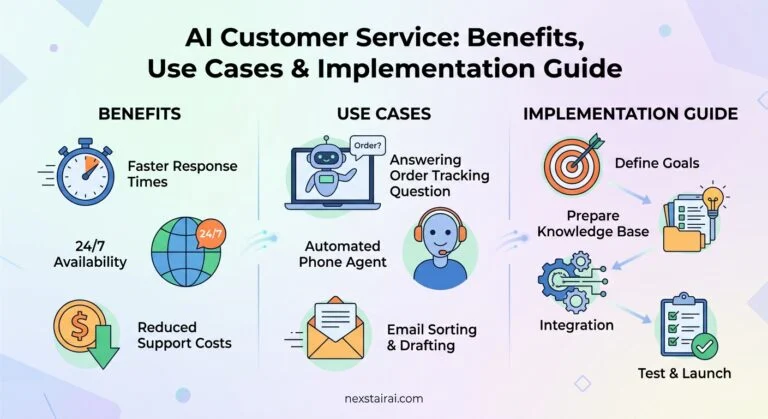
 can help you build one that actually fits the way you work.** ## What Technologies Power an AI Virtual Assistant? Here's a quick, scannable summary of the main building blocks: | Technology | What It Does | |---|---| | **Natural Language Processing (NLP)** | Helps the assistant read and interpret human language | | **Natural Language Understanding (NLU)** | Identifies intent and extracts key details from a request | | **Large Language Models (LLMs)** | Generate flexible, human-like responses and handle complex questions | | **Speech Recognition (ASR)** | Converts spoken words into text | | **Text-to-Speech (TTS)** | Converts text responses into natural-sounding speech | | **Machine Learning (ML)** | Helps the system learn patterns and improve over time | | **APIs and Integrations** | Connect the assistant to business tools and data | | **Knowledge Base / Retrieval** | Gives the assistant accurate, up-to-date information to draw from | ## What Are the Different Types of AI Virtual Assistants? Not every virtual assistant works the same way. Here are the main categories. **Rule-based assistants.** These follow pre-written scripts and decision trees. They're predictable and good for simple tasks, but they struggle when customers phrase things unexpectedly. **AI-powered conversational assistants.** These use NLP and machine learning to understand free-form language. They're far more flexible and can handle a wide range of questions. **LLM-powered assistants.** The newest generation uses large language models to hold fluid, natural conversations, summarize information, and reason through multi-part requests. **Voice assistants.** These specialize in spoken interactions, whether on smart speakers, phones, or automated call systems. **Agentic assistants.** An emerging category, these assistants don't just respond; they can plan and carry out multi-step tasks on your behalf, such as researching options, filling out forms, or coordinating across several apps, all within boundaries you define. ## What Is the Difference Between an AI Virtual Assistant and a Chatbot? People often use these terms interchangeably, but there's a useful distinction. A **chatbot** is typically designed for a narrow purpose, usually answering questions or following a set script within a chat window. A **virtual assistant** is generally broader: it understands context, works across multiple channels, connects to several systems, and can complete a wider range of tasks. In practice, the line is blurring. Many modern chatbots are really AI virtual assistants under the hood. The key difference to look for is capability: can it merely respond, or can it understand, remember, and act? ## What Are the Real-World Uses of AI Virtual Assistants? Virtual assistants are showing up in nearly every industry. Here are some of the most common uses. **Customer support.** Answering FAQs, tracking orders, handling returns, and escalating tricky issues to human agents, all around the clock. **E-commerce.** Recommending products, answering sizing and shipping questions, and nudging shoppers who hesitate at checkout. **Healthcare.** Scheduling appointments, sending reminders, and answering basic administrative questions (while leaving medical decisions to professionals). **Banking and finance.** Checking balances, explaining fees, and guiding customers through routine account tasks securely. **Real estate.** Answering listing questions, qualifying leads, and booking property viewings. **Hospitality and travel.** Handling reservations, itinerary questions, and local recommendations. **Human resources.** Answering employee questions about policies, benefits, and time off, and helping with onboarding. **Sales and marketing.** Qualifying leads, capturing contact details, and booking demos for the sales team. ## What Are the Benefits of Using an AI Virtual Assistant? Businesses and individuals adopt virtual assistants for good reasons. - **24/7 availability.** Help is there whenever customers need it, across every time zone. - **Instant responses.** No more waiting in queues or for email replies. - **Cost efficiency.** Handling more conversations without proportionally growing your team. - **Consistency.** The same accurate answer every time, based on your approved information. - **Scalability.** Whether you have ten conversations a day or ten thousand, the assistant keeps up. - **Happier teams.** Employees spend less time on repetitive tasks and more on meaningful work. - **Useful insights.** Conversations reveal what customers really want to know, helping you improve your products, website, and policies. - **More sales.** Quick answers and helpful recommendations remove friction and help customers complete purchases. **Curious how much time and money a virtual assistant could save your business? [nexstairai.com](https://nexstairai.com/) can help you map out the opportunity and get started without the guesswork.** ## What Are the Limitations of AI Virtual Assistants? It's worth being realistic. Even great assistants have limits. - **They can misunderstand.** Unusual phrasing, heavy ambiguity, or very niche topics may trip them up. - **They depend on their information.** If the knowledge base is outdated or incomplete, the answers will be too. - **They can sometimes be wrong.** Language-model-based systems may occasionally produce confident but inaccurate responses, which is why guardrails and good source material matter. - **They lack true human empathy.** They can detect sentiment, but emotionally sensitive situations still benefit from a real person. - **Privacy and security need attention.** Handling personal data responsibly requires proper safeguards and compliance. The good news is that all of these can be managed with thoughtful design: clear boundaries, quality information, regular reviews, and an easy path to a human when needed. ## How Do You Choose the Right AI Virtual Assistant for Your Business? If you're thinking about adopting one, ask yourself these questions. 1. **What problem am I solving?** Support volume, lead capture, scheduling, internal help, or something else? 2. **Which channels do my customers use?** Website, WhatsApp, Instagram, email, phone? 3. **What systems does it need to connect to?** Your CRM, calendar, store, or helpdesk? 4. **How customizable is it?** Can you control tone, workflows, and escalation rules? 5. **How does it handle human handoff?** The transition should be smooth, with full context passed along. 6. **What does security look like?** Look for data protection and compliance with regulations relevant to your customers. 7. **Can I see performance data?** Good analytics help you measure and improve. 8. **What support will I get?** Setup and ongoing optimization make a big difference to results. ## How Do You Get Started With an AI Virtual Assistant? You don't need a massive project to begin. A simple path looks like this: 1. **Identify your top 5 to 10 most common customer questions or tasks.** 2. **Gather accurate, up-to-date information** such as FAQs, policies, and product details. 3. **Choose a platform or partner** that fits your needs and integrates with your tools. 4. **Set up and test** with real-world questions before launching. 5. **Launch on one channel first**, then expand as you gain confidence. 6. **Review conversations regularly**, improving responses and adding new capabilities over time. Starting small and growing steadily is almost always better than trying to automate everything at once. ## What Does the Future Hold for AI Virtual Assistants? The technology is moving quickly. A few trends worth watching: - **More proactive help.** Assistants that reach out with useful information before you ask, such as shipping delays or appointment reminders. - **Greater autonomy.** Agentic assistants that complete multi-step tasks within rules you set. - **Richer personalization.** Better memory of preferences and history, creating more natural, tailored experiences. - **Multimodal interaction.** Assistants that understand text, voice, images, and documents all in one conversation. - **Smoother voice experiences.** Phone and voice interactions that feel increasingly human and natural. - **Stronger safeguards.** Better accuracy controls, privacy protections, and transparency about when you're talking to AI. The businesses that start learning and experimenting now will be best positioned to benefit as these capabilities mature. ## Final Thoughts: Is an AI Virtual Assistant Worth It? An AI virtual assistant is, at its heart, a digital teammate. It listens to what people ask, understands what they mean, finds or does what's needed, and responds in a way that feels natural, all in a matter of seconds and at any hour of the day. Under the hood, it's a clever combination of speech recognition, language understanding, decision-making, integrations, and language generation. But from the customer's point of view, it's simple: they ask, and they get helped. For businesses, the payoff is faster service, lower costs, happier teams, and more room to grow. The key is to start with a clear goal, give your assistant good information, keep humans available for the moments that matter, and keep improving based on real conversations. **Ready to bring an AI virtual assistant into your business? Visit [nexstairai.com](https://nexstairai.com/) to explore how a custom-built assistant can help you serve customers better, save time, and grow with confidence.** --- Want me to write a follow-up next? Good options might be "AI Virtual Assistant vs. Chatbot: What's the Difference?" or "How to Train an AI Virtual Assistant on Your Business Data.](https://nexstairai.com/wp-content/uploads/2026/10/🚀-Supercharge-Your-Business-Growth-with-Nexstair-–-AI-Digital-Marketing-Agency-768x419.jpg.webp)