What is AI automation? Learn how artificial intelligence streamIines workflows, replaces repetitive manual tasks, and drives scalable business growth in 2026.
If you’ve spent any time on LinkedIn lately, you’ve seen “AI automation” used to describe everything from a chatbot to a fully autonomous digital employee. It’s become one of those terms that everyone uses and almost nobody defines the same way.
So let’s actually define it, properly, and walk through what it looks like in practice for a real business in 2026, not a hypothetical one.
What Is AI Automation, Exactly?
AI automation is the use of artificial intelligence, things like machine learning, natural language processing, and large language models, to handle business tasks that used to require human judgment, and then chain those tasks together into a process that runs on its own.
The key word there is judgment. Older automation could only follow instructions. AI automation can interpret messy information, make a decision about it, and act, without someone rewriting a script every time the situation changes slightly.
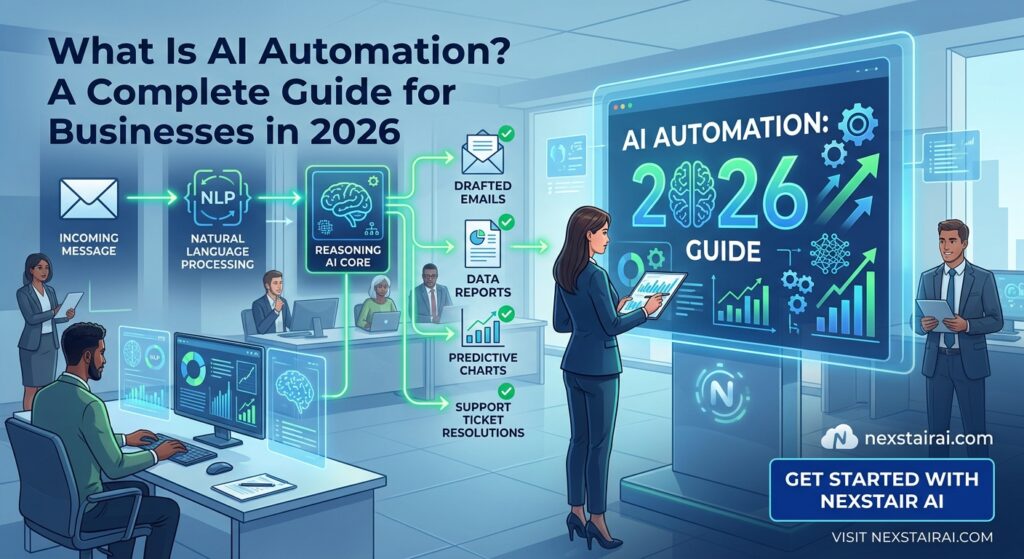
A simple way to picture it: every AI automation, whether it’s a one-step email classifier or a multi-app workflow spanning five tools, tends to follow the same basic pattern: something triggers it, an AI model reasons about what’s happening, and then an action gets taken based on that reasoning.
How Is AI Automation Different from Traditional Automation (RPA)?
This is probably the single most-asked question on the topic, so let’s settle it clearly.
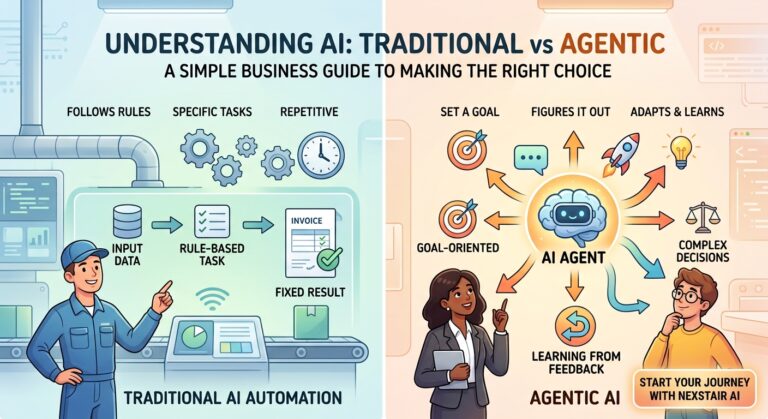
Traditional automation, often called RPA (Robotic Process Automation), follows a fixed, pre-programmed path: if this happens, do that. It’s excellent at repetitive, structured tasks, but it breaks the moment it hits something unexpected, an invoice in a slightly different format, an email that doesn’t match the template, a step that needs a judgment call.
AI automation extends much further into the messy parts of a business. Where classic RPA typically covers only a narrow slice of structured, rules-based work, AI automation can handle unstructured inputs, documents, emails, natural language requests, and make probabilistic decisions about what to do with them.
Most businesses in 2026 aren’t choosing one over the other, they’re combining both: RPA for the simple, high-volume, structured tasks, and AI automation for the judgment-heavy, exception-prone work that used to require a person.
What Are the Main Types of AI Automation?
AI automation isn’t one single thing, it’s a family of related techniques. The three that show up most often in business settings are:
- Cognitive automation — uses natural language processing and document recognition to read and understand unstructured content: invoices, contracts, emails, support tickets, reports.
- Predictive automation — uses machine learning to anticipate what’s likely to happen next (a stockout, a customer churning, equipment failing) and trigger a response before it becomes a problem.
- Generative automation — uses large language models to actually create things: draft replies, marketing copy, reports, code, summaries, at a pace no human team could match manually.
Most real-world AI automation setups blend more than one of these. A lead-qualification workflow, for example, might use cognitive automation to read an inbound form, predictive automation to score how likely that lead is to convert, and generative automation to draft a personalized follow-up.
What Are the Benefits of AI Automation for Businesses?
The appeal isn’t just “it saves time,” though it certainly does that. The more complete list looks like:
- Speed — tasks that used to take hours (sorting leads, processing documents, drafting responses) often complete in minutes.
- Cost reduction — businesses that adopt automation broadly report meaningful reductions in operational costs, largely by removing manual, repetitive work from people’s plates.
- Fewer errors — AI-driven processes tend to dramatically cut the error rate on repetitive tasks compared to manual handling.
- Scalability without headcount — you can handle a growing volume of customer queries, orders, or documents without proportionally growing your team.
- Better customer experience — faster response times and more consistent answers, especially for support and sales inquiries, which is often where the ROI shows up fastest.
The honest catch: most organizations have adopted AI somewhere in their business by now, but a much smaller share have actually reached full operational maturity with it. Adoption and mastery are two very different stages, and most companies are still somewhere in the middle.
See What AI Automation Looks Like for Your Business
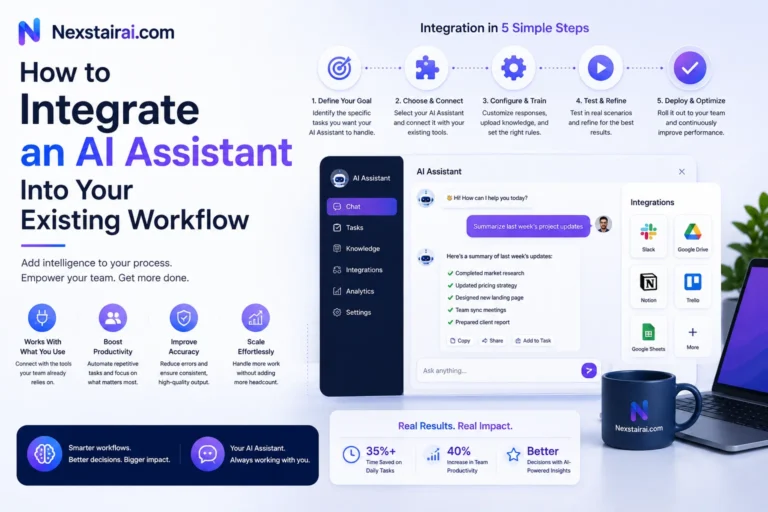
Reading about the benefits is one thing, watching it actually answer a customer question or handle a routine task on your own site is another. Nexstair’s AI Assistant and AI Chatbot are built to plug into your existing workflow, no technical team required, and start automating the repetitive parts of your business from day one. Start your free trial and see it in action.
What Are Real-World Examples of AI Automation?
Theory is nice, but this is where it gets concrete. Some of the most common, highest-payoff use cases in 2026:
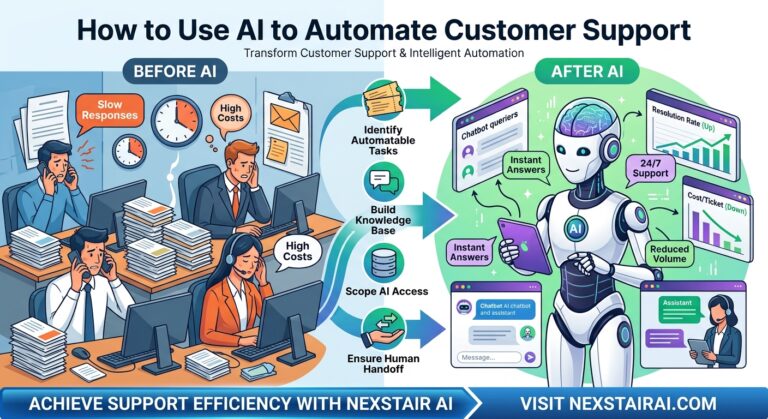
Customer support An AI system reads an incoming customer message, understands the actual issue (not just keyword-matches it), pulls relevant account or order data, and either resolves it directly or routes it to the right person with full context attached.
Lead qualification and routing Instead of a rep manually reviewing every form submission, AI automation reads the details, scores the lead against your criteria, and routes high-quality leads for immediate follow-up while low-quality ones go into a nurture sequence, often handling the vast majority of submissions without a human touching them.
Document and invoice processing AI reads invoices, receipts, and contracts in varying formats, extracts the relevant data, matches it against purchase orders, and flags exceptions automatically instead of routing every document to a person.
Content production Drafting, repurposing, and scheduling content across channels, freeing your team to focus on strategy and the creative judgment calls AI still can’t make well.
HR and onboarding Screening applications, scheduling interviews, and managing onboarding paperwork, tasks that are time-intensive but highly repeatable.
How Much Does AI Automation Cost, and What’s the ROI?
This is the part most guides gloss over, so here’s the honest version.
Costs vary a lot depending on approach. A simple AI-assisted workflow (a model that classifies, drafts, or routes, with a human still reviewing the output) is the cheapest and safest entry point, and it’s genuinely affordable for small businesses, often paying for itself within a couple of months. Fully autonomous, multi-step AI agents cost more to build and govern, since you need logging, oversight, and monitoring for the actions they take on their own.
The workflows with the clearest, fastest ROI tend to share three traits: they’re high-volume, the desired outcome is clearly defined, and there’s enough historical data to work from. Customer support, lead handling, and document processing consistently show up as the areas where the math works out fastest.
The realistic expectation: don’t assume day-one perfection. Most successful rollouts start narrow, on one well-defined process, prove it out, and then expand.
Ready to Put a Number on This for Your Own Business?
If you’re trying to figure out where AI automation would actually move the needle for you, a good first step is understanding where your current gaps are. Nexstair’s SEO Audit Report and AI tools are built to give you a clear, jargon-free picture of what’s working and what’s costing you, so you’re automating the right things first. Explore Nexstair AI’s tools to see where to start.
What Are the Biggest Challenges When Implementing AI Automation?
Most AI automation projects don’t fail because the technology doesn’t work. They fail for much more ordinary reasons:
- Messy or incomplete data. AI automation is only as good as the information it’s working from. Unready data is one of the most common reasons pilots stall.
- No clear ownership. Automation isn’t a “set it and forget it” project. Processes change, and someone needs to be accountable for keeping the automation current.
- Overreaching too fast. Trying to automate an entire department at once, instead of proving value on one well-scoped process first, is a common way projects lose momentum and budget.
- Confusing correlation with causation. It’s easy to credit an automation for results that were actually driven by something else. Clear baselines matter more than most teams expect going in.
- Governance gaps. The more autonomous a system is, the more it needs oversight, logging, and clear boundaries on what it’s allowed to do without a human checking in.
None of these are reasons to avoid AI automation. They’re reasons to implement it deliberately instead of rushing in and hoping it sorts itself out.
How Do You Get Started with AI Automation in Your Business?
A realistic, low-risk starting point looks like this:
- Pick one process, not ten. Choose something repetitive, high-volume, and clearly defined, customer support inquiries and lead follow-ups are usually the easiest wins.
- Keep a human in the loop at first. Start with AI-assisted automation (the AI drafts or recommends, a person approves) before moving to anything fully autonomous.
- Measure a real baseline. Know how long the process takes and how much it costs today, so you can actually prove the improvement later.
- Assign ownership. Someone needs to be responsible for watching how it performs and updating it as your business changes.
- Expand only after it’s working. Once one process is genuinely running well, use what you learned to tackle the next one.
Frequently Asked Questions
Is AI automation the same as RPA? No. RPA follows fixed, rule-based scripts and works best on structured, repetitive tasks. AI automation can interpret unstructured information and make judgment-based decisions, which is why it covers a much broader range of business processes.
Is AI automation only for large enterprises? Not anymore. Affordable AI automation tools now let small and mid-sized businesses automate things like lead follow-up, customer support, and appointment booking without an in-house engineering team.
Will AI automation replace my employees? For most businesses, it replaces repetitive manual tasks, not entire roles. The most common pattern is AI handling the repetitive lookup-and-respond work, while people focus on judgment calls, relationships, and strategy.
How long does it take to see ROI from AI automation? It depends on the process, but well-scoped, high-volume workflows like customer support or lead handling often show measurable returns within a couple of months of going live.
What’s the difference between AI automation and agentic AI? AI automation typically executes a defined process using AI reasoning at key steps. Agentic AI goes further, planning and adapting its own sequence of actions toward a goal, with less predefined structure. Most businesses use a mix of both.
The Bottom Line | What Is AI Automation
AI automation isn’t a single tool you buy, it’s a shift in how much judgment your systems can handle on their own. The businesses seeing real results in 2026 aren’t the ones chasing every new AI trend. They’re the ones who picked one repetitive, well-defined process, automated it properly, proved the value, and then expanded from there.
You don’t have to figure out where to start on your own. Get started with Nexstair AI today and let an AI assistant or chatbot take the first repetitive task off your plate this week.