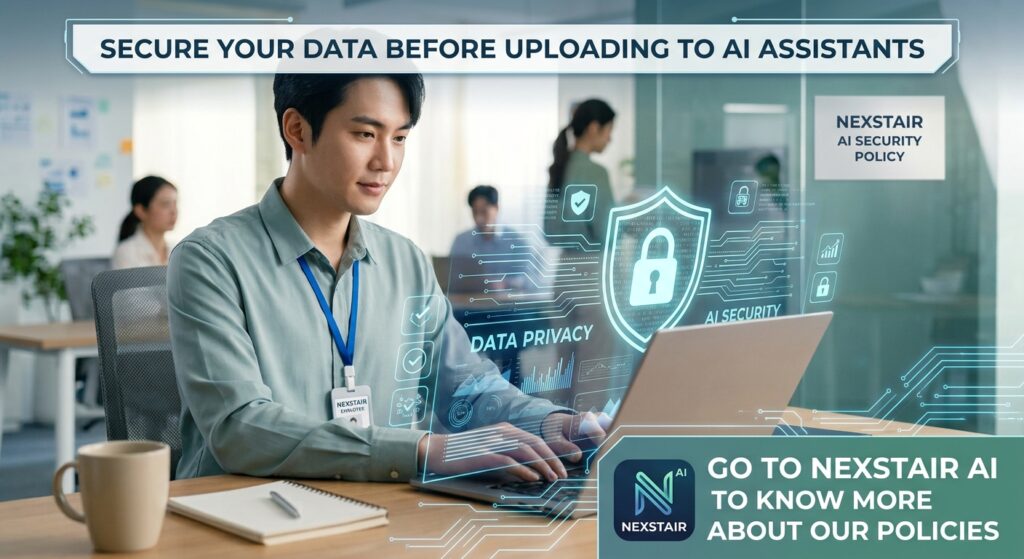
Avoid quiet leaks with proper AI assistant data privacy. Check DPAs, account tiers, and zero-retention settings before uploading internal records.
Here’s a stat worth sitting with: by default, the consumer versions of ChatGPT, Claude, and Gemini all use your conversations to improve their models, on the standard Free, Plus, and Pro tiers alike. That means the “private setting” most people assume they’re on usually isn’t the default. It’s an opt-in you have to go find.
That’s not a scare tactic, it’s just the current reality of 2026. AI assistants have become genuinely useful for drafting, summarizing, and analyzing internal work. But “useful” and “safe to paste your entire customer database into” are two very different things, and the line between them isn’t always obvious.
So here’s a practical, no-jargon walkthrough of exactly what to check before your team uploads internal data to any AI tool.
Is It Actually Safe to Upload Company Data to AI Assistants Like ChatGPT or Claude?
It depends entirely on three things: which tier you’re on, what kind of data it is, and what settings you’ve actually turned on, not what the marketing page implies.
The honest breakdown: public information (blog drafts, marketing copy, anything already meant for the outside world) is low-risk almost anywhere. Internal documents (strategy docs, internal processes, non-sensitive business data) should generally only go into enterprise-tier tools with retention controls turned on. Customer PII, financial data, credentials, and trade secrets shouldn’t go into a third-party AI tool at all unless you’ve got a signed Data Processing Addendum (DPA) explicitly covering it.
Most privacy failures in AI usage aren’t dramatic hacks. They’re an employee pasting a customer list into a free ChatGPT account to “reformat it quickly,” with zero malicious intent and zero awareness of where that data just went.
Does AI “Training on My Data” Actually Mean It Could Leak to Someone Else?
This is one of the most-asked questions on the topic, and the honest answer is nuanced, not a flat yes or no.
When a model trains on your input, your exact text won’t reliably “pop out” verbatim to a stranger the next day. But here’s what does happen: you’ve handed a copy of that information to a third party, under terms most people never actually read, and once it’s sent, you can’t pull it back. Depending on the platform, that data may also be retained for a set period and, in some cases, reviewed by human staff as part of quality or safety checks.
For a low-stakes marketing draft, that’s a non-issue. For a document containing customer PII, internal financials, or proprietary source code, it’s exactly the kind of exposure a DPA and a zero-retention setting exist to prevent.
What Types of Internal Data Should Never Go Into an AI Tool Without Serious Precautions?
A simple three-tier way to think about it:
| Data tier | Examples | Where it’s safe to go |
|---|---|---|
| Public | Published blog content, marketing copy, public product info | Almost any AI tool, consumer or enterprise |
| Internal | Internal processes, non-sensitive strategy docs, meeting notes | Enterprise-tier tools with zero data retention enabled |
| Sensitive / Regulated | Customer PII, financial records, health data, credentials, source code, trade secrets | Only third-party AI tools with a signed DPA explicitly covering that data type, and ideally with dedicated isolation |
If you’re not sure which tier something falls into, treat it as sensitive until proven otherwise. It’s a far cheaper mistake to over-classify a document than to under-classify one that ends up in the wrong place.
Not Sure Where Your Own Data Actually Stands?
Getting this right starts with knowing what tools your team is already using and how they’re configured, not guessing after something goes wrong. Nexstair’s AI Assistant is built with clear, enterprise-grade data handling from the ground up, so your team gets the productivity benefits without the guesswork. Learn how it handles your data.
What Should You Actually Check Before Uploading Data to an AI Assistant?
Skip the marketing page. Here’s what actually matters, and where to verify it:
- Pull the real Data Processing Addendum (DPA), not the sales deck. Confirm three things in writing: the vendor doesn’t train its models on your data, there’s a clearly stated retention period for prompts and outputs, and there’s a documented sub-processor list with notification terms if it changes.
- Check whether zero-retention (or “don’t train on my data”) is actually turned on. On most platforms, this is a setting you have to enable, not a default you can assume.
- Confirm encryption in transit and at rest. This should be stated plainly in the vendor’s security documentation, not buried in a FAQ.
- Know who the sub-processors are. If your vendor’s AI tool relies on another company’s infrastructure behind the scenes, that’s another party your data is touching.
- Get it in writing. If a vendor won’t put “we do not train on your data” in writing, that’s your answer, don’t put sensitive data into that tool.
- Check your own account tier, not just the vendor’s policy. A vendor can offer strong enterprise privacy controls that simply aren’t active on the free or personal tier your team happens to be using.
What’s the Real Difference Between Enterprise AI Tools and Consumer AI Tools for Data Privacy?
This distinction trips up more businesses than almost anything else on this list.
Consumer-tier AI accounts, the free or personal-paid versions most employees sign up for on their own, are generally built around improving the product, which often means your data helps train future models by default. Enterprise-tier accounts, by contrast, are built around business customers who need contractual guarantees, and typically include zero-retention options, formal DPAs, admin-level controls, and audit logs as standard, not as an upsell you have to dig for.
The practical takeaway: if your team is using personal ChatGPT, Claude, or Gemini accounts for work, even well-meaning ones, you likely don’t have the protections you assume you do. Moving to properly licensed business or enterprise accounts is one of the highest-leverage, lowest-effort fixes available.
Want AI Tools Your Team Can Actually Trust With Real Business Data?
This is exactly why the tool matters as much as the policy. Nexstair’s AI Chatbot and Assistant are designed for business use from the start, not repurposed consumer tools, so your team isn’t stuck choosing between productivity and data safety. See how Nexstair AI approaches data privacy.
Do You Need a DPA or DPIA Before Using AI Internally?
Increasingly, yes, and the requirements are tightening fast. A few things worth knowing as of 2026:
- Twenty US states now enforce comprehensive privacy laws, several of which added new assessment, notice, and transparency obligations specifically for automated decision-making and AI use this year.
- The EU AI Act layers directly on top of GDPR rather than replacing it. If your AI system touches EU personal data at all, even for a business outside the EU, both frameworks can apply simultaneously.
- A Data Protection Impact Assessment (DPIA) is generally expected before deploying AI systems that process personal data at meaningful scale, particularly anything involving profiling or automated decisions.
- Risk tiers matter. Under the EU AI Act, most everyday business tools, customer service bots, internal assistants, document processing, fall into the “limited risk” category, which mainly requires transparency: telling people they’re interacting with AI and explaining what data it collects. Tools that screen job candidates, assess creditworthiness, or gate access to essential services fall into a much stricter “high risk” category with real compliance overhead.
If any of this sounds like it applies to you and you haven’t looked at it yet, it’s worth a conversation with someone who handles data privacy professionally rather than guessing. The cost of getting it wrong isn’t just regulatory, either: in consumer surveys, a large majority of people say they wouldn’t do business with a company again after a personal data breach, regardless of whether AI was involved.
What Is “Shadow AI” and Why Is It a Growing Risk?
“Shadow AI” refers to employees using AI tools the company hasn’t approved, vetted, or even knows about, usually not out of malice, but because the tool was genuinely useful and nobody set a clear policy.
It’s one of the fastest-growing privacy risks in 2026 precisely because it’s invisible until something goes wrong. An employee pastes a client contract into a free AI tool to summarize it. Someone uploads a spreadsheet of internal metrics to get a quick chart. None of it feels risky in the moment, and all of it can quietly bypass every DPA, retention setting, and access control your company actually has in place.
The fix isn’t banning AI tools outright, that just pushes the behavior further underground. It’s giving your team an approved, genuinely useful option, paired with a clear, simple policy about what can and can’t go into it.
How Do You Build an AI Data Usage Policy for Your Team?
You don’t need a 40-page legal document to start. A workable first version covers:
- Which AI tools are approved for business use, and which accounts (enterprise, not personal) employees should be using.
- A simple data classification guide, the public / internal / sensitive breakdown above works well as a starting point.
- What’s explicitly off-limits without additional approval, customer PII, financial records, credentials, source code, anything covered by a client contract’s confidentiality terms.
- Who to ask when someone’s unsure. A single point of contact removes the guesswork that leads to shadow AI in the first place.
- A review cadence. AI tools and their privacy settings change often, revisit the policy at least twice a year, not once and forget it.
Publish it somewhere your team will actually see it, and walk through it once live rather than just emailing a PDF nobody opens.
Frequently Asked Questions | AI Assistant Data Privacy
Can AI assistants see and remember everything I type?
It depends on the platform and your account settings. Many tools retain conversation data for a defined period, and on consumer tiers, that data may also be used to improve the model unless you’ve turned that setting off.
Is it safe to use AI tools for internal documents if I don’t paste in customer data?
It’s lower-risk, but not automatically safe. Internal strategy documents, unreleased product plans, and proprietary processes still have real value if exposed, and generally belong on enterprise-tier tools with retention controls, not free consumer accounts.
What’s the single fastest fix for AI data privacy risk?
Moving your team off personal, free-tier AI accounts and onto properly licensed business accounts with zero-retention settings enabled. It’s a low-effort change with a disproportionately large privacy benefit.
Do small businesses actually need to worry about the EU AI Act?
If you have any EU customers or process any EU residents’ data, potentially yes, the Act can apply regardless of where your business is based. It’s worth a quick check even for small teams.
What should I do if I think sensitive data was already uploaded somewhere it shouldn’t have been?
Check the vendor’s DPA and retention policy for your options, many allow deletion requests, and loop in whoever handles data privacy or legal matters at your company sooner rather than later.
The Bottom Line | AI Assistant Data Privacy
AI assistants aren’t inherently risky, careless defaults and unclear policies are. The businesses handling this well in 2026 aren’t avoiding AI, they’re being deliberate about which data goes into which tool, under which settings, with the paperwork to back it up.
Start simple: classify your data, check your DPAs, turn on zero-retention where it matters, and give your team an approved tool that’s actually built for business use. Get started with Nexstair AI today and put AI to work on your internal processes without gambling with your customers’ trust.