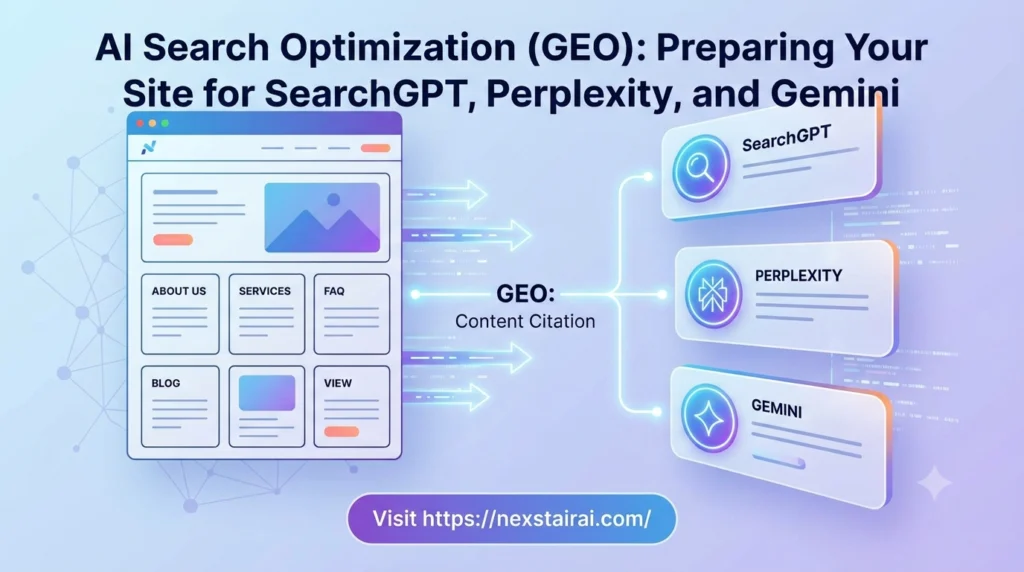
Here’s something that might surprise you: a growing share of your future customers may never “Google” you at all. Instead, they’ll ask ChatGPT’s SearchGPT, Perplexity, or Gemini a question, and get a conversational answer with a handful of cited sources — no ten blue links, no scrolling, just a summary and a short list of brands the AI trusted enough to quote.
If your site isn’t one of those sources, you’re invisible in that moment, no matter how well you rank on Google.
That’s the whole idea behind Generative Engine Optimization (GEO) — sometimes also called AEO (Answer Engine Optimization) or AIO. It’s the practice of shaping your website so AI systems can find it, understand it, trust it, and quote it. Think of it as SEO’s sibling: same family, new rules.
In this guide, we’ll break down what GEO actually means, how SearchGPT, Perplexity, and Gemini each “think,” and the concrete steps you can take this month to start showing up in AI answers. Grab a coffee — this one’s practical, not theoretical.
What Is GEO (Generative Engine Optimization)?
GEO is the process of optimizing your content so it gets discovered, selected, and cited by AI-powered answer engines — tools like ChatGPT/SearchGPT, Perplexity, Google’s Gemini and AI Overviews, and Microsoft Copilot. Instead of chasing a ranking position on a results page, GEO is about earning a mention inside a generated answer.
It helps to understand how GEO relates to two terms you’ve probably also heard:
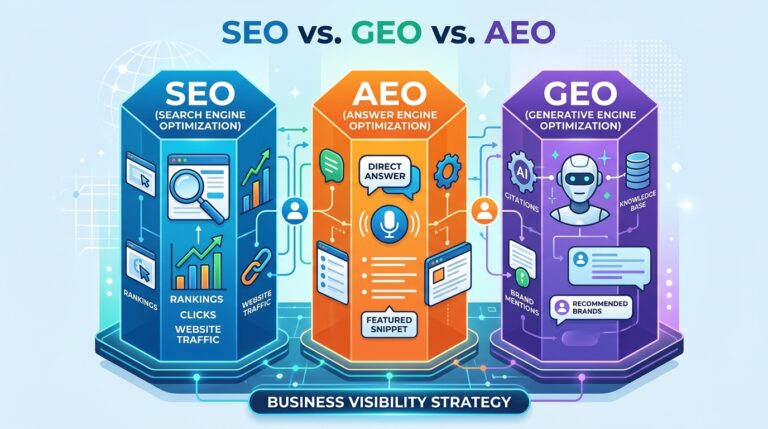
- SEO (Search Engine Optimization) — getting your pages to rank in traditional, link-based search results.
- AEO (Answer Engine Optimization) — formatting content (FAQs, definitions, structured answers) so it’s easy for any engine to lift out a direct answer.
- GEO (Generative Engine Optimization) — the broader discipline of becoming a trusted, citable source for AI systems that generate a synthesized response instead of just linking out.
The important part: GEO doesn’t replace SEO. It builds on it. AI engines still rely heavily on crawlable, well-structured, authoritative web content — they just process it differently once they find it.
Why This Matters Right Now
A few things are converging at once:
- ChatGPT alone now has hundreds of millions of weekly users, many of whom use its search features instead of a traditional search engine.
- Google’s AI Overviews and AI Mode place a synthesized answer above the organic results on a large share of queries, meaning fewer clicks flow to the “old” blue links.
- Perplexity has built its entire product around cited, conversational answers rather than a results page.
- Analysts widely expect organic click-through behavior to keep shifting toward these AI surfaces as people get comfortable asking a question and getting an answer, not a list of options to sort through.
The upshot: if AI engines can’t find, parse, or trust your content, you can be doing everything “right” for Google and still lose visibility where a growing number of buying decisions start. That’s the gap GEO is built to close — and it’s exactly the kind of gap the team at Nexstair AI helps businesses close every day.
How SearchGPT, Perplexity, and Gemini Actually Work (In Plain English)
Each engine has its own quirks, but they all follow a similar pattern: crawl → retrieve → synthesize → cite.
- Crawl: A bot (or several) visits your site to index its content.
- Retrieve: When someone asks a question, the engine pulls the most relevant, trustworthy passages from its index — often using retrieval-augmented generation (RAG), which grabs live or recently indexed content rather than relying purely on what the underlying model “remembers.”
- Synthesize: The AI blends information from multiple sources into one conversational answer.
- Cite: It links back to (some of) the sources it used, so users can verify or dig deeper.
Here’s where it gets specific:
- SearchGPT (ChatGPT Search): Uses
OAI-SearchBotto build its search index andChatGPT-Userfor real-time fetches when a person’s question needs live web data. This is separate fromGPTBot, which is OpenAI’s model-training crawler. - Perplexity: Uses
PerplexityBotfor indexing and answer generation, and a separate user-triggered fetcher for on-demand lookups. Perplexity is built entirely around citation-first answers, so being crawlable and quotable matters enormously here. - Gemini / Google AI Overviews: Draws on Google’s core search index plus
Google-Extended, the crawler that controls whether your content can be used for Gemini’s AI features and grounding. Notably, blockingGoogle-Extendeddoes not affect your normal Google Search rankings — it’s a separate switch.
The practical takeaway: make sure you know which bots are allowed on your site, because it’s shockingly common for a misconfigured firewall, CDN, or robots.txt file to block these crawlers by accident — which quietly erases you from AI answers without anyone noticing.
Not sure where your site actually stands with AI crawlers? Most sites have fixable issues — blocked bots, missing schema, weak entity structure — quietly keeping them out of AI answers, and most teams have no idea until someone checks. Nexstair AI’s SEO Audit Report digs into your crawlability, schema markup, and Answer Engine readiness, and hands you a clear, prioritized roadmap to fix it — no jargon, no guesswork. Get your free SEO audit trial and see exactly what’s holding you back from AI search visibility.
The Core Principles of GEO
Across every engine, a handful of principles keep showing up in how AI systems choose what to cite.
1. Answer the question in the first few sentences
AI systems weigh the opening of a page heavily when deciding whether to use it. Start each key section with a clear, direct answer — a definition, a number, a yes/no — before you unpack the nuance. Save the storytelling for after the answer, not before it.
2. Structure content so it can be pulled apart, not just read top to bottom
AI engines don’t necessarily use your whole page — they lift the specific passage that answers the question. That means every section should be able to stand on its own: a clear subheading, a self-contained paragraph, a tight answer. Bullet points, numbered steps, comparison tables, and short FAQ blocks are all easy for AI systems to extract cleanly.
3. Load up on verifiable facts, not fluff
Generic marketing language (“industry-leading,” “best-in-class”) gives an AI nothing to cite. Specific numbers, named methodologies, dated statistics, and original data give it plenty. If you have proprietary research, case study results, or original benchmarks, that’s GEO gold — it’s exactly the kind of thing engines like to quote because it can’t be found anywhere else.
4. Build genuine authority (E-E-A-T still matters, maybe more than ever)
Experience, Expertise, Authoritativeness, and Trustworthiness aren’t just a Google concept — they’re how both search and generative engines decide who’s worth citing. Real author bylines, clear credentials, transparent sourcing, and a consistent publishing history all help.
5. Keep content fresh
AI engines favor recently updated, accurate content over stale pages, and they can generally tell the difference between a page that’s genuinely been revised and one where only the “last updated” date changed. Revisit your best-performing pages regularly, update statistics, and make sure your schema’s dateModified field matches reality.
6. Get mentioned elsewhere, too
AI models don’t only look at your website. They synthesize signals from review sites, forums like Reddit, industry publications, and social mentions. Digital PR, guest content, and community engagement all feed the broader pool of information an AI might draw on when it forms an opinion about your brand.
Your GEO Technical Checklist
If you want a starting point you can hand to a developer this week, here it is.
- Audit your robots.txt. Confirm you’re allowing the retrieval/search bots you want visibility from (
OAI-SearchBot,ChatGPT-User,PerplexityBot,Google-Extended, and Anthropic’sClaude-SearchBot/Claude-Userif relevant to your audience). You can choose separately whether to allow the training crawlers (GPTBot,ClaudeBot,Google-Extendedfor training use,CCBot) — blocking training doesn’t have to mean blocking search visibility. - Add or update structured data (schema.org JSON-LD). Article, Organization, FAQPage, Product, and Review schema all help AI systems understand who you are and what your content covers. Keep it accurate — inaccurate schema is increasingly likely to be flagged rather than ignored.
- Consider an
llms.txtfile. This emerging standard gives AI systems a clean, high-level summary of what your site is about and links to your most important pages — think of it as a sitemap written for language models instead of search crawlers. - Fix crawlability basics. Make sure key pages aren’t accidentally
noindex‘d, aren’t hidden behind JavaScript rendering issues, and load fast. An AI system can’t cite what it can’t reach. - Write FAQ sections in real question form. Match the actual phrasing people use when they talk to a chatbot (“What’s the best CRM for a 10-person sales team?”) rather than generic keyword phrases.
- Keep a clean, crawlable sitemap and consistent internal linking, so bots can discover your newest and most important pages quickly.
- Monitor referral traffic from AI platforms in your analytics, and track whether your brand shows up when you (or a tool) ask SearchGPT, Perplexity, and Gemini questions relevant to your industry.
That last point matters more than people expect — GEO is genuinely hard to measure with traditional SEO tools, since there’s no “position #3” to track. It takes deliberate monitoring to know whether your efforts are working.
SEO vs. AEO vs. GEO: A Quick Comparison
| Focus | Optimized For | Example Tactic | |
|---|---|---|---|
| SEO | Ranking in search results | Keywords, backlinks, technical health | Optimizing title tags and page speed |
| AEO | Answering direct questions | Snippets, FAQs, voice search | Writing a tight, quotable definition |
| GEO | Being cited in AI-generated answers | Structured, factual, authoritative content across platforms | Adding original data an AI can quote |
They overlap — and honestly, the healthiest strategy treats them as one connected system rather than three separate projects.
Common Mistakes That Quietly Kill Your AI Visibility
- Blocking AI crawlers by accident. Many sites built or configured before AI search took off are blocking
OAI-SearchBotorPerplexityBotthrough overly aggressive bot-protection settings, without anyone realizing it. - Burying the answer. If your key point is paragraph six, most engines will grab a competitor’s paragraph one instead.
- Treating schema as a checkbox. Schema markup alone rarely moves the needle — it needs to sit on top of genuinely strong, well-structured content, not replace it.
- Letting content go stale. An outdated statistic or an old “last updated” date without real revisions is a quiet way to lose citation priority over time.
- Ignoring off-site mentions. If your brand is invisible on review sites, forums, and industry publications, you’re giving AI models less to work with when they form an opinion about you.
Getting Started: A Simple 30-Day Approach
You don’t need to overhaul your entire site overnight. A focused first month might look like:
- Week 1: Audit robots.txt, schema, and crawlability. Fix anything actively blocking AI bots.
- Week 2: Rewrite your 5–10 most important pages so each section leads with a direct, factual answer.
- Week 3: Add or refresh FAQ sections in natural question form, and build out an
llms.txtfile. - Week 4: Start monitoring AI citations and referral traffic, and identify your next batch of pages to optimize.
Small, consistent effort compounds here, the same way it did with early SEO — the brands that start now have a real head start before AI visibility becomes as competitive as Google rankings are today.
Frequently Asked Questions
What is GEO in simple terms? GEO (Generative Engine Optimization) is the practice of structuring your website content so AI tools like SearchGPT, Perplexity, and Gemini can find it, understand it, and cite it in their generated answers.
Is GEO replacing SEO? No. GEO builds on SEO fundamentals — crawlability, site speed, authority, and quality content all still matter. GEO adds an extra layer focused specifically on how AI systems retrieve and synthesize information.
Do I need to block AI crawlers to protect my content? That’s your call, and you can be selective. You can block training crawlers like GPTBot while still allowing search/retrieval crawlers like OAI-SearchBot and PerplexityBot, so you stay eligible for citations without contributing to model training.
How do I know if my site is being cited by AI engines? Check your analytics for referral traffic from chat.openai.com, perplexity.ai, and gemini.google.com, and periodically ask each platform questions relevant to your business to see whether — and how — you’re mentioned.
How long does GEO take to show results? Most sites start seeing citations within days to a few weeks of making structural changes, but building consistent, meaningful visibility typically takes a few months of steady effort, similar to organic SEO.
Ready to Show Up in AI Search?
AI search isn’t a future trend anymore — it’s already reshaping how people find businesses like yours. The sites that adapt now, while GEO is still a wide-open field, are the ones that will dominate AI answers later.
At Nexstair AI, we help businesses get found by SearchGPT, Perplexity, and Gemini — from technical crawlability audits to content restructuring and ongoing AI visibility monitoring. Get in touch with the Nexstair AI team to see exactly where your site stands today and what it would take to start showing up in AI-generated answers.
Not ready to talk yet? Explore more AI search insights on the Nexstair AI blog and start applying these steps at your own pace.
 can help you build one that actually fits the way you work.** ## What Technologies Power an AI Virtual Assistant? Here's a quick, scannable summary of the main building blocks: | Technology | What It Does | |---|---| | **Natural Language Processing (NLP)** | Helps the assistant read and interpret human language | | **Natural Language Understanding (NLU)** | Identifies intent and extracts key details from a request | | **Large Language Models (LLMs)** | Generate flexible, human-like responses and handle complex questions | | **Speech Recognition (ASR)** | Converts spoken words into text | | **Text-to-Speech (TTS)** | Converts text responses into natural-sounding speech | | **Machine Learning (ML)** | Helps the system learn patterns and improve over time | | **APIs and Integrations** | Connect the assistant to business tools and data | | **Knowledge Base / Retrieval** | Gives the assistant accurate, up-to-date information to draw from | ## What Are the Different Types of AI Virtual Assistants? Not every virtual assistant works the same way. Here are the main categories. **Rule-based assistants.** These follow pre-written scripts and decision trees. They're predictable and good for simple tasks, but they struggle when customers phrase things unexpectedly. **AI-powered conversational assistants.** These use NLP and machine learning to understand free-form language. They're far more flexible and can handle a wide range of questions. **LLM-powered assistants.** The newest generation uses large language models to hold fluid, natural conversations, summarize information, and reason through multi-part requests. **Voice assistants.** These specialize in spoken interactions, whether on smart speakers, phones, or automated call systems. **Agentic assistants.** An emerging category, these assistants don't just respond; they can plan and carry out multi-step tasks on your behalf, such as researching options, filling out forms, or coordinating across several apps, all within boundaries you define. ## What Is the Difference Between an AI Virtual Assistant and a Chatbot? People often use these terms interchangeably, but there's a useful distinction. A **chatbot** is typically designed for a narrow purpose, usually answering questions or following a set script within a chat window. A **virtual assistant** is generally broader: it understands context, works across multiple channels, connects to several systems, and can complete a wider range of tasks. In practice, the line is blurring. Many modern chatbots are really AI virtual assistants under the hood. The key difference to look for is capability: can it merely respond, or can it understand, remember, and act? ## What Are the Real-World Uses of AI Virtual Assistants? Virtual assistants are showing up in nearly every industry. Here are some of the most common uses. **Customer support.** Answering FAQs, tracking orders, handling returns, and escalating tricky issues to human agents, all around the clock. **E-commerce.** Recommending products, answering sizing and shipping questions, and nudging shoppers who hesitate at checkout. **Healthcare.** Scheduling appointments, sending reminders, and answering basic administrative questions (while leaving medical decisions to professionals). **Banking and finance.** Checking balances, explaining fees, and guiding customers through routine account tasks securely. **Real estate.** Answering listing questions, qualifying leads, and booking property viewings. **Hospitality and travel.** Handling reservations, itinerary questions, and local recommendations. **Human resources.** Answering employee questions about policies, benefits, and time off, and helping with onboarding. **Sales and marketing.** Qualifying leads, capturing contact details, and booking demos for the sales team. ## What Are the Benefits of Using an AI Virtual Assistant? Businesses and individuals adopt virtual assistants for good reasons. - **24/7 availability.** Help is there whenever customers need it, across every time zone. - **Instant responses.** No more waiting in queues or for email replies. - **Cost efficiency.** Handling more conversations without proportionally growing your team. - **Consistency.** The same accurate answer every time, based on your approved information. - **Scalability.** Whether you have ten conversations a day or ten thousand, the assistant keeps up. - **Happier teams.** Employees spend less time on repetitive tasks and more on meaningful work. - **Useful insights.** Conversations reveal what customers really want to know, helping you improve your products, website, and policies. - **More sales.** Quick answers and helpful recommendations remove friction and help customers complete purchases. **Curious how much time and money a virtual assistant could save your business? [nexstairai.com](https://nexstairai.com/) can help you map out the opportunity and get started without the guesswork.** ## What Are the Limitations of AI Virtual Assistants? It's worth being realistic. Even great assistants have limits. - **They can misunderstand.** Unusual phrasing, heavy ambiguity, or very niche topics may trip them up. - **They depend on their information.** If the knowledge base is outdated or incomplete, the answers will be too. - **They can sometimes be wrong.** Language-model-based systems may occasionally produce confident but inaccurate responses, which is why guardrails and good source material matter. - **They lack true human empathy.** They can detect sentiment, but emotionally sensitive situations still benefit from a real person. - **Privacy and security need attention.** Handling personal data responsibly requires proper safeguards and compliance. The good news is that all of these can be managed with thoughtful design: clear boundaries, quality information, regular reviews, and an easy path to a human when needed. ## How Do You Choose the Right AI Virtual Assistant for Your Business? If you're thinking about adopting one, ask yourself these questions. 1. **What problem am I solving?** Support volume, lead capture, scheduling, internal help, or something else? 2. **Which channels do my customers use?** Website, WhatsApp, Instagram, email, phone? 3. **What systems does it need to connect to?** Your CRM, calendar, store, or helpdesk? 4. **How customizable is it?** Can you control tone, workflows, and escalation rules? 5. **How does it handle human handoff?** The transition should be smooth, with full context passed along. 6. **What does security look like?** Look for data protection and compliance with regulations relevant to your customers. 7. **Can I see performance data?** Good analytics help you measure and improve. 8. **What support will I get?** Setup and ongoing optimization make a big difference to results. ## How Do You Get Started With an AI Virtual Assistant? You don't need a massive project to begin. A simple path looks like this: 1. **Identify your top 5 to 10 most common customer questions or tasks.** 2. **Gather accurate, up-to-date information** such as FAQs, policies, and product details. 3. **Choose a platform or partner** that fits your needs and integrates with your tools. 4. **Set up and test** with real-world questions before launching. 5. **Launch on one channel first**, then expand as you gain confidence. 6. **Review conversations regularly**, improving responses and adding new capabilities over time. Starting small and growing steadily is almost always better than trying to automate everything at once. ## What Does the Future Hold for AI Virtual Assistants? The technology is moving quickly. A few trends worth watching: - **More proactive help.** Assistants that reach out with useful information before you ask, such as shipping delays or appointment reminders. - **Greater autonomy.** Agentic assistants that complete multi-step tasks within rules you set. - **Richer personalization.** Better memory of preferences and history, creating more natural, tailored experiences. - **Multimodal interaction.** Assistants that understand text, voice, images, and documents all in one conversation. - **Smoother voice experiences.** Phone and voice interactions that feel increasingly human and natural. - **Stronger safeguards.** Better accuracy controls, privacy protections, and transparency about when you're talking to AI. The businesses that start learning and experimenting now will be best positioned to benefit as these capabilities mature. ## Final Thoughts: Is an AI Virtual Assistant Worth It? An AI virtual assistant is, at its heart, a digital teammate. It listens to what people ask, understands what they mean, finds or does what's needed, and responds in a way that feels natural, all in a matter of seconds and at any hour of the day. Under the hood, it's a clever combination of speech recognition, language understanding, decision-making, integrations, and language generation. But from the customer's point of view, it's simple: they ask, and they get helped. For businesses, the payoff is faster service, lower costs, happier teams, and more room to grow. The key is to start with a clear goal, give your assistant good information, keep humans available for the moments that matter, and keep improving based on real conversations. **Ready to bring an AI virtual assistant into your business? Visit [nexstairai.com](https://nexstairai.com/) to explore how a custom-built assistant can help you serve customers better, save time, and grow with confidence.** --- Want me to write a follow-up next? Good options might be "AI Virtual Assistant vs. Chatbot: What's the Difference?" or "How to Train an AI Virtual Assistant on Your Business Data.](https://nexstairai.com/wp-content/uploads/2026/10/🚀-Supercharge-Your-Business-Growth-with-Nexstair-–-AI-Digital-Marketing-Agency-300x164.jpg.webp)

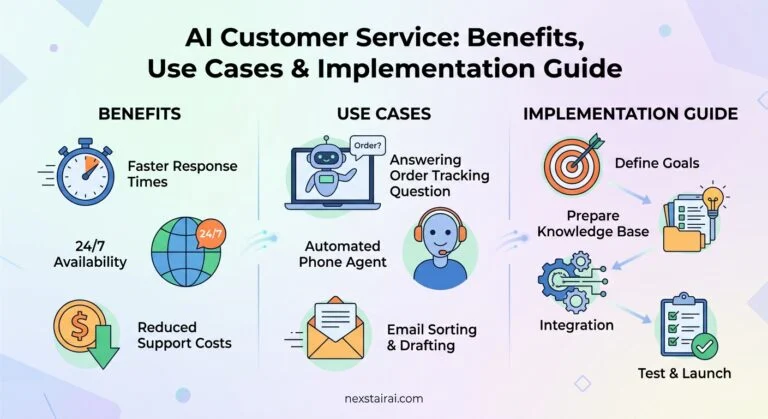
 can help you build one that actually fits the way you work.** ## What Technologies Power an AI Virtual Assistant? Here's a quick, scannable summary of the main building blocks: | Technology | What It Does | |---|---| | **Natural Language Processing (NLP)** | Helps the assistant read and interpret human language | | **Natural Language Understanding (NLU)** | Identifies intent and extracts key details from a request | | **Large Language Models (LLMs)** | Generate flexible, human-like responses and handle complex questions | | **Speech Recognition (ASR)** | Converts spoken words into text | | **Text-to-Speech (TTS)** | Converts text responses into natural-sounding speech | | **Machine Learning (ML)** | Helps the system learn patterns and improve over time | | **APIs and Integrations** | Connect the assistant to business tools and data | | **Knowledge Base / Retrieval** | Gives the assistant accurate, up-to-date information to draw from | ## What Are the Different Types of AI Virtual Assistants? Not every virtual assistant works the same way. Here are the main categories. **Rule-based assistants.** These follow pre-written scripts and decision trees. They're predictable and good for simple tasks, but they struggle when customers phrase things unexpectedly. **AI-powered conversational assistants.** These use NLP and machine learning to understand free-form language. They're far more flexible and can handle a wide range of questions. **LLM-powered assistants.** The newest generation uses large language models to hold fluid, natural conversations, summarize information, and reason through multi-part requests. **Voice assistants.** These specialize in spoken interactions, whether on smart speakers, phones, or automated call systems. **Agentic assistants.** An emerging category, these assistants don't just respond; they can plan and carry out multi-step tasks on your behalf, such as researching options, filling out forms, or coordinating across several apps, all within boundaries you define. ## What Is the Difference Between an AI Virtual Assistant and a Chatbot? People often use these terms interchangeably, but there's a useful distinction. A **chatbot** is typically designed for a narrow purpose, usually answering questions or following a set script within a chat window. A **virtual assistant** is generally broader: it understands context, works across multiple channels, connects to several systems, and can complete a wider range of tasks. In practice, the line is blurring. Many modern chatbots are really AI virtual assistants under the hood. The key difference to look for is capability: can it merely respond, or can it understand, remember, and act? ## What Are the Real-World Uses of AI Virtual Assistants? Virtual assistants are showing up in nearly every industry. Here are some of the most common uses. **Customer support.** Answering FAQs, tracking orders, handling returns, and escalating tricky issues to human agents, all around the clock. **E-commerce.** Recommending products, answering sizing and shipping questions, and nudging shoppers who hesitate at checkout. **Healthcare.** Scheduling appointments, sending reminders, and answering basic administrative questions (while leaving medical decisions to professionals). **Banking and finance.** Checking balances, explaining fees, and guiding customers through routine account tasks securely. **Real estate.** Answering listing questions, qualifying leads, and booking property viewings. **Hospitality and travel.** Handling reservations, itinerary questions, and local recommendations. **Human resources.** Answering employee questions about policies, benefits, and time off, and helping with onboarding. **Sales and marketing.** Qualifying leads, capturing contact details, and booking demos for the sales team. ## What Are the Benefits of Using an AI Virtual Assistant? Businesses and individuals adopt virtual assistants for good reasons. - **24/7 availability.** Help is there whenever customers need it, across every time zone. - **Instant responses.** No more waiting in queues or for email replies. - **Cost efficiency.** Handling more conversations without proportionally growing your team. - **Consistency.** The same accurate answer every time, based on your approved information. - **Scalability.** Whether you have ten conversations a day or ten thousand, the assistant keeps up. - **Happier teams.** Employees spend less time on repetitive tasks and more on meaningful work. - **Useful insights.** Conversations reveal what customers really want to know, helping you improve your products, website, and policies. - **More sales.** Quick answers and helpful recommendations remove friction and help customers complete purchases. **Curious how much time and money a virtual assistant could save your business? [nexstairai.com](https://nexstairai.com/) can help you map out the opportunity and get started without the guesswork.** ## What Are the Limitations of AI Virtual Assistants? It's worth being realistic. Even great assistants have limits. - **They can misunderstand.** Unusual phrasing, heavy ambiguity, or very niche topics may trip them up. - **They depend on their information.** If the knowledge base is outdated or incomplete, the answers will be too. - **They can sometimes be wrong.** Language-model-based systems may occasionally produce confident but inaccurate responses, which is why guardrails and good source material matter. - **They lack true human empathy.** They can detect sentiment, but emotionally sensitive situations still benefit from a real person. - **Privacy and security need attention.** Handling personal data responsibly requires proper safeguards and compliance. The good news is that all of these can be managed with thoughtful design: clear boundaries, quality information, regular reviews, and an easy path to a human when needed. ## How Do You Choose the Right AI Virtual Assistant for Your Business? If you're thinking about adopting one, ask yourself these questions. 1. **What problem am I solving?** Support volume, lead capture, scheduling, internal help, or something else? 2. **Which channels do my customers use?** Website, WhatsApp, Instagram, email, phone? 3. **What systems does it need to connect to?** Your CRM, calendar, store, or helpdesk? 4. **How customizable is it?** Can you control tone, workflows, and escalation rules? 5. **How does it handle human handoff?** The transition should be smooth, with full context passed along. 6. **What does security look like?** Look for data protection and compliance with regulations relevant to your customers. 7. **Can I see performance data?** Good analytics help you measure and improve. 8. **What support will I get?** Setup and ongoing optimization make a big difference to results. ## How Do You Get Started With an AI Virtual Assistant? You don't need a massive project to begin. A simple path looks like this: 1. **Identify your top 5 to 10 most common customer questions or tasks.** 2. **Gather accurate, up-to-date information** such as FAQs, policies, and product details. 3. **Choose a platform or partner** that fits your needs and integrates with your tools. 4. **Set up and test** with real-world questions before launching. 5. **Launch on one channel first**, then expand as you gain confidence. 6. **Review conversations regularly**, improving responses and adding new capabilities over time. Starting small and growing steadily is almost always better than trying to automate everything at once. ## What Does the Future Hold for AI Virtual Assistants? The technology is moving quickly. A few trends worth watching: - **More proactive help.** Assistants that reach out with useful information before you ask, such as shipping delays or appointment reminders. - **Greater autonomy.** Agentic assistants that complete multi-step tasks within rules you set. - **Richer personalization.** Better memory of preferences and history, creating more natural, tailored experiences. - **Multimodal interaction.** Assistants that understand text, voice, images, and documents all in one conversation. - **Smoother voice experiences.** Phone and voice interactions that feel increasingly human and natural. - **Stronger safeguards.** Better accuracy controls, privacy protections, and transparency about when you're talking to AI. The businesses that start learning and experimenting now will be best positioned to benefit as these capabilities mature. ## Final Thoughts: Is an AI Virtual Assistant Worth It? An AI virtual assistant is, at its heart, a digital teammate. It listens to what people ask, understands what they mean, finds or does what's needed, and responds in a way that feels natural, all in a matter of seconds and at any hour of the day. Under the hood, it's a clever combination of speech recognition, language understanding, decision-making, integrations, and language generation. But from the customer's point of view, it's simple: they ask, and they get helped. For businesses, the payoff is faster service, lower costs, happier teams, and more room to grow. The key is to start with a clear goal, give your assistant good information, keep humans available for the moments that matter, and keep improving based on real conversations. **Ready to bring an AI virtual assistant into your business? Visit [nexstairai.com](https://nexstairai.com/) to explore how a custom-built assistant can help you serve customers better, save time, and grow with confidence.** --- Want me to write a follow-up next? Good options might be "AI Virtual Assistant vs. Chatbot: What's the Difference?" or "How to Train an AI Virtual Assistant on Your Business Data.](https://nexstairai.com/wp-content/uploads/2026/10/🚀-Supercharge-Your-Business-Growth-with-Nexstair-–-AI-Digital-Marketing-Agency-768x419.jpg.webp)